Resit notes for Computation II - 5EIB0
Datapath
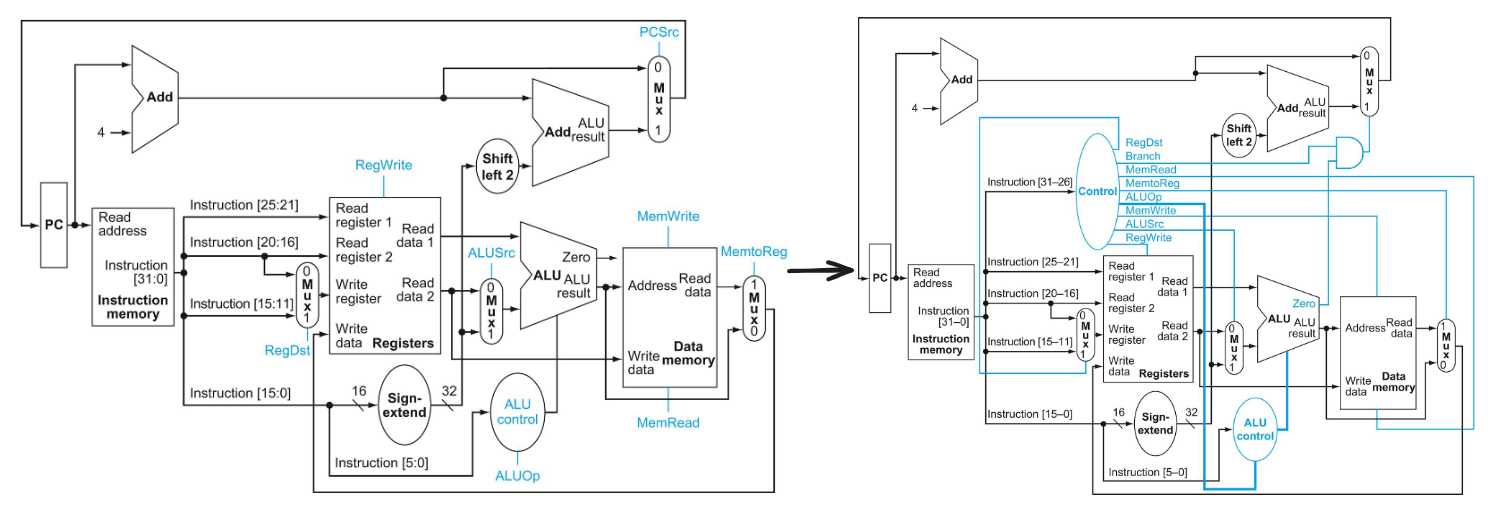
Add/sub (R): PC + Adder + IMEM + Reg + ALU
Immediate: (I) + ImmGen + Mux (R[rs2] - ALU)
Load/store: + DMEM + Mux (DMEM DataB - DataD Reg)
Branch/jump: + Mux (ALU - PC) + Mux (PC - ALU) + BranchComp
→ Critical path (slowest) is lw (~800 ps)→ Pipelining
Single-cycle
Multicycle
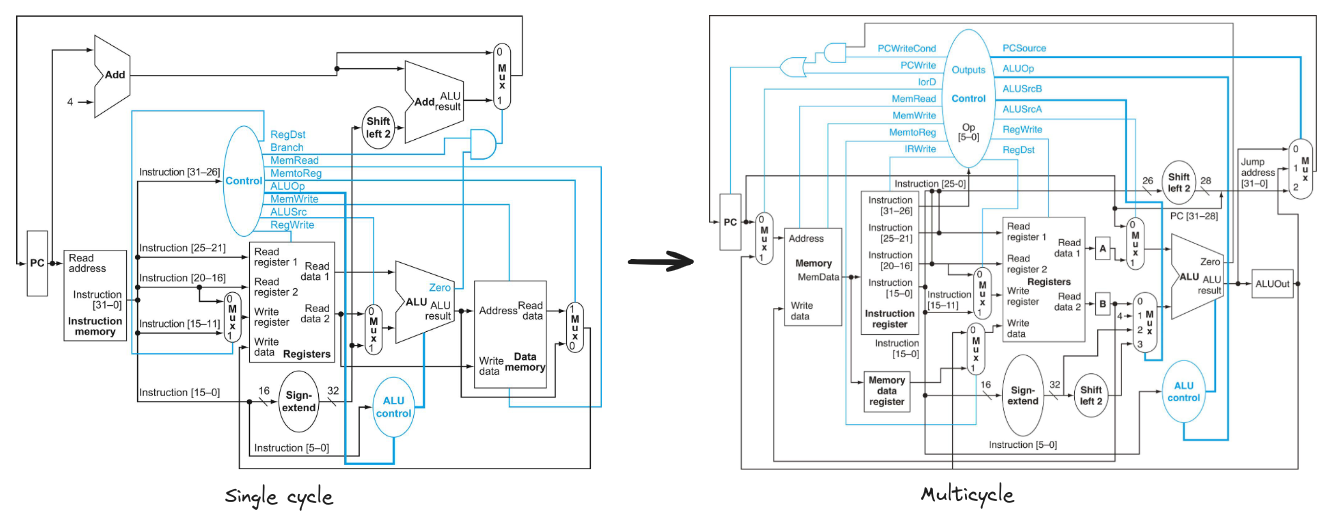
Single cycle → Multicycle: instructions separated into stages
- Separate memory unit for instructions + data → need memory data access for ALU
- 1 ALU + 2 adders → 1 ALU
- Store values of every stage:
- Instruction Register (IR) & Memory data register (MDR) added
- A & B for operand values
- ALUOut for ALU output
- ALU:
- ALU input 1: PC | A
- ALU input 2: + Shift left (branch address) | 4 (increment PC)
- Jump and branch output:
- ALU output (PC+4)
- ALUout
- The lower 26 bits of the Instruction register (IR) shifted left by two and concatenated with the upper 4 bits of the incremented PC, which is the source when the instruction is a jump
Control Signal
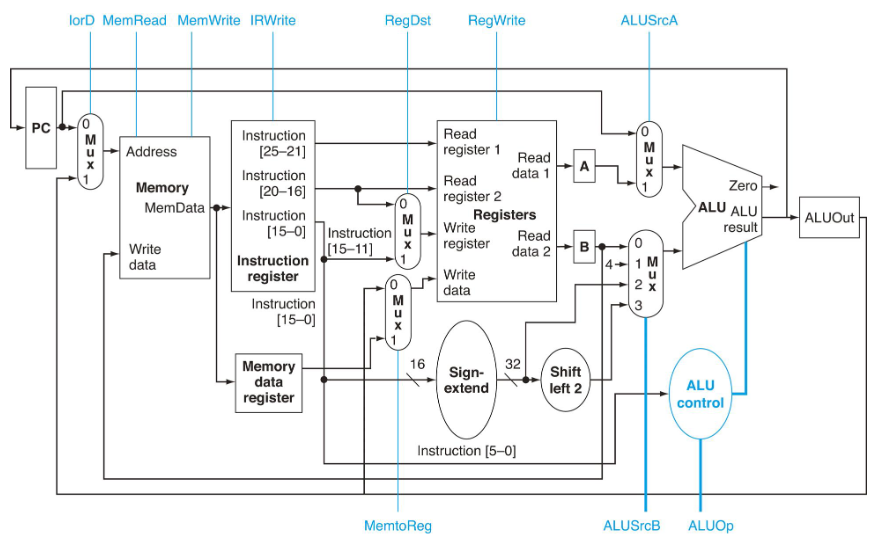
| Signal name | Effect when deasserted | Effect when asserted |
|---|---|---|
| RegDst | Write register = rt | Write register = rd |
| RegWrite | None. | The general-purpose register selected by the Write register number is written with the value of the Write data input. |
| ALUSrcA | The first ALU operand is the PC. | The first ALU operand comes from the A register. |
| MemRead | None. | Content of memory at the location specified by the Address input is put on Memory data output. |
| MemWrite | None. | Memory contents at the location specified by the Address input is replaced by the value on the Write data input. |
| MemtoReg | Write data = ALUOut | Write data = MDR |
| IorD | Address = PC | Address = ALUOut |
| IRWrite | None. | IR = memory output |
| PCWrite | None. | The PC is written; the source is controlled by PCSource. |
| PCWriteCond | None. | The PC is written if the Zero output from the ALU is also active. |
| Signal name | Value (binary) | Effect |
|---|---|---|
| ALUOp | 00 | The ALU performs an add operation. |
| 01 | The ALU performs a subtract operation. | |
| 10 | The funct field of the instruction determines the ALU operation. | |
| ALUSrcB | 00 | The second input to the ALU comes from the B register. |
| 01 | The second input to the ALU is the constant 4. | |
| 10 | The second input to the ALU is the sign-extended, lower 16 bits of the IR. | |
| 11 | The second input to the ALU is the sign-extended, lower 16 bits of the IR shifted left 2 bits. | |
| PCSource | 00 | Output of the ALU (PC + 4) is sent to the PC for writing. |
| 01 | The contents of ALUOut (the branch target address) are sent to the PC for writing. | |
| 10 | The jump target address (IR[25:0] shifted left 2 bits and concatenated with PC + 4[31:28]) is sent to the PC for writing. |
Pipelined
Instructions separated into like Multicycle but multiple stages can be active simultaneously
- Instruction Fetch (IF): Fetch instruction + increment PC
- Instruction Decode (ID): Decode instruction + Get operands (+ Branch decision + target)
- Execute (EX): ALU (Arithmetic-Logic Unit)
- Memory Access (MEM): store or load mem
- Write Back to Register (WB)
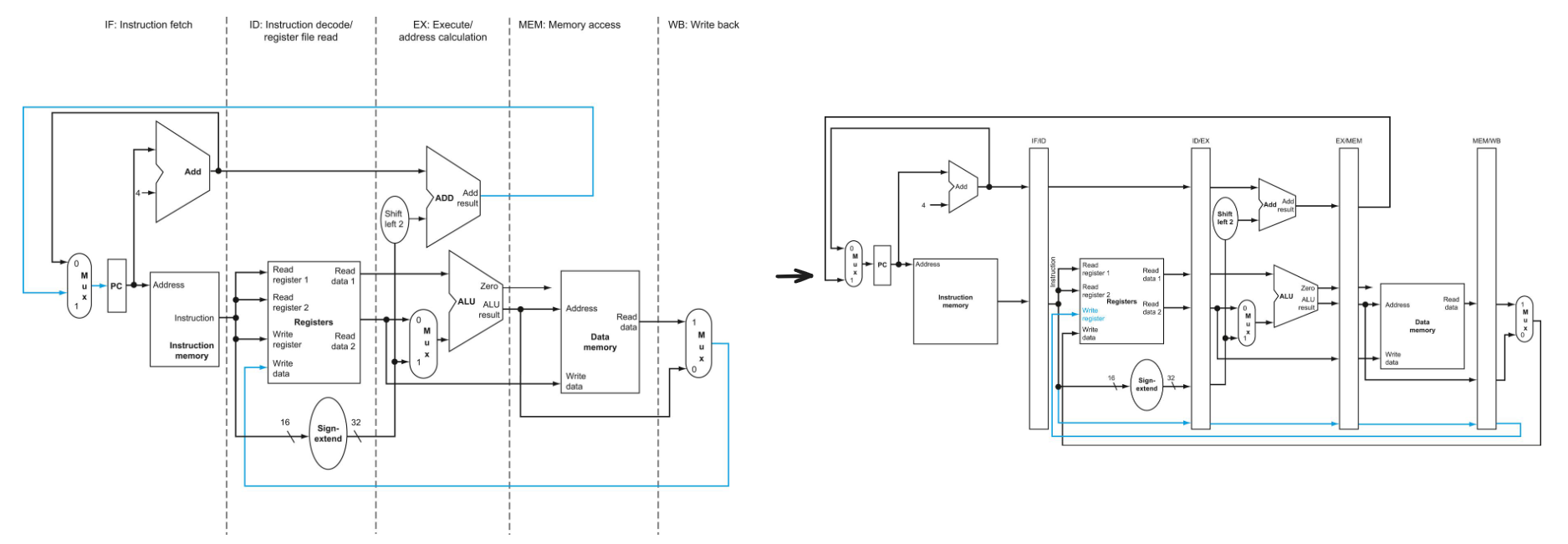
!! load instructions need to calculate write register → pipeline write register
Control Signal
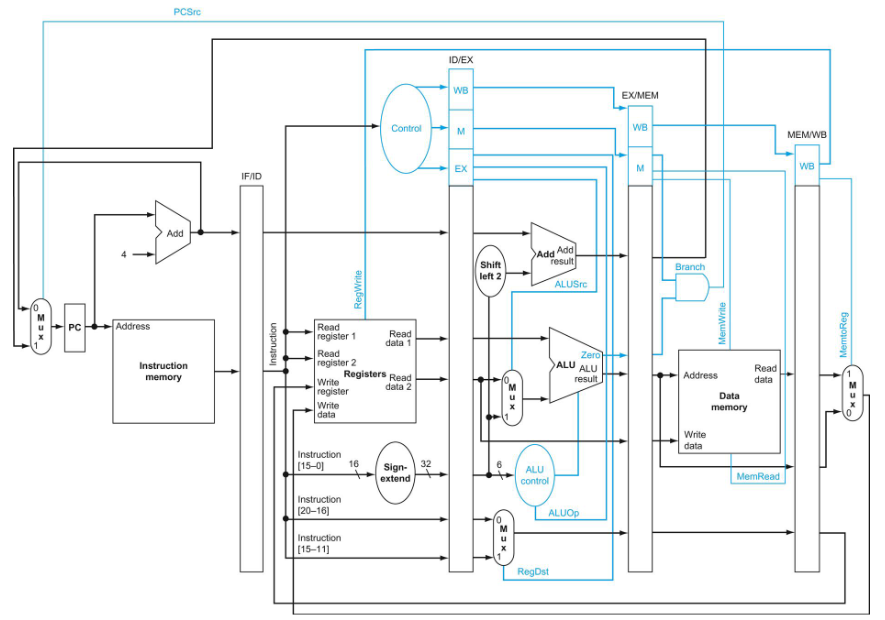
| Signal name | Effect when deasserted (0) | Effect when asserted (1) |
|---|---|---|
| RegDst | The register destination number for the Write register comes from the rt field (bits 20:16). | The register destination number for the Write register comes from the rd field (bits 15:11). |
| RegWrite | None. | The register on the Write register input is written with the value on the Write data input. |
| ALUSrc | The second ALU operand comes from the second register file output (Read data 2). | The second ALU operand is the sign-extended, lower 16 bits of the instruction. |
| PCSrc | The PC is replaced by the output of the adder that computes the value of PC + 4. | The PC is replaced by the output of the adder that computes the branch target. |
| MemRead | None. | Data memory contents designated by the address input are put on the Read data output. |
| MemWrite | None. | Data memory contents designated by the address input are replaced by the value on the Write data input. |
| MemtoReg | The value fed to the register Write data input comes from the ALU. | The value fed to the register Write data input comes from the data memory. |
Pipelining Considerations
Hazards:
- Structural
- Data
- Control
Structural Hazard: Occupied Physical Resource
Multiple instructions compete for physical resources → stall/ more resources
Instruction and data mem used simultaneously → use seperate I/D mem → I/D cache
Data Hazard: Simultaneous read/write
Register read+write access: can be solved if using single cycle read-write
ALU result hazard:
Forwarding (bypassing)
use result from ALU directly (b4 storing in registers) → need extra connections
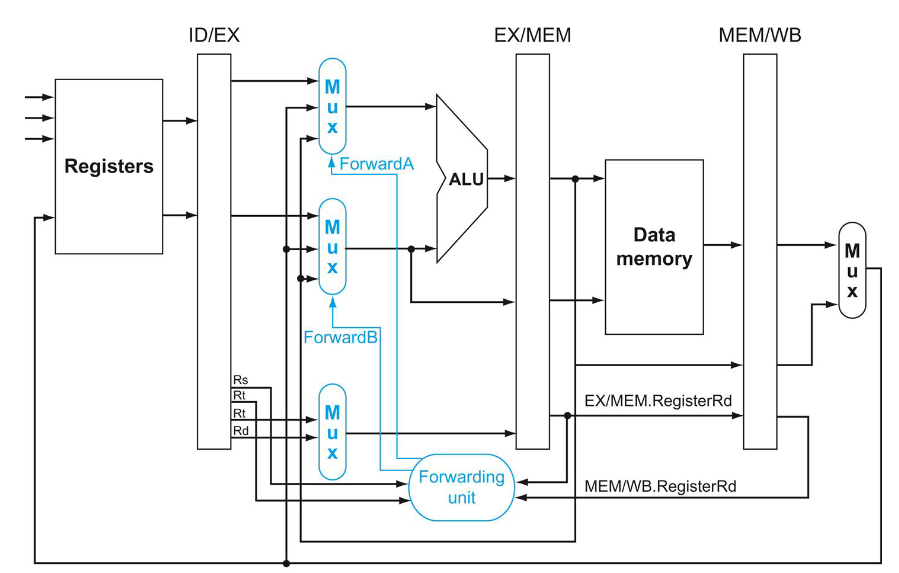
if (EX/MEM.RegWrite
and (EX/MEM.RegisterRd ≠ 0)
and (EX/MEM.RegisterRd = ID/EX.RegisterRs)) ForwardA = 10

if (MEM/WB.RegWrite
and (MEM/WB.RegisterRd ≠ 0)
and not(EX/MEM.RegWrite and (EX/MEM.RegisterRd ≠ 0)
and (EX/MEM.RegisterRd ≠ ID/EX.RegisterRs))
and (MEM/WB.RegisterRd = ID/EX.RegisterRs)) ForwardA = 01
No forwarding if Rd=0
Don’t forward from WB if already forwarded from MEM
Stall (insert nops)
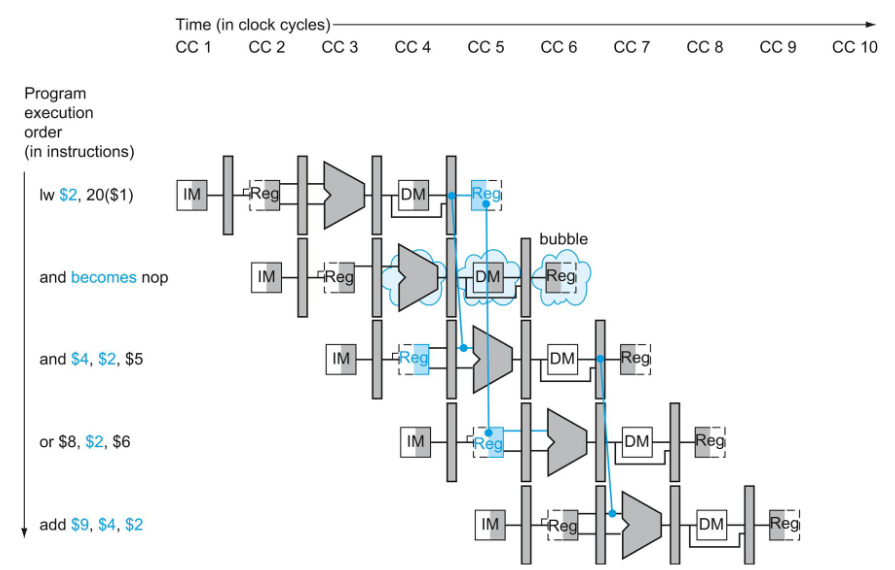
- Load-use hazard: 1 cycle stall (MEM to EX) → nops/rearrange code = set control signals in EX, MEM, WB stages to 0
- Load-branch hazard: 2 cycle stall (MEM to IF) (with Branch speedup)
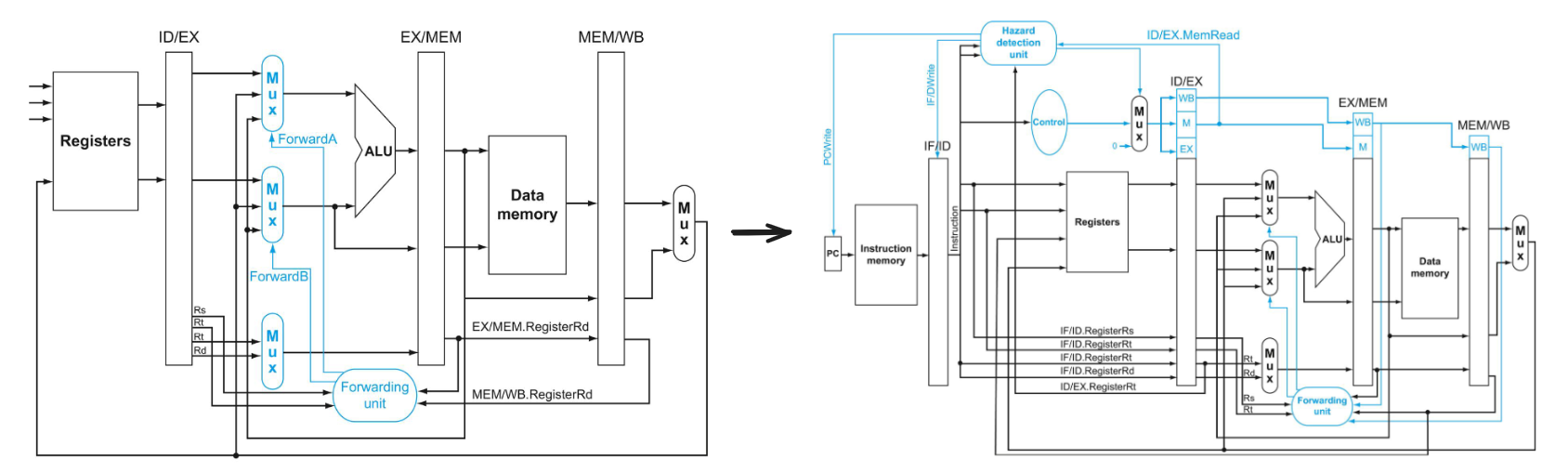
if (ID/EX.MemRead and
((ID/EX.RegisterRt = IF/ID.RegisterRs) or
(ID/EX.RegisterRt = IF/ID.RegisterRt)))
Control Hazard
Branch undetermined: convert 2 stall cycles + branch prediction
Branch Speedup
Calculate address and condition earlier at ID
→ Can only implement beq|bneq (others require 1 more calculation instructions) + Load-branch hazard
Branch Prediction
Branch prediction = predict of branch is taken != Branch target prediction = predict branch address
Static:
- Default = progress (assume branch not taken) → execute branch delay slot → flush IR if branch taken
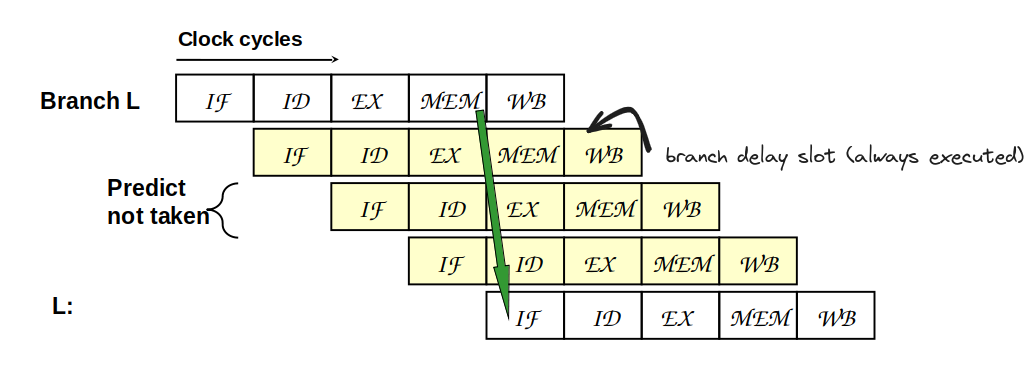
Dynamic - Branch predictor#Saturating_counter :strictly based on previous outcomes if branch taken (1 or 2 bit (takes 2 wrong prediction to change))
- Branch predictor#Two-level_predictor
- Local prediction: correlate with previous outcomes
- Global prediction: correlate with all branches
- Local + global
Load delay + Branch delay
RISC-V ISA designed for pipelining:
- All instructions are 32-bits
- Easy to fetch and decode in one cycle
- Versus x86: 1- to 15-byte instructions
- Few and regular instruction formats
- Decode and read registers in one step
- Load/store addressing
- Alignment of memory operands
- Memory access takes only one cycle