5EMA0 Math II (Optimization and Probability)
- Area: Mathematics
- Topics: Probability and Random Variables
- Related courses: Math I - 2DE20 · Calculus - 2WBB0 · Computation Modeling - 5XIE0 · Communication Theory - 5ETB0
Optimizations and Probabilities
Unconstrained optimization
Linear optimization
Convex optimization
Language duality theoryProbabilities
Discrete random variables
Continuous random variables
Pairs and sum of random variables
Unconstrained Optimization
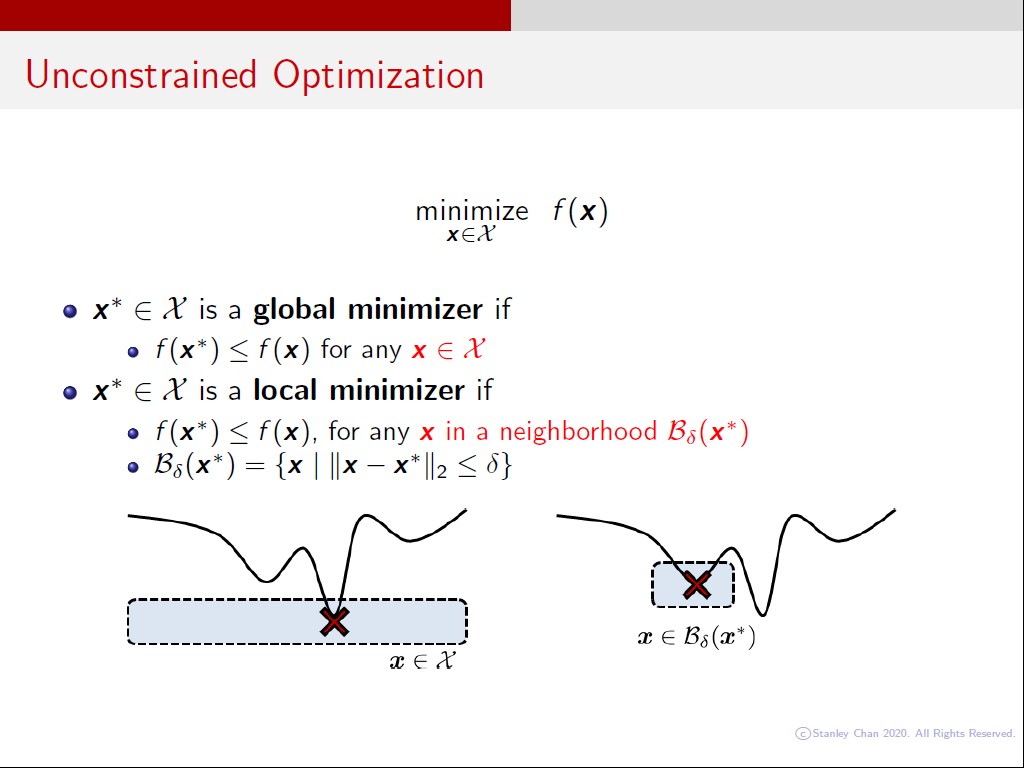
If
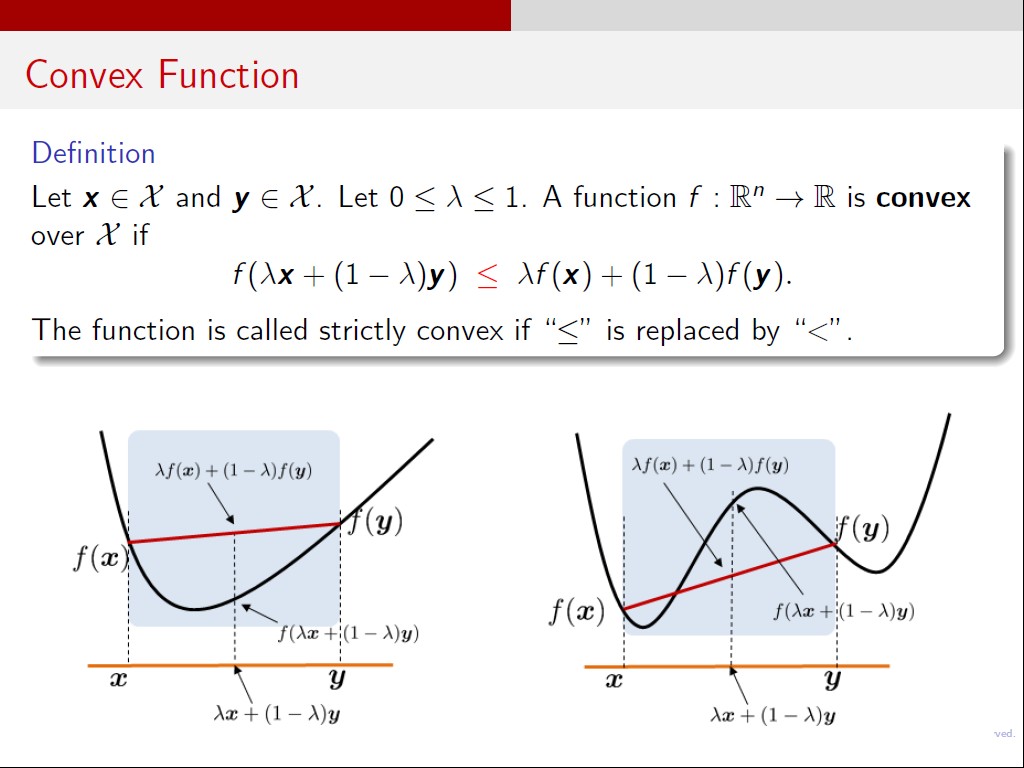
Convex Lemma
convex:
for alland all
ifthen function is convex affine: (=) instead of (
) and
f is affine ←> both f and -f are convex
Linear Optimization
Farkas Lemma
One of the following is true
for and for -⇒ feasable solution
, , for -⇒ no feasable solution
Fredholm Alternative Lemma
One of the following is true, special case
for
,
Farkas Extension Lemma
We have
for all such that for ⇐> there are so that:
, , and for
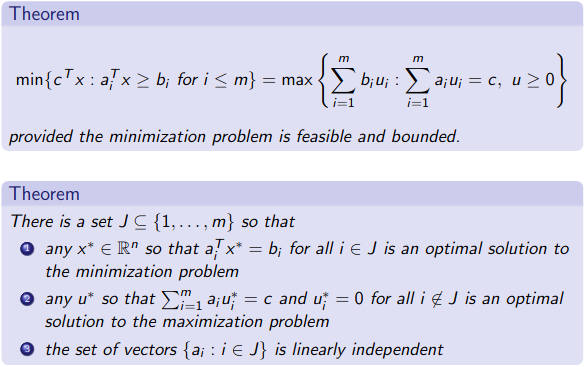
Linear Optimization Duality Theorem
Then
for
and for
maximization problem feasable and bounded
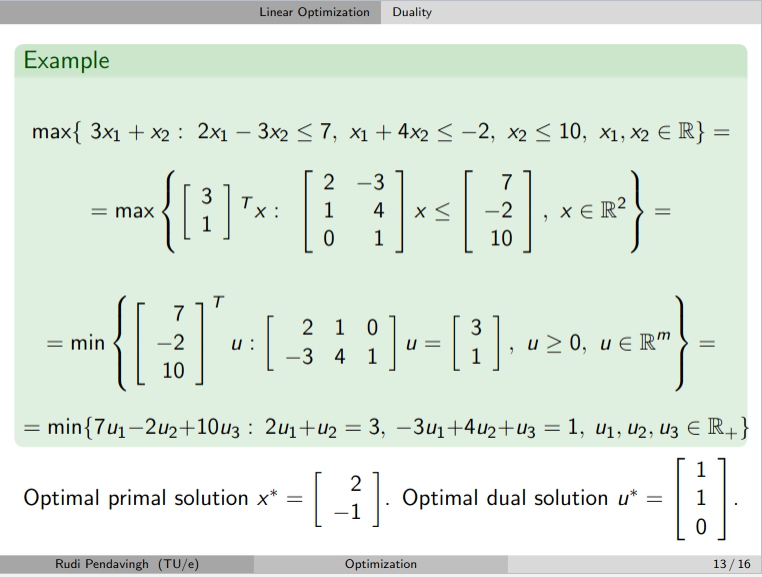
Algebraic Formulation:
Duality is the principle that optimization problems may be viewed from either of two perspectives, the primal problem or the dual problem. If the primal is a minimization problem then the dual is a maximization problem (and vice versa).
Any feasible solution to the primal (minimization) problem is at least as large as any feasible solution to the dual (maximization) problem. Therefore, the solution to the primal is an upper bound to the solution of the dual, and the solution of the dual is a lower bound to the solution of the primal. This fact is called weak duality.
Convex Penalty Function:
Lemmas in Dual Analysis
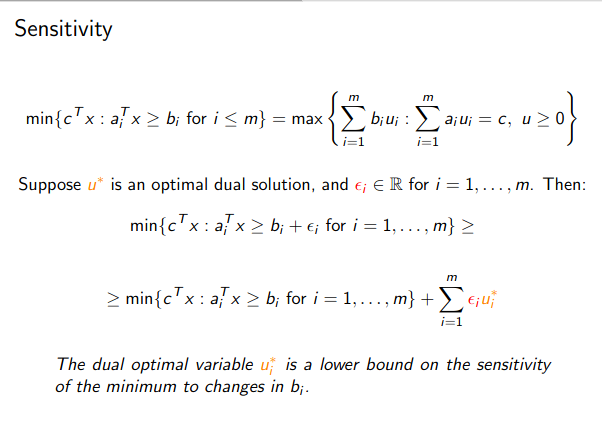
The minimum will not decrease as long the constraints
for remain unchanged; even if the constraints for are removed. If
is an optimal solution, then for all . If
are both feasable, then both are optimal.
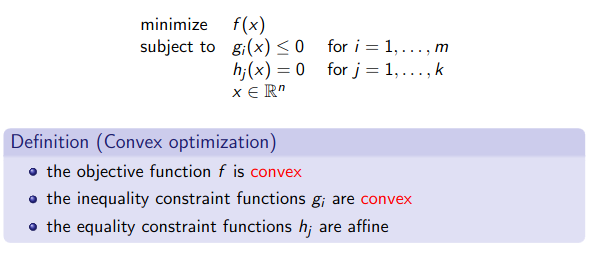
Convex Optimization
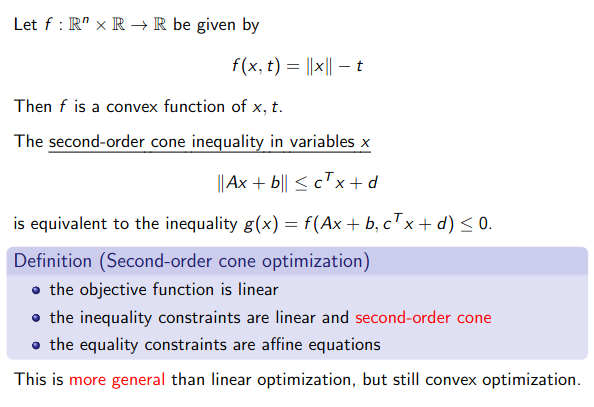
Convex Lemma
If
is convex with domain , then is a convex set. (First-order condition):
is convex if and only if:
for all If
is differentiable and convex, then:
if and only if (Second-order condition): Suppose
is twice differentiable with domain . Then is convex ⇐> is convex and for all
Convex Theorem Primary
If
are convex, then the function given by:
for all, is convex. If
are convex, then the function given by:
for all, is convex. If
is convex and , then the function given by:
for all, is convex. If
is convex, A is an matrix and , then the function given by:
for all, is convex.
Let
Convex Functions Theorem
is NOT convex if and only if there are so that is not convex. (First-order condition): Let
be differentiable. Then is convex if and only if:
for all Corollary:
Supposeis convex and differentiable, Then:
⇐> (Second-order condition): Let
be twice differentiable, domain Then is convex ⇐>
is a convex set for all
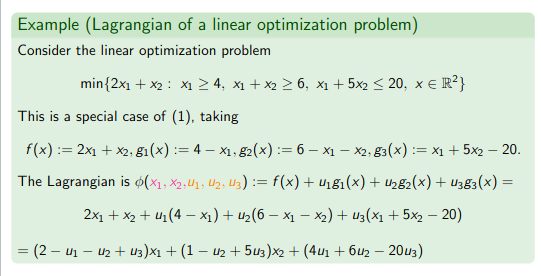
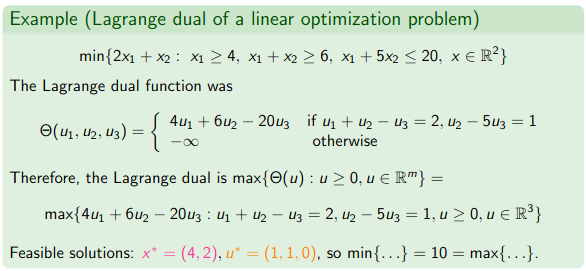
Lemma Weak Langrange Duality
for
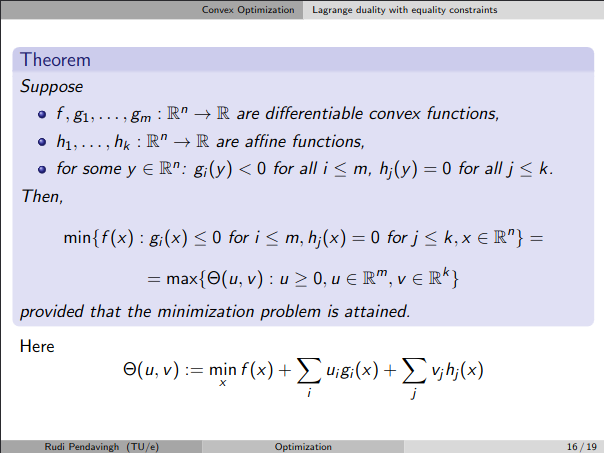
Lagrange Duality Theorem
If
are differentiable convex functions and there exists an such that for all , then: Weak Langrange Duality Lemma → provided that minimizaiton problem is attained.
Lagrange Duality Lemmas
Suppse that
and If then:
for all sufficiently small. There is no
such that:
and for . There is a
and a with so that:
- if
then . Suppose there exists a
so that for . Then there is a , so that:
- if
, then . Suppose
are convex functions. If is a KKT point of (8) with multipliers , then
Definition Karush-Kuhn-Tucker Point
is a KKT point of (8) if there is a and s.t.
for and for - if
then
The numbersand then are KKT multipliers for .
Definition Conjugate
For any function
, the conjugate function is defined by:
for each
Lagrange Dual Conjugate Lemmas
The Lagrange dual of:
is
Suppose
is convex and differentiable, and let . If , then
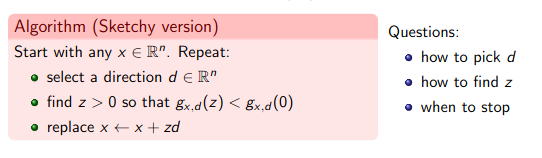
Convex Optimization Algorithm Lemmas
Let
. If there is a with , then:
for some How to find z: Newtonian Descent Direction
Ifis a twice differentiable convex function and is such that is an invertible matrix. Then:
hasSuppose
are functions such that for all . Consider fixed such that . Let:
,
Then
Convex Optimization Algorithm Theorems
How to pick d:
Letbe a differentiable function, let and . If:
thnefor some .
Barrier Method Lemma
If
are convex functions, then:
is a berrier function for (1).For all
we have → m is number of constraints. Theorem:
and coverage to optimal solutions as .
Probabilities
Topic: Probability and Random Variables
De Morgans law:
Disjoint:
Probability Axioms
A probability measure
is a function that maps events in the sample space to real numbers such that:
Axiom 1: For any event
Axiom 2:
Axiom 3: For any countable collectionof disjoint sets:
The probability measures
satisfies
For any A and B (not necessarily disjoint):
If, then . For any event A and partition
Conditional Probability Axioms
Axiom 1:
Axiom 2:
Axiom 3: Ifand for then:
Probability Theorems
Law of total probability:
For a partitionwith for all ,
Bayes’ theorem:
Events A and B are independent if and only if:
- Disjoint events
Independent Events
Sampling WITH/WITHOUT Replacement
WITHOUT: Binomial Coefficient:
WITH: Multinomial Coefficient:Sampling with/without the ability to select an observation more than once.
Independent Trials
Subexperiment probability of success:
, probability of failure
Probability offailures and successes
Discrete Random Variables
Topic: Probability and Random Variables
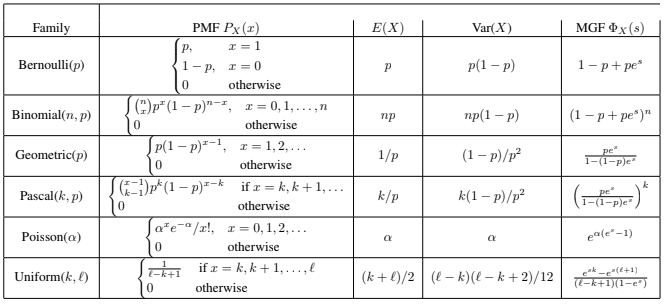
WHEN WHICH:
- Bernoulli: A random event that results in a success or a failure.
- Binomial: Number of trials (n) and the probability of success (p), counting amount of (x) successes.
- Geometric: Counts independent Bernoulli trials (1-p) until a success (p) occurs.
- Pascal: Until (k) successes, (x) number of trials required.
- Poisson: Counts the number times event occurs in a given unit of distance. It has one parameter, (a) the mean number of occurrences per specified unit.
- Uniform: When all outcomes of a random variable have equal probability within a specified range.
Probability Mass Function (PMF)
Properties:
For any
For any eventthe probability that is in the set is equal to:
Cumulative Distribution Function (CDF)
Properties:
and
for all
forand an arbitrary small positive number:
for all such that
Expectation (MEAN), Variance, Standard Deviation
or
n-th moment:
n-th central moment:
Continuous Random Variables
Topic: Probability and Random Variables
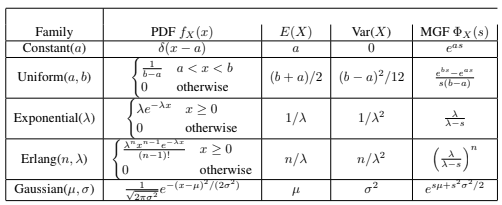
Probability Density Function (PDF)
Properties:
for all
Expectation (MEAN), Variance
or
- Cumulative Distribution Function (CDF): Integral of PDF.
- CDF is obtained same way as in Discrete Random Variables.
Standard Normal Random Variable
Delta Function
sifting property:
For a discrete with range
we have:
generalized PDF:
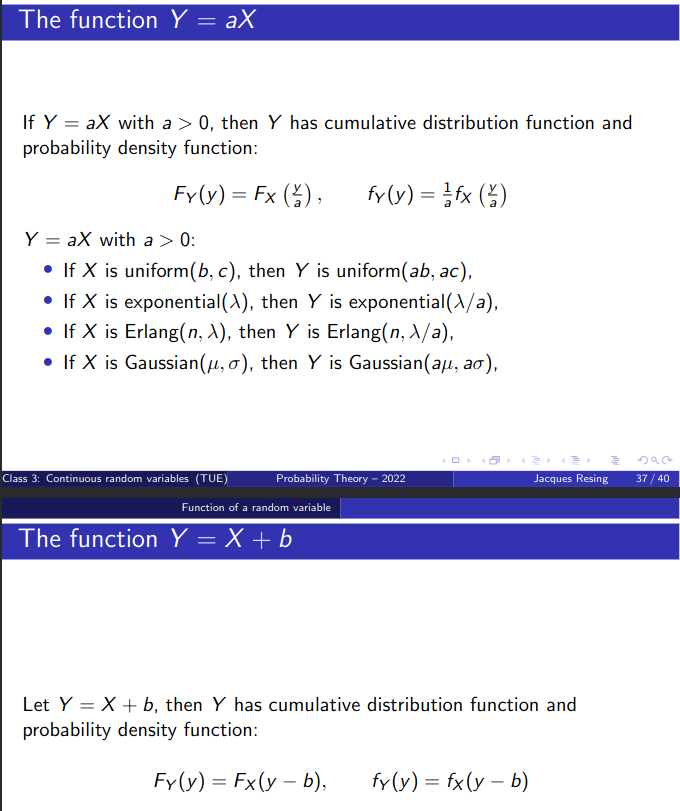
Summary
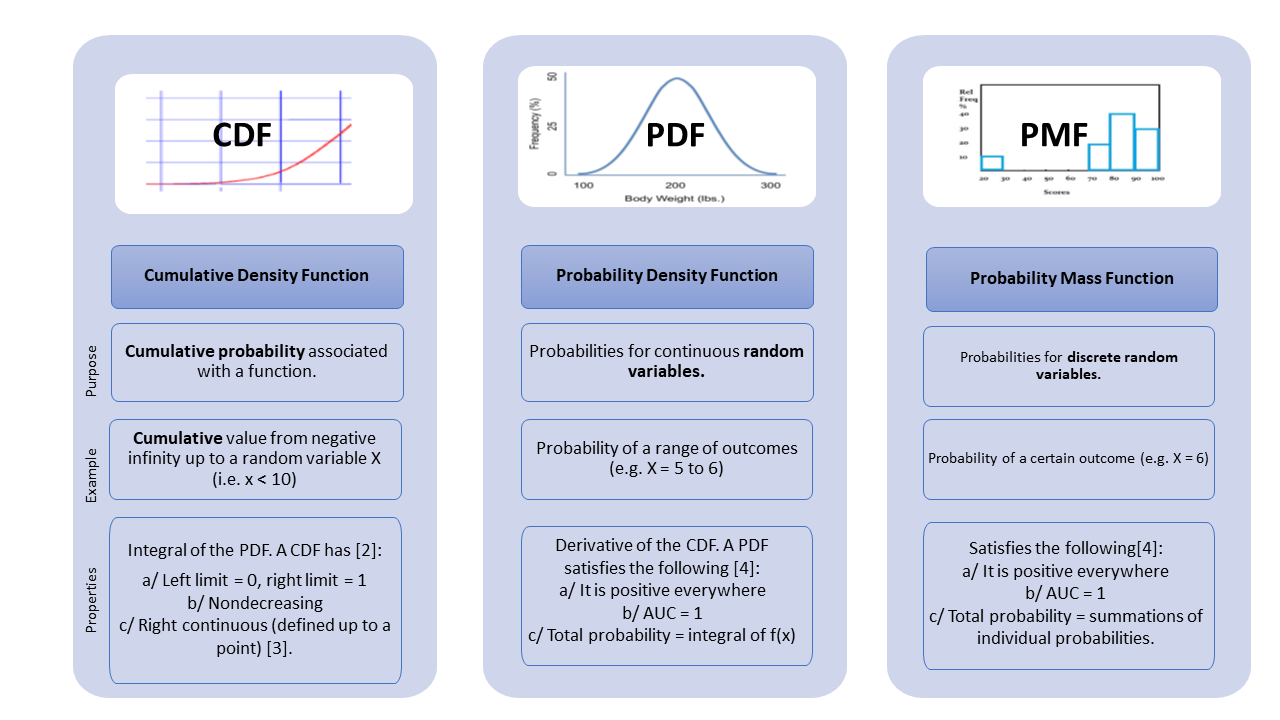
Pairs of Random Variables
Topic: Probability and Random Variables
Joint CDF
Joint PMF
Joint PDF
Marginal
PMF ⇒
⇒ ⇒ similar for Y
PDF ⇒⇒ ⇒ similar for Y
Expectation & Variance
Expectation →
Discrete: ⇒
Continuous: ⇒
Variance
Correlation
always between→ negative/positive correlation
Independent Random Variables
Discrete: ⇒
Continuous: ⇒
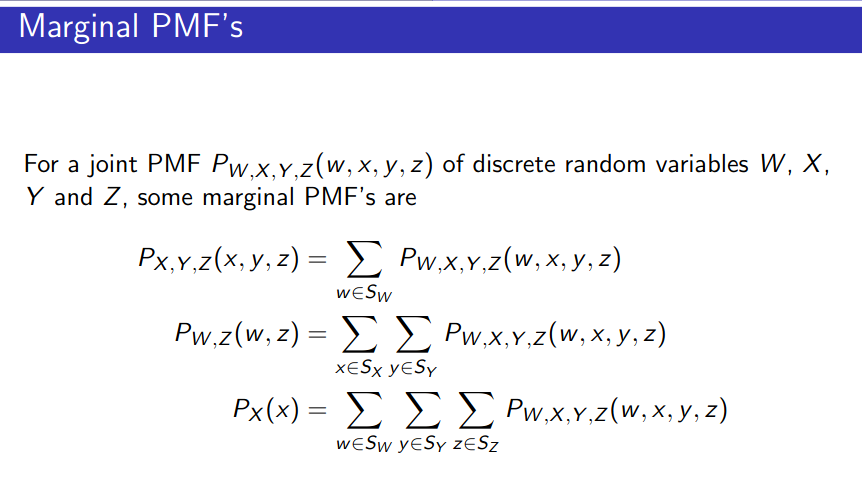
- There can be in general more than 2 variables considered in a probability, below is an example and it applies for continuous in same format:
Conditional Probability Models
Conditional PMF/PDF
PMF:
if else
PDF:
if else
Conditioning by Event/Random Variable
Event:
if else
if else
Random Variable:
Conditioning of Independent Random Variables
or
for all
MGF & Sums of Random Variables
Moment Generating Function (MGF)
Purpose → Calculate Moments Through Deriviation
Sum of Random Variables
Expectation
Variance
uncorrelated:
independent:→ Convolution of PDF of X and the PDF of Y.
MGF
independent:
Central Limit Theorem
Cumulative distribution function of a standard normal Gaussian(0,1) Random Variable.
&