5XIE0 Computation Modeling
- Area: Computer Engineering
- Topics: Linear Algebra · Probability and Random Variables · State-Space Models · Finite State Machines and Automata
- Related courses: Computation II - 5EIB0 · Math II - 5EMA0
Module A: Languages and Automata, Property Checking
Week 1: A.1 & A.2
Formal Languages A.1
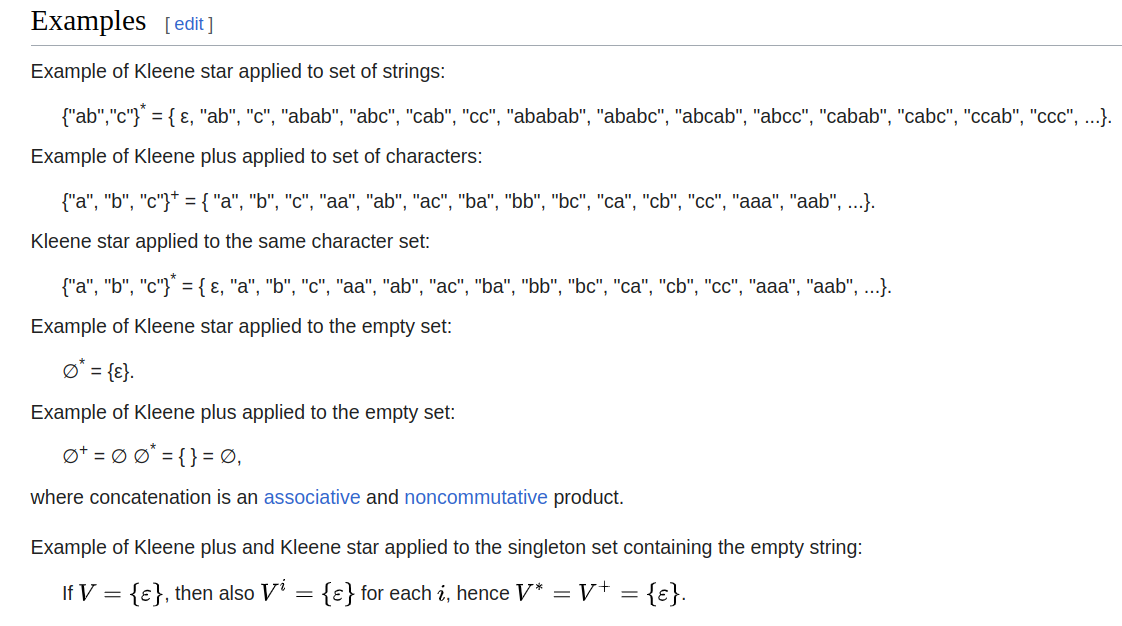
Kleene star - Wikipedia
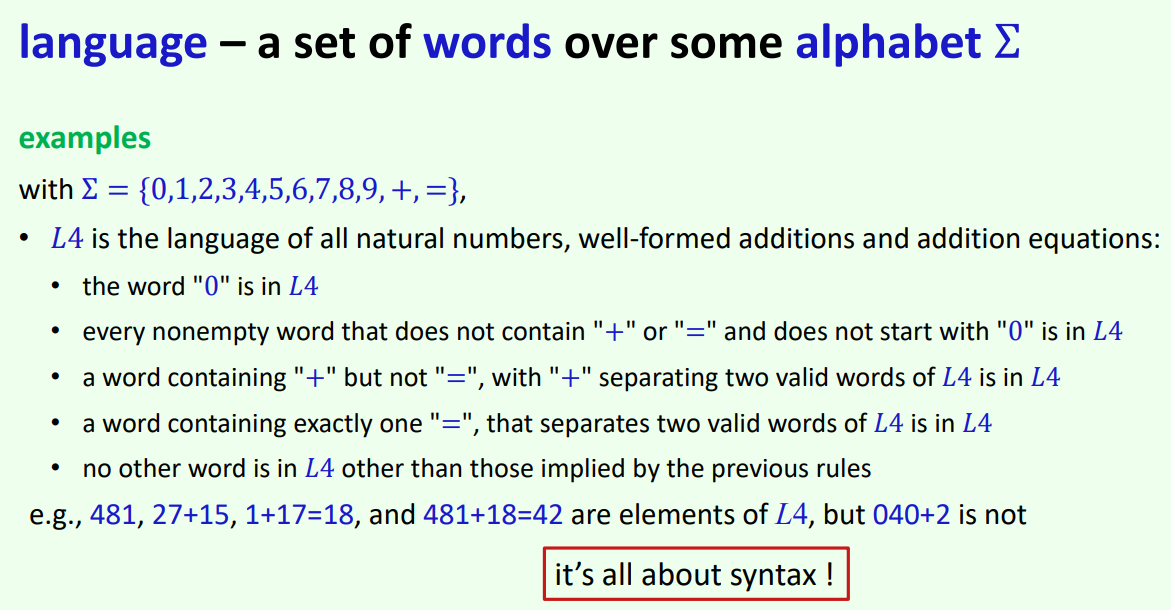
precise means of specifying patterns/behaviors
example:
Regular Languages A.2.1
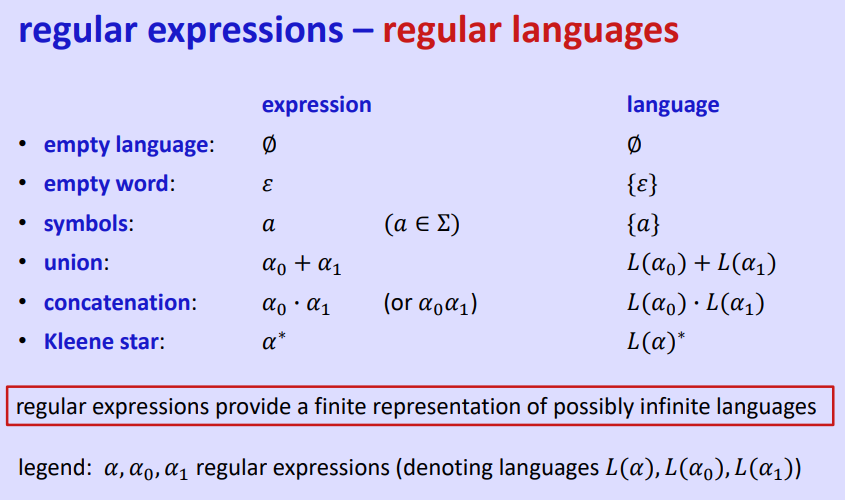
class of language specified by regular expressions
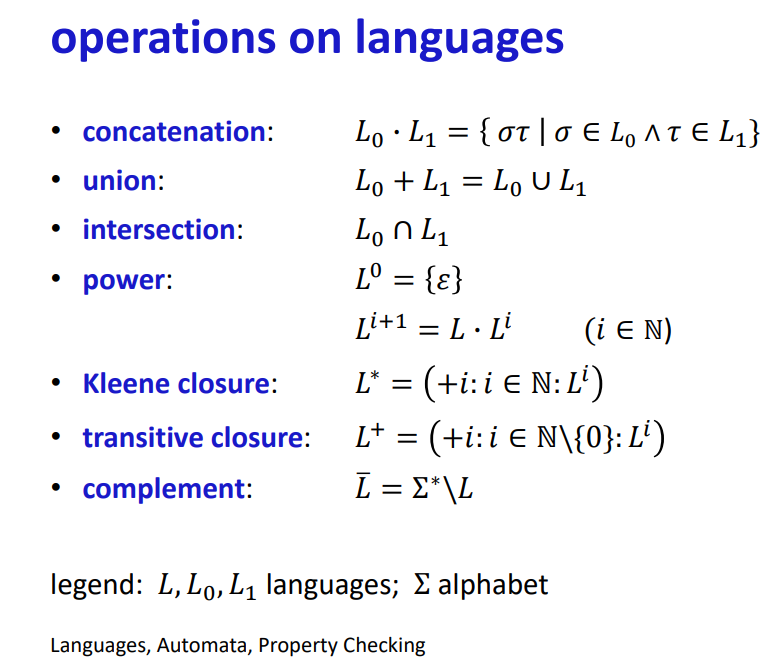
powers: repetition where
concatenation: put words together.
operations on languages: regular expressions define languages.
concatenation: combining strings of two languages to form a language.
interaction: find common elements between languages.
empty word, you can perform concatenations on which would result in the other. cant concatenate empty language like multiplying by zero.
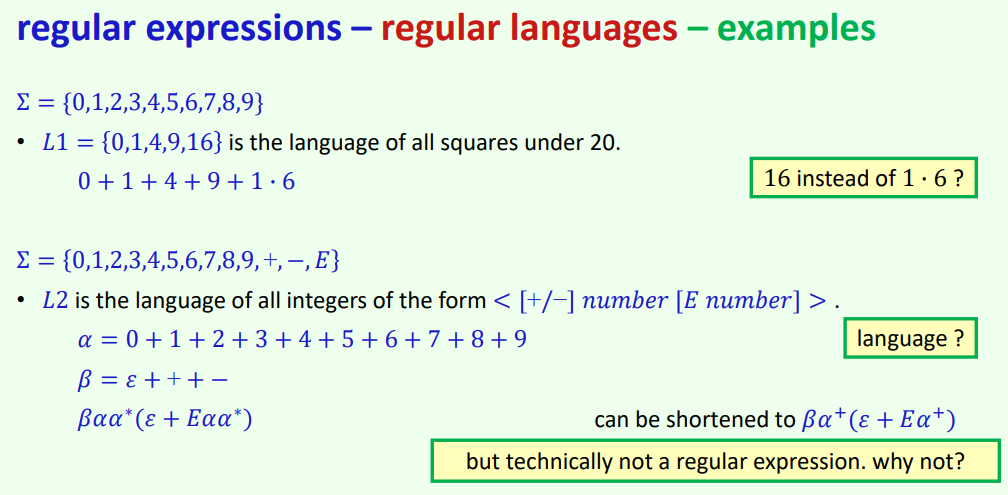
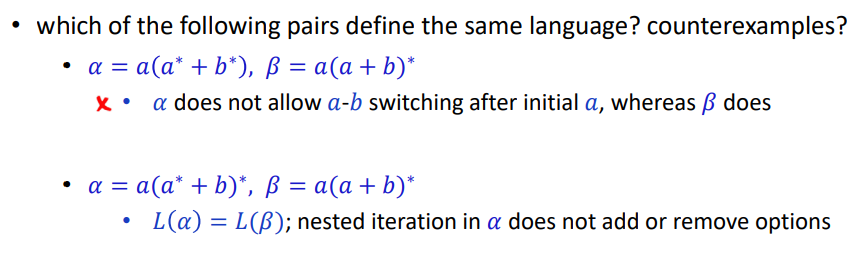
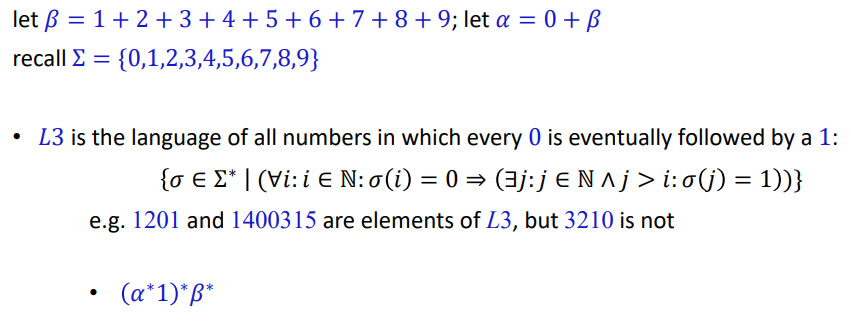
((as long as repetition of
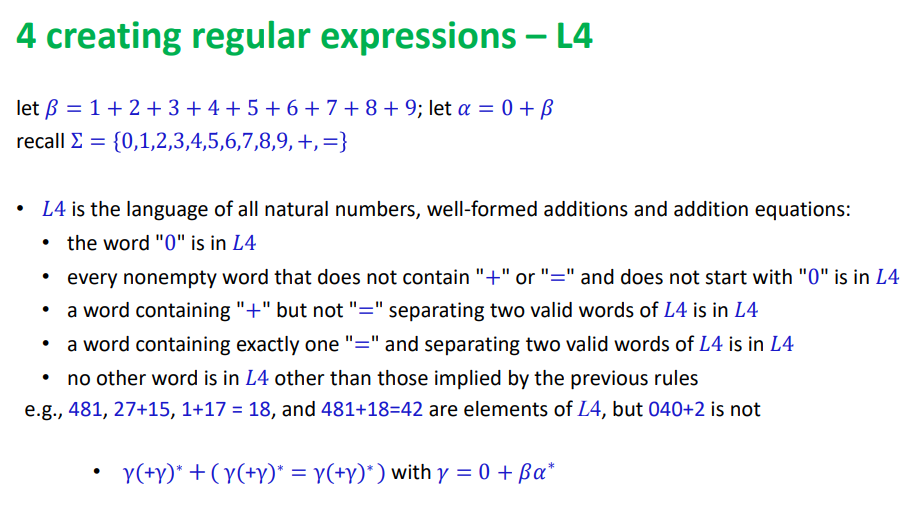
regular expression cant keep track of more than 1 count.
for counting amount of amount of 1s making sure its even:
Finite Automata A.2.2
Topic: Finite State Machines and Automata
Regular Languages: Deterministic Finite Automaton (DFA)
Regular Languages: Nondeterministic Finite Automaton (NFA)
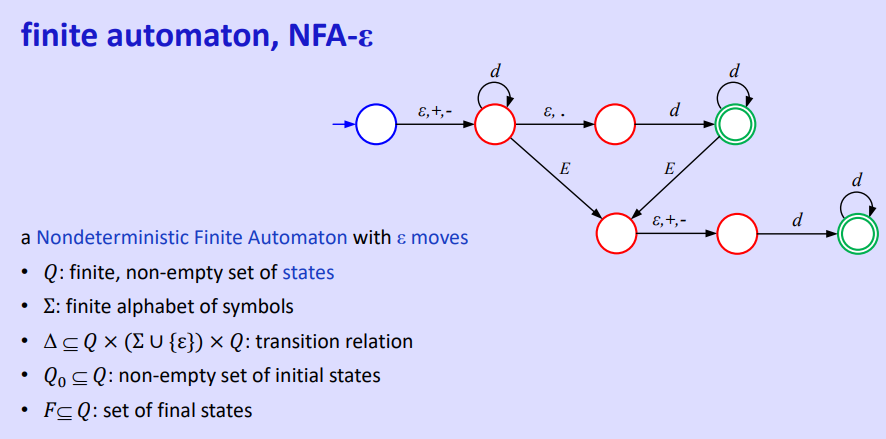
word/string
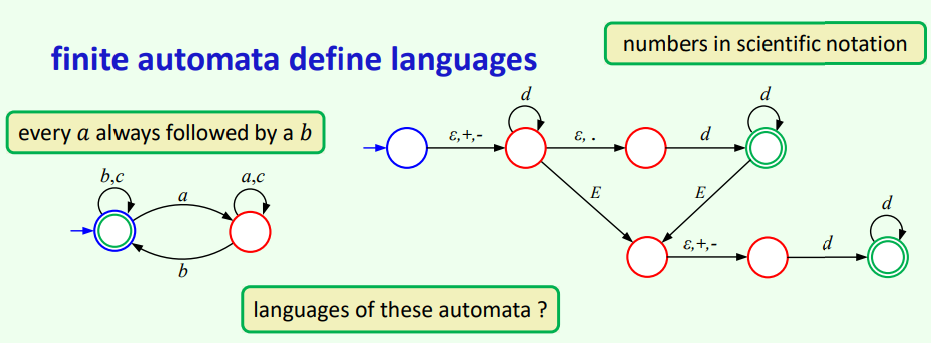
left: DFA so is NFA, right: none
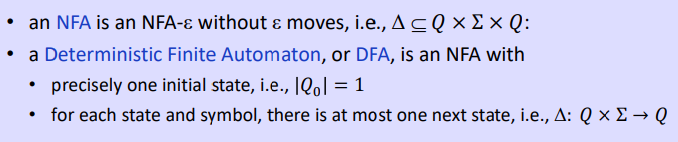

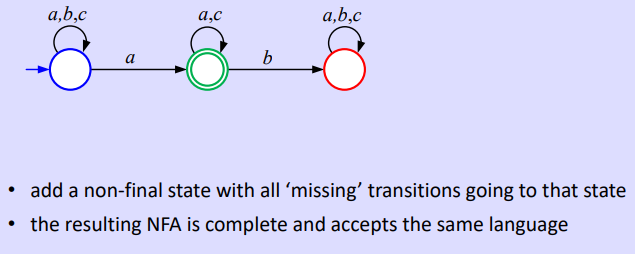
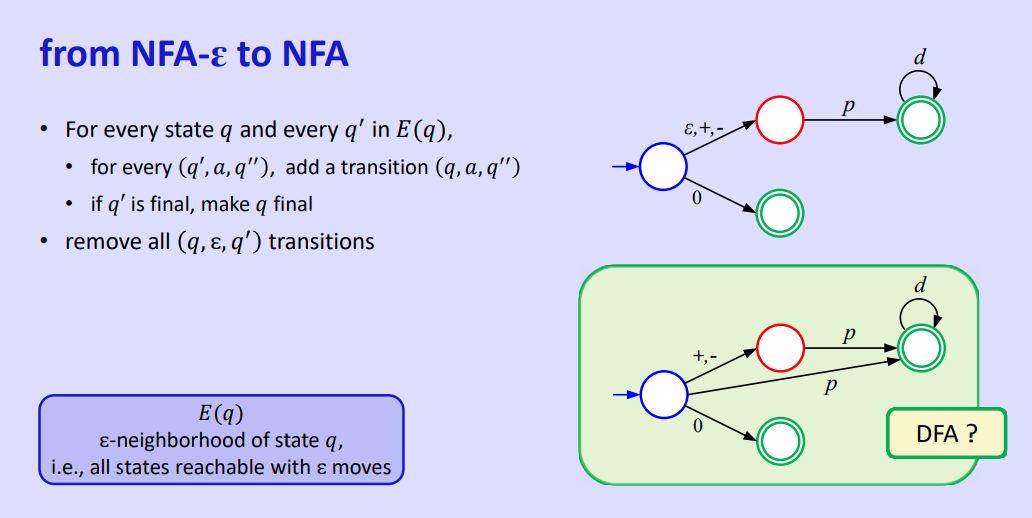
dfa,nfa,nfa-
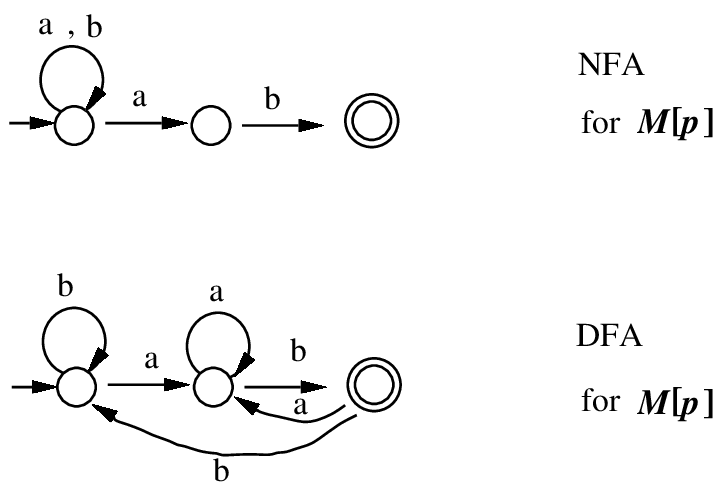
examples
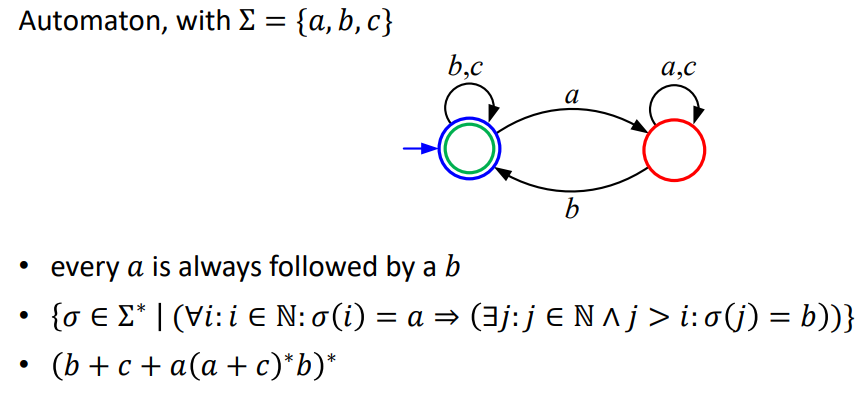
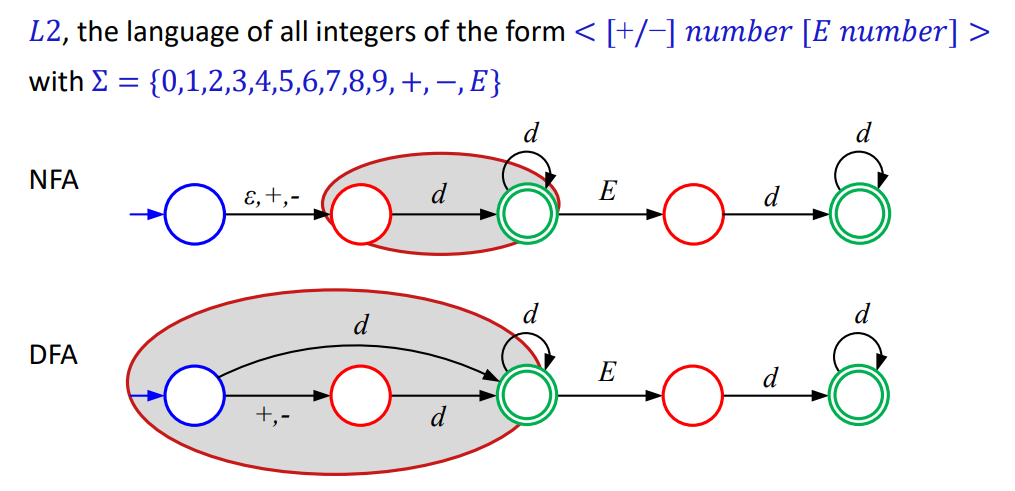
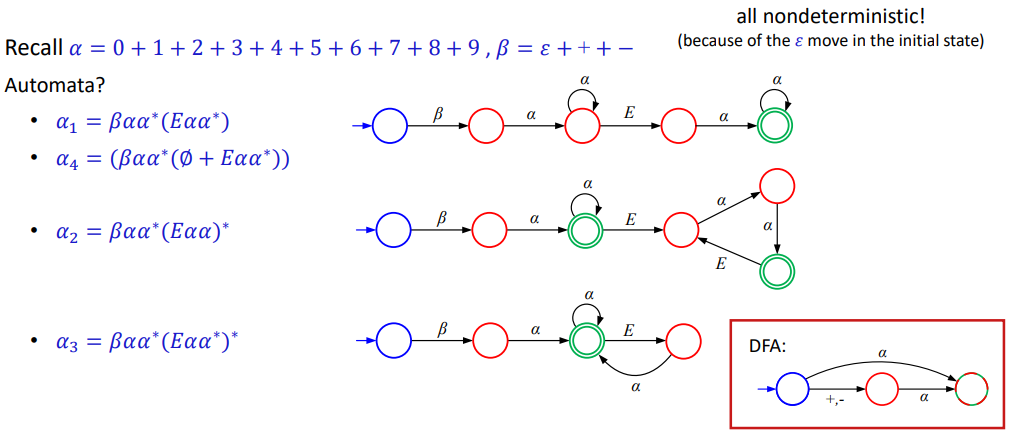
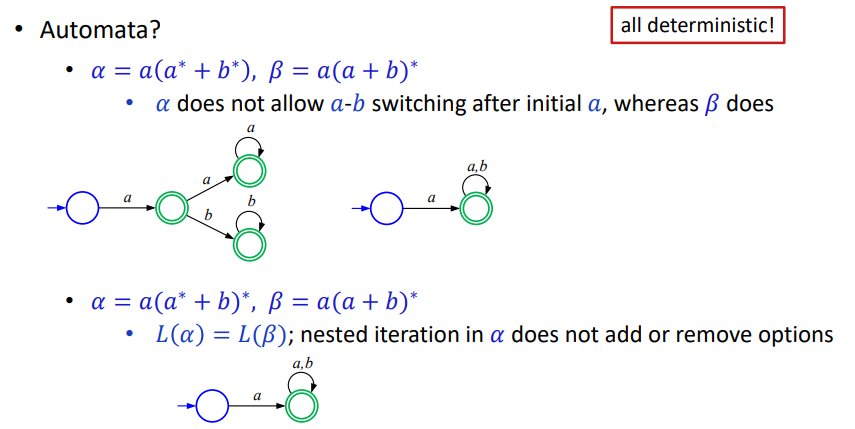
a3 in picture above look at it as if it reuses a*
and thats why the image on the right shows that repetition logic
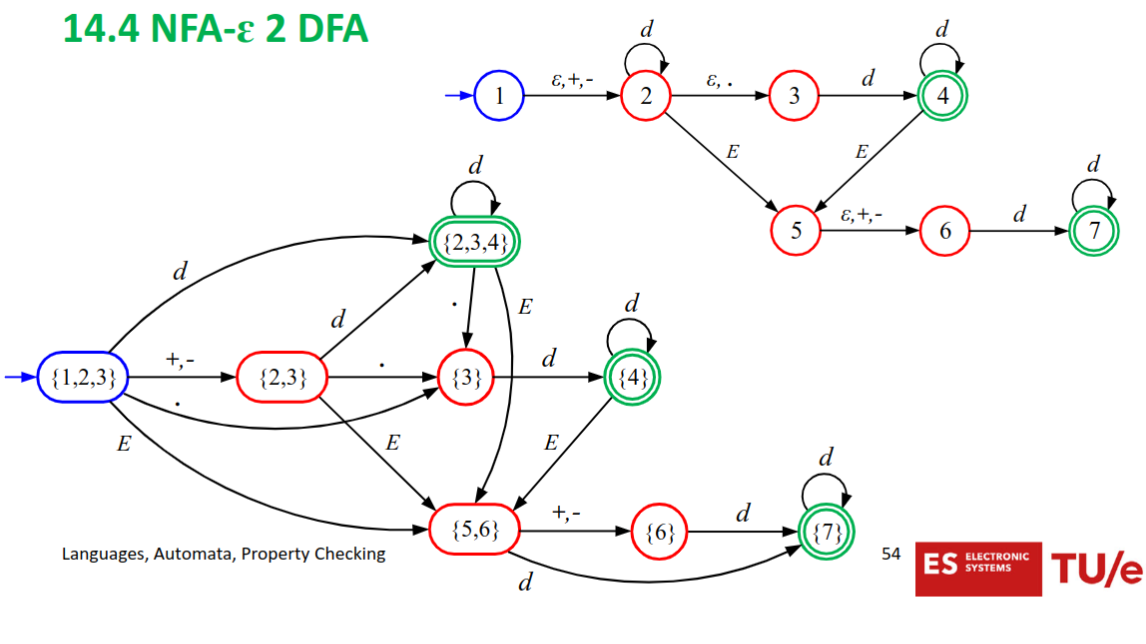
Conversions Between Representations of Regular Languages A.2.4
A Quick Non-Deterministic to Deterministic Finite Automata Conversion - YouTube
Best conversion example
Deterministic Finite Automata (Example 3) - YouTube
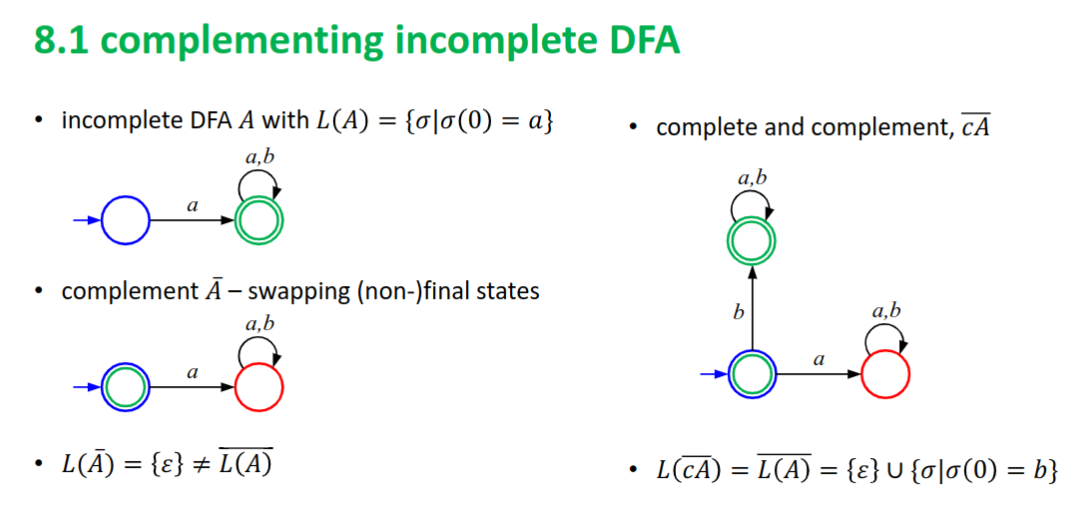
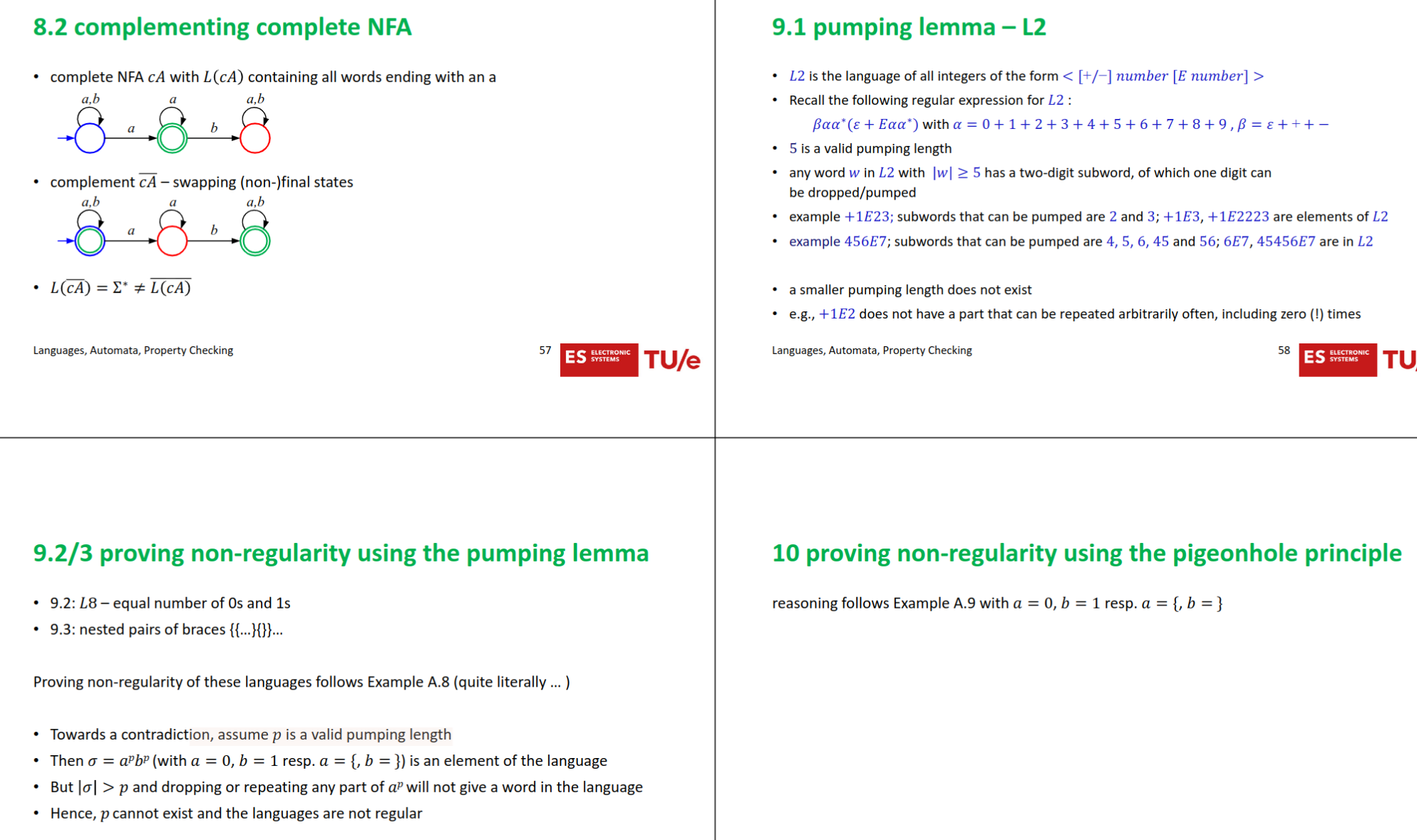
revert a state machine DFA → flip final states to none final and vice versa
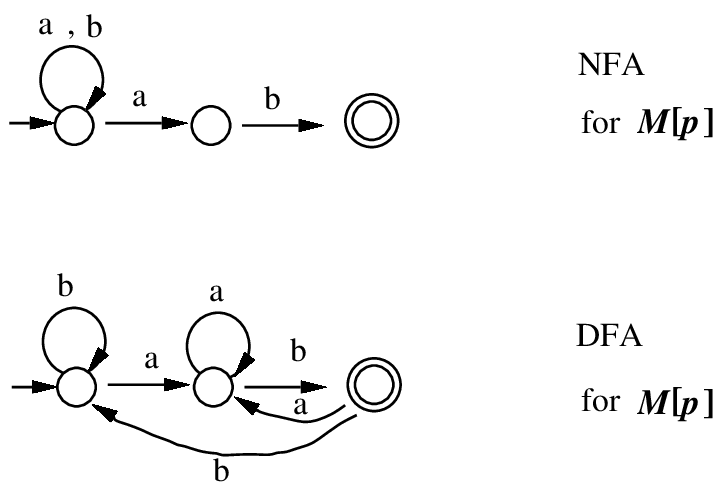
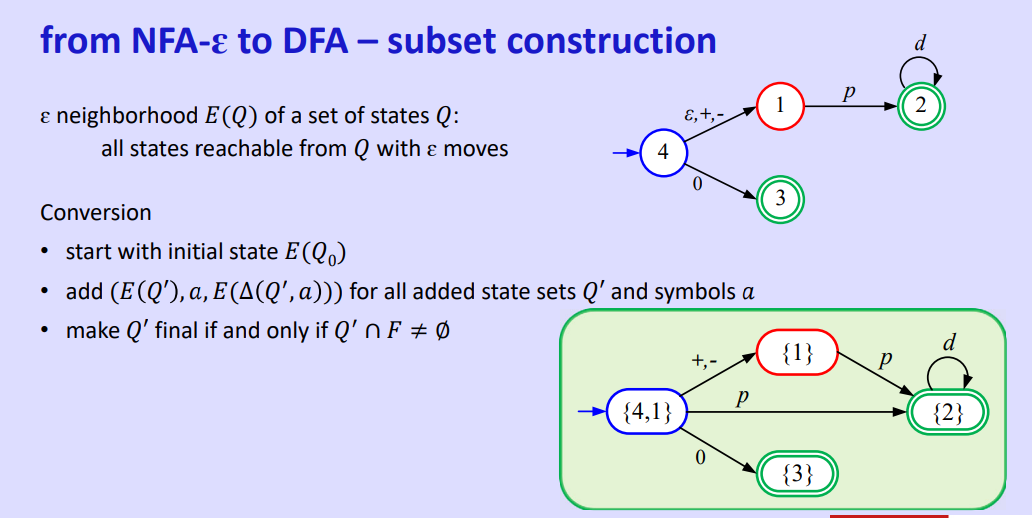
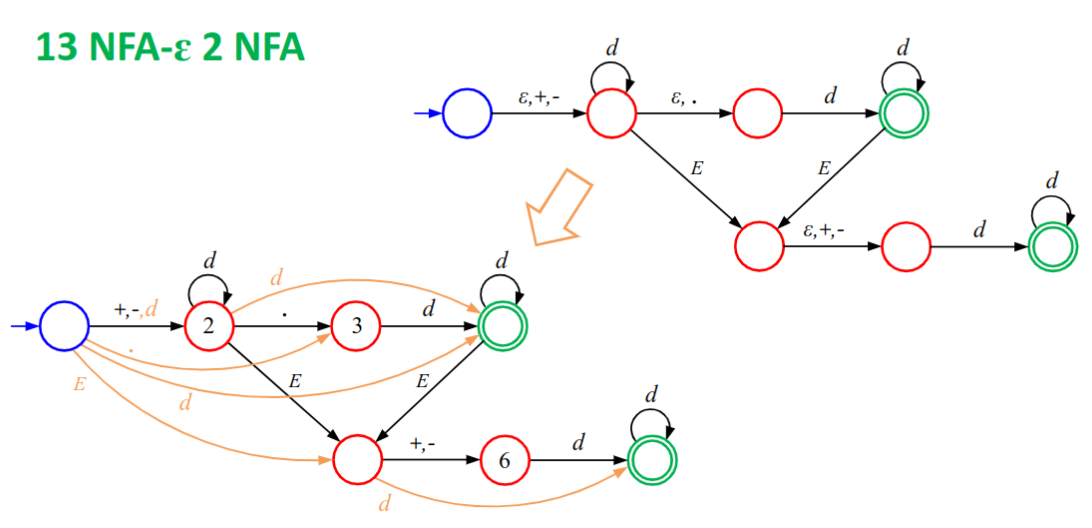
conversions between regular expressions, DFA, NFA, NFA-
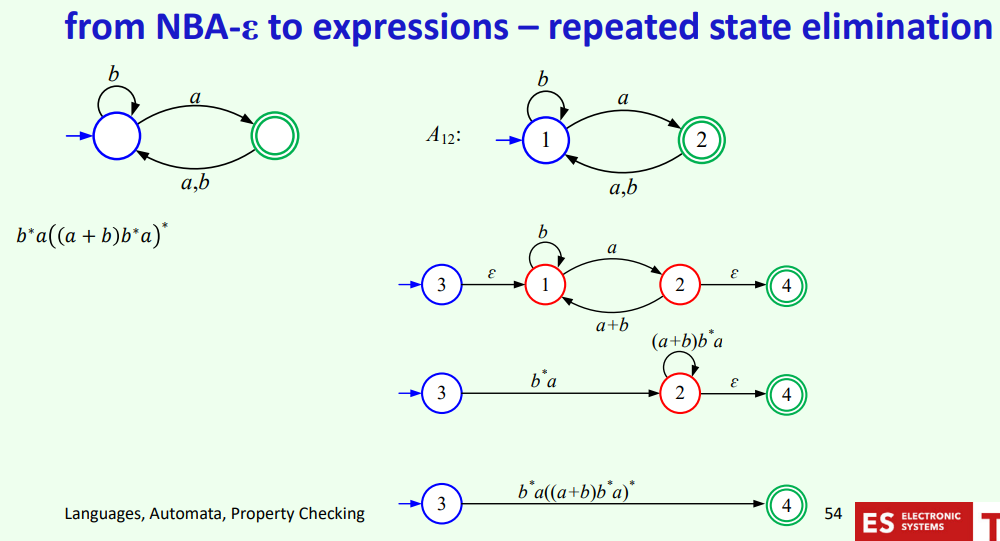
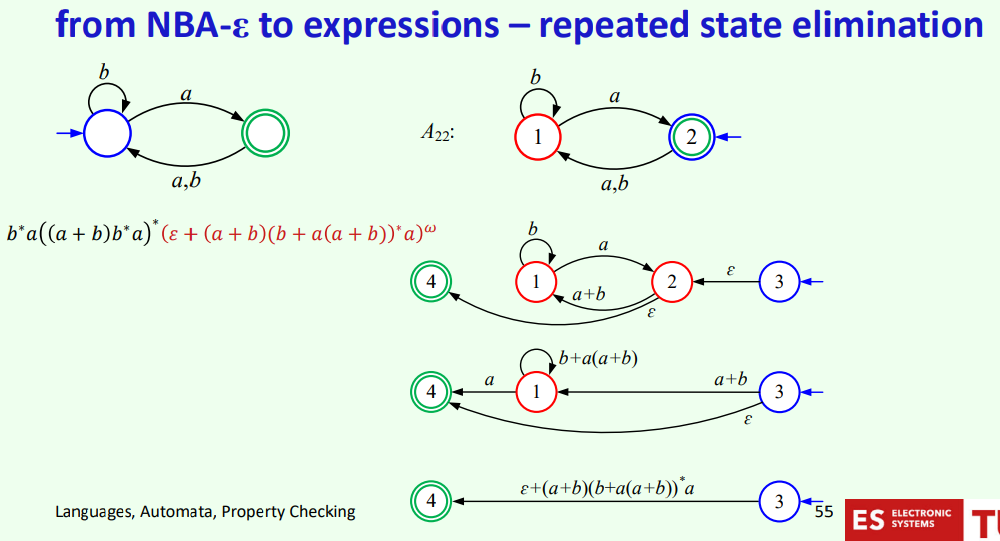
conversion between expressions and NFA-
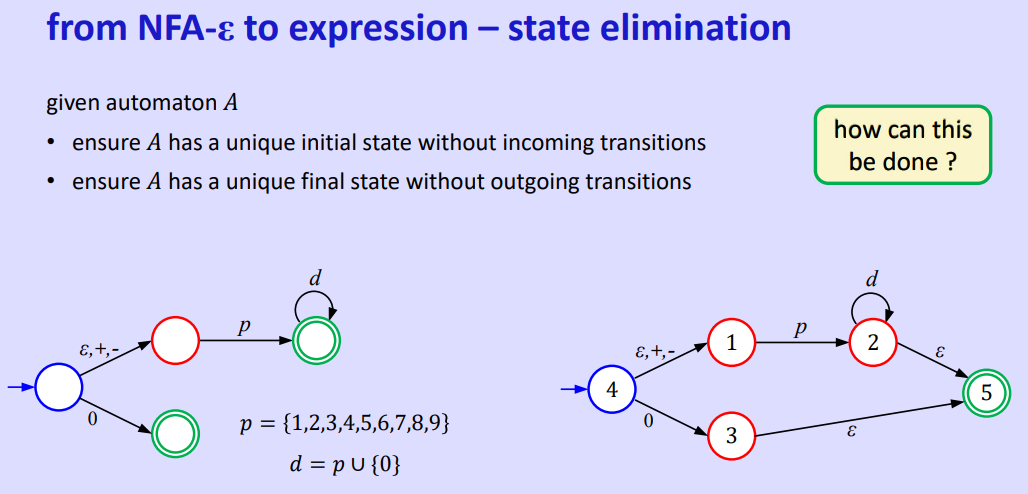
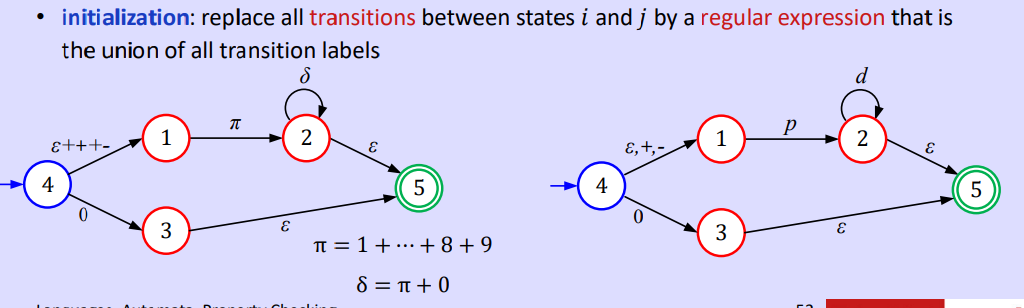
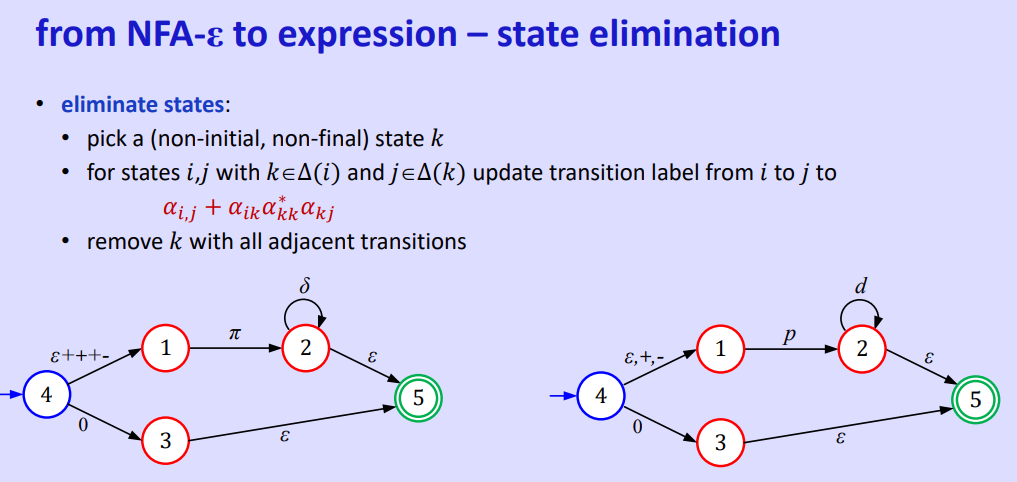

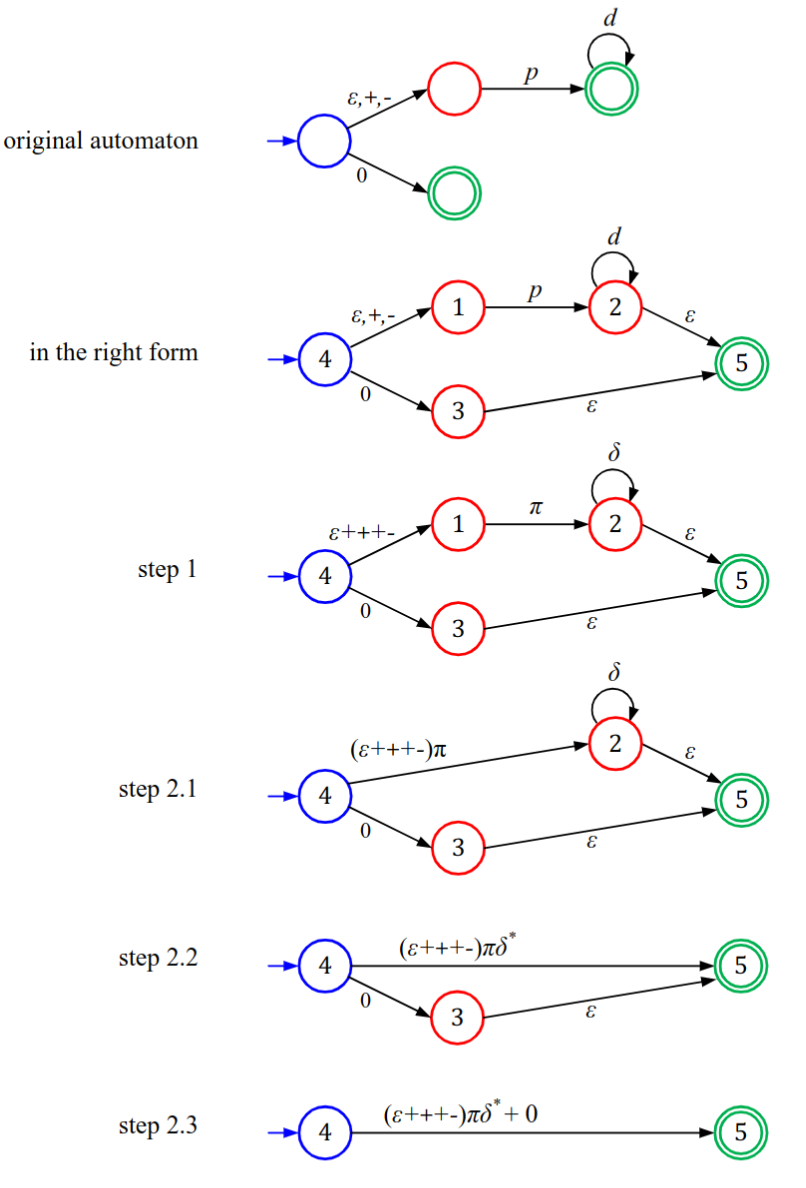
basically repeat until only initial and final state remain
Expressiveness A.2.3
What is the Pumping Lemma - YouTube
Nonregular languages: How to use the Pumping Lemma - YouTube
Pumping lemma for regular languages - Wikipedia
What Is the Pigeonhole Principle? - YouTube

any complete DFA
Best example for pumping lemma: Pumping Lemma (For Regular Languages) | Example 1 - YouTube
infinite many options is impossible in regular languages.
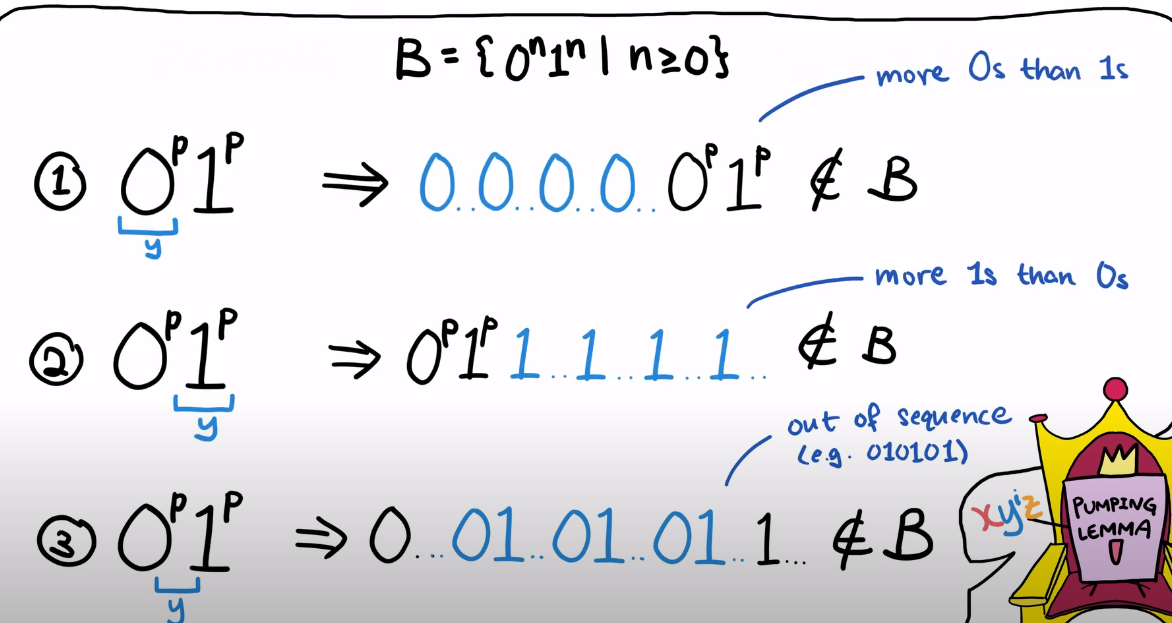
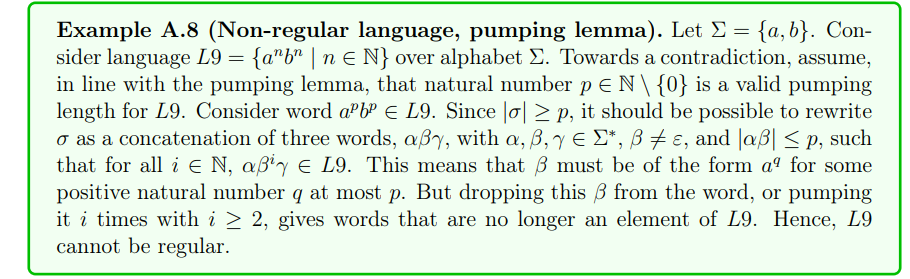
pumping lemma: some section of a language can be repeated still keeping the language regular. (pumping lemma can prove is language is NOT REGULAR)
string in language can be “pumped” repeated if they are at least as long as pumping length p.
pumping: have a middle section of the string repeated an arbitrary number of times
for example: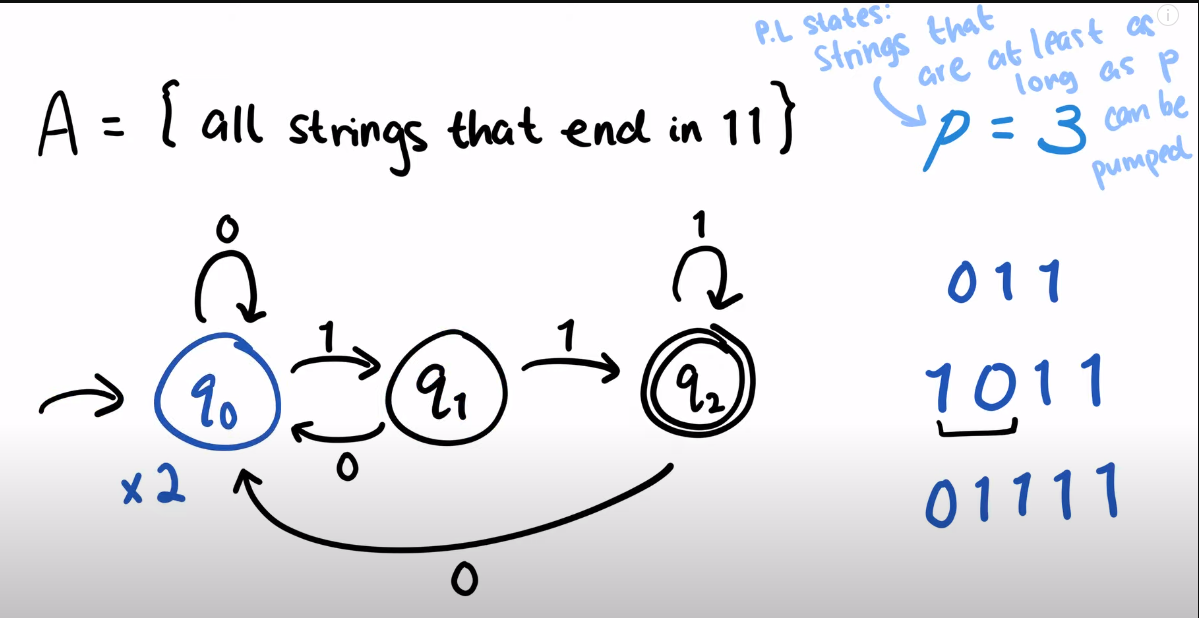
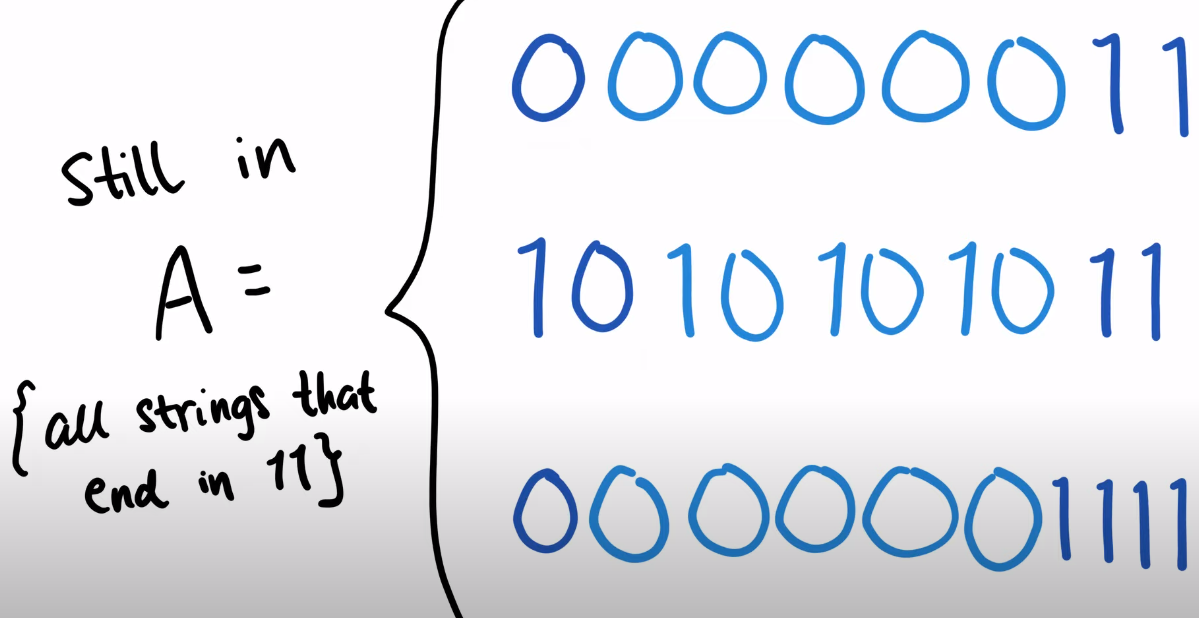
- so we can split strings into parts before being pumped, being pumped and part that takes us to final state.
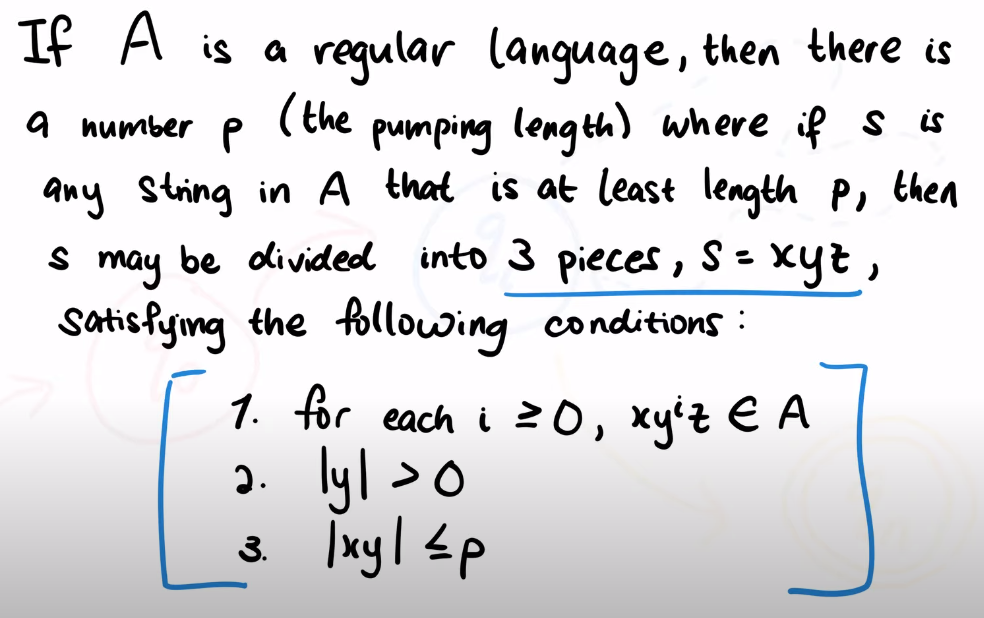
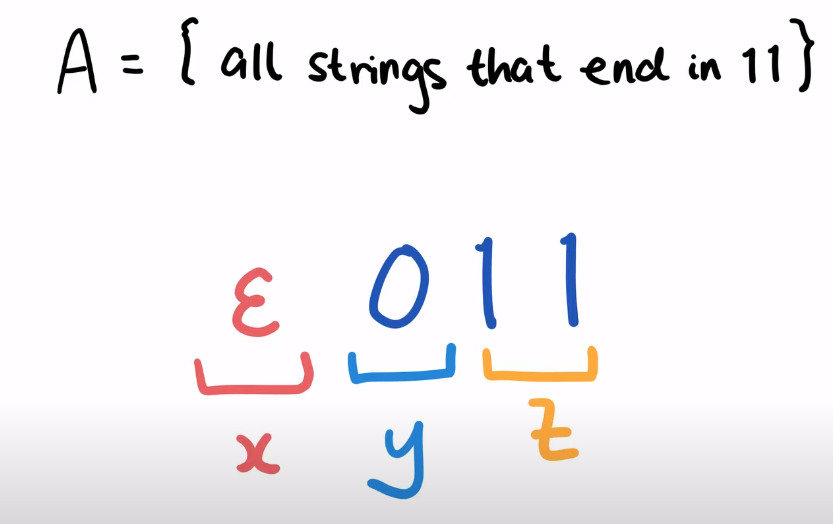
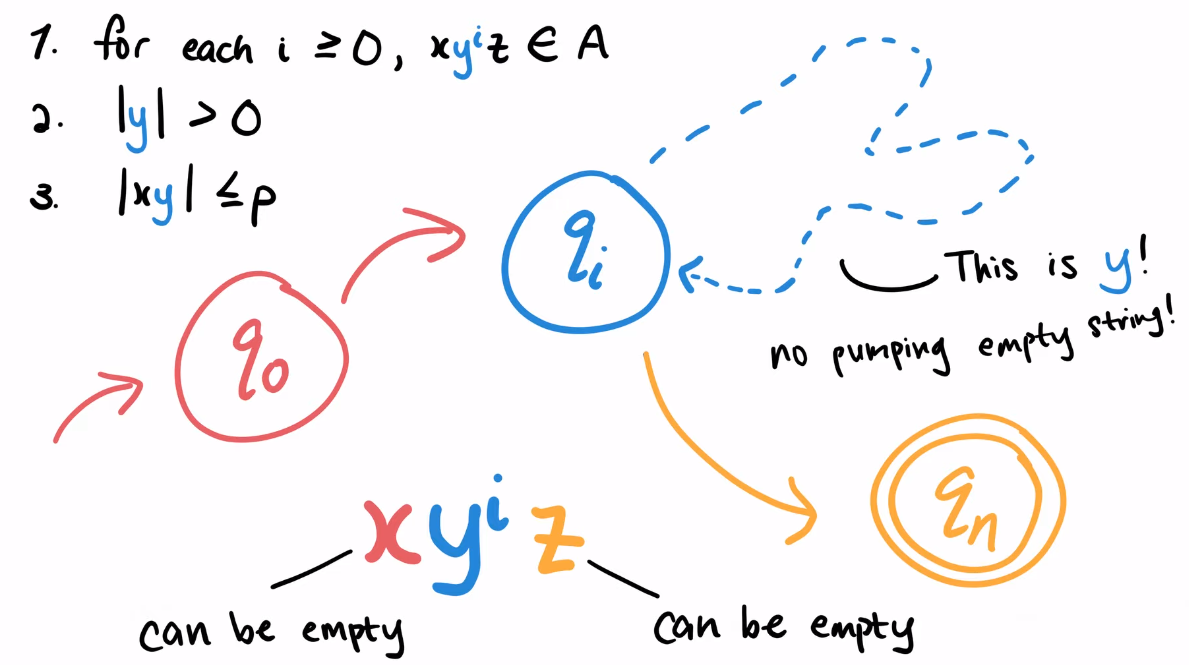
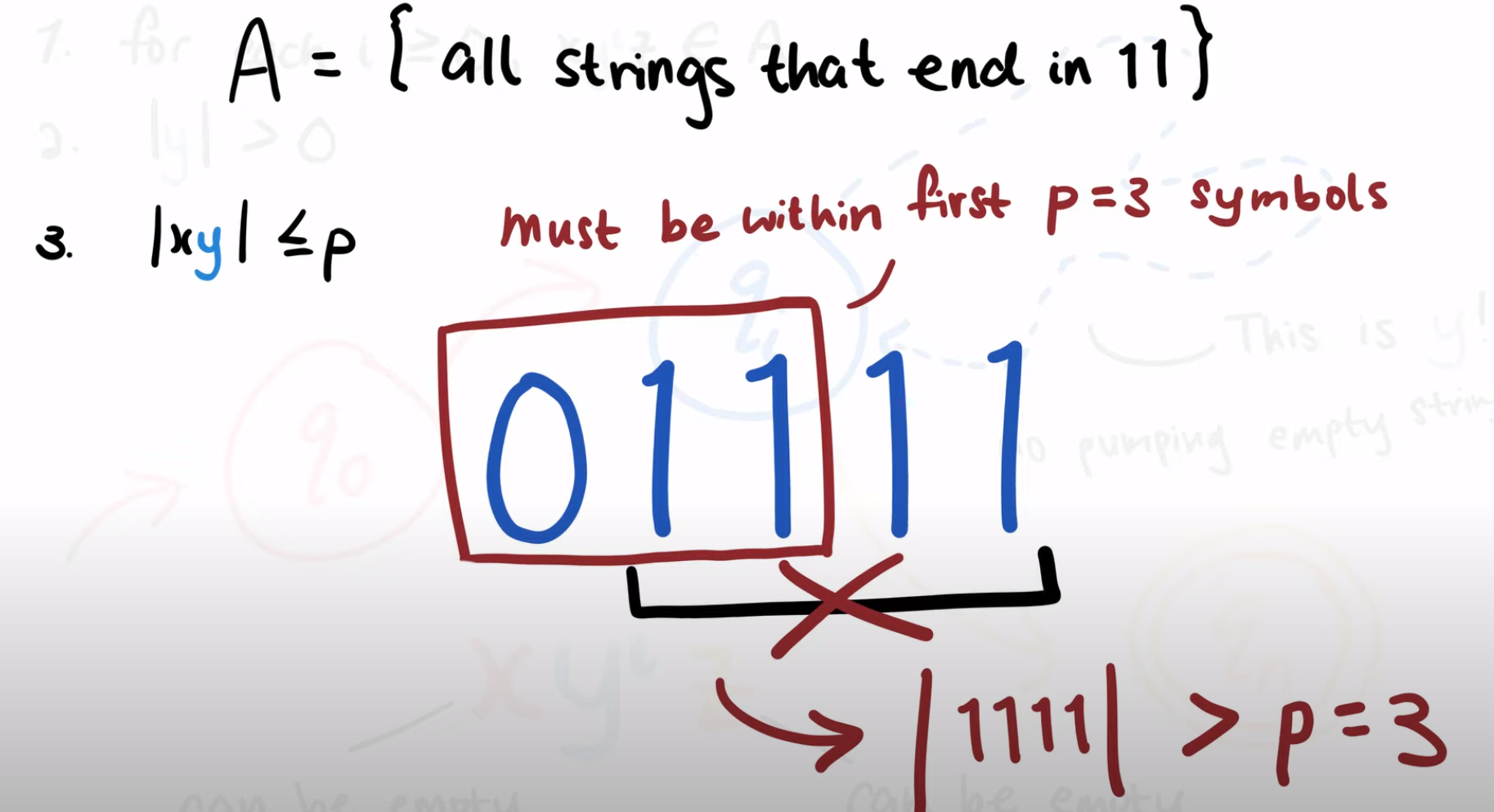
y can be pumped any number of times, y must be bigger than 0 (not), cant pump words bigger than p
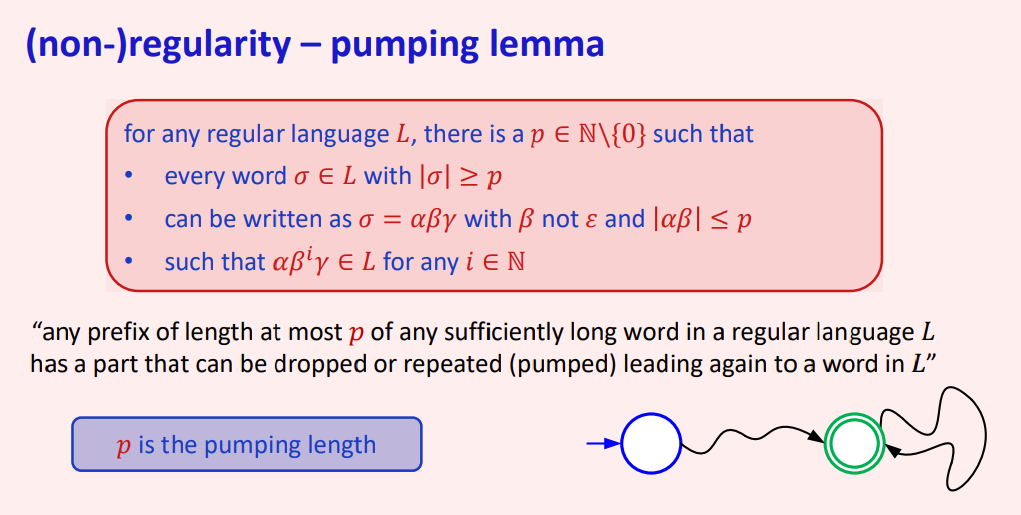
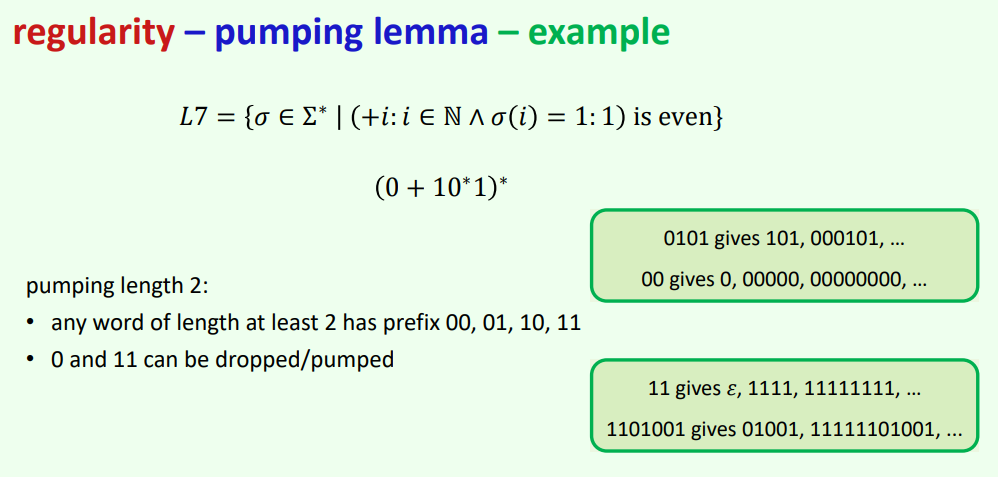
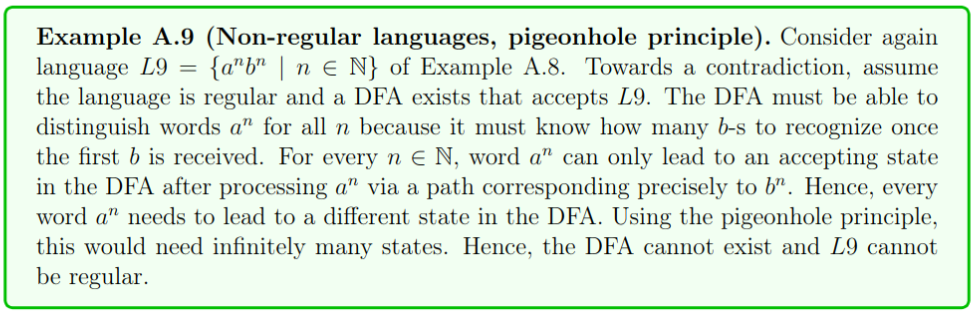
pigeon hole principle: if
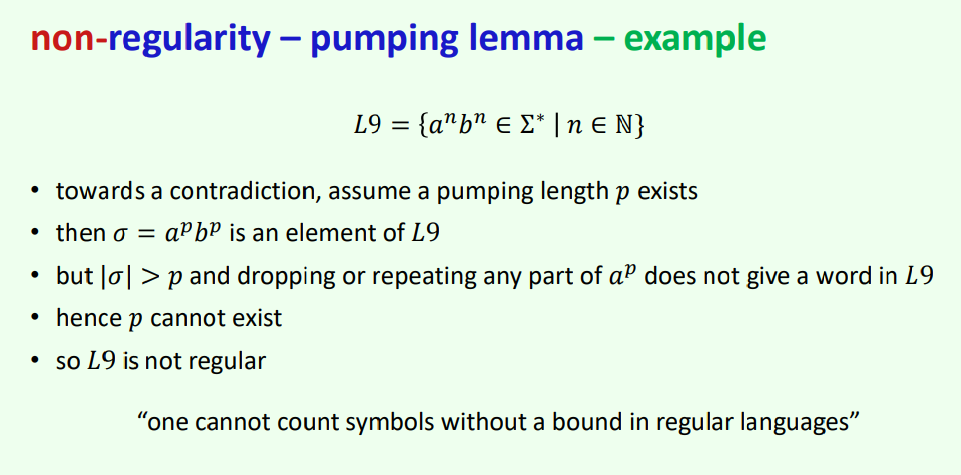
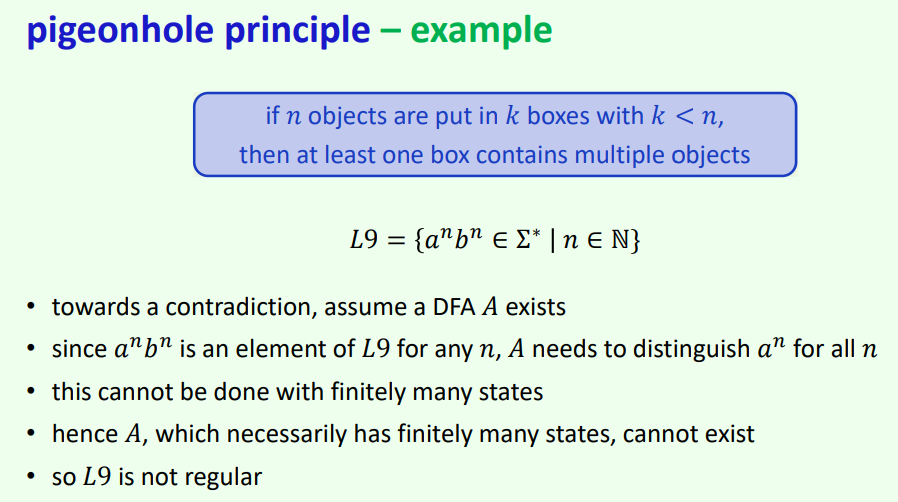
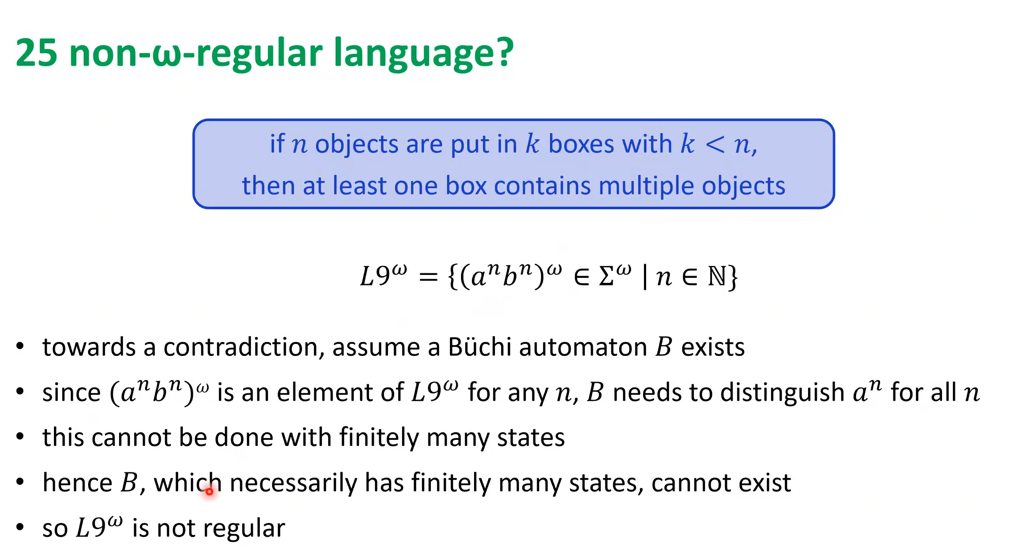
So, if a language contains infinitely many words that need to be distinguished, this cannot be done with finitely many states. In such a case, using the pigeonhole principle, no finite automaton recognizing the language exists. So the language is not regular.
Week 2: A.3 & A.4
Property Checking A.3
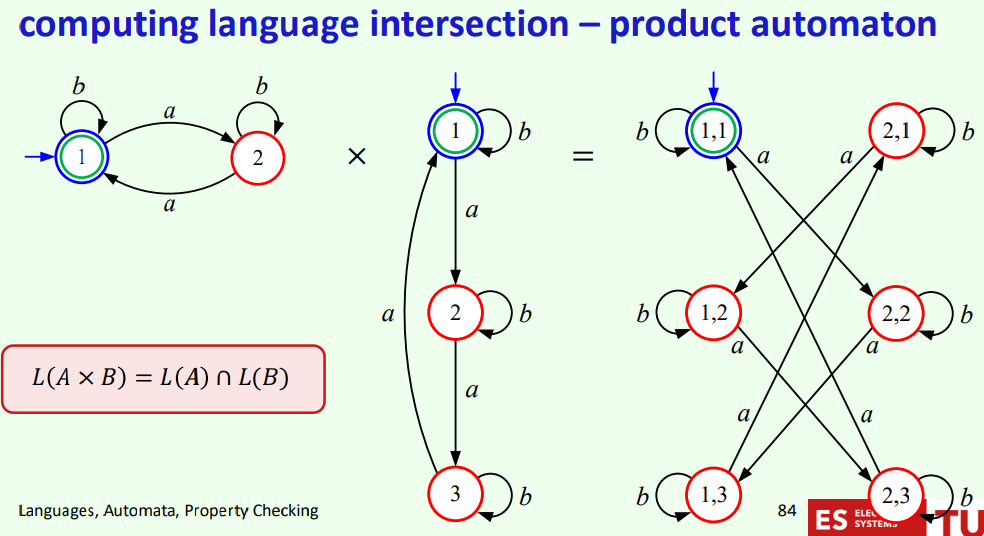
computing language interaction product automation: think of matrix dot product.
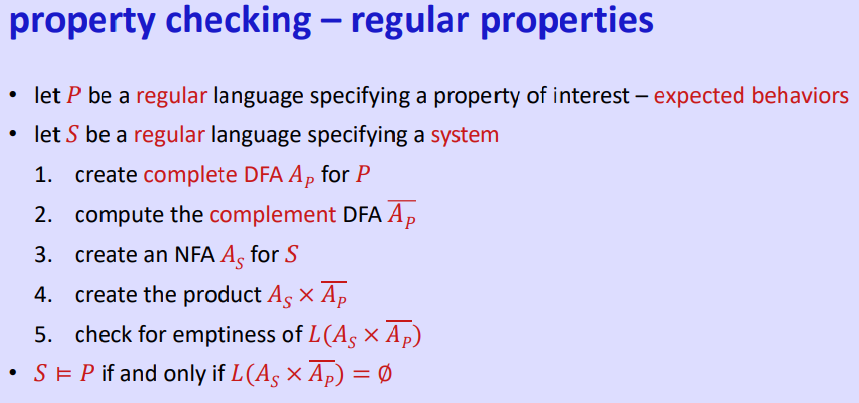
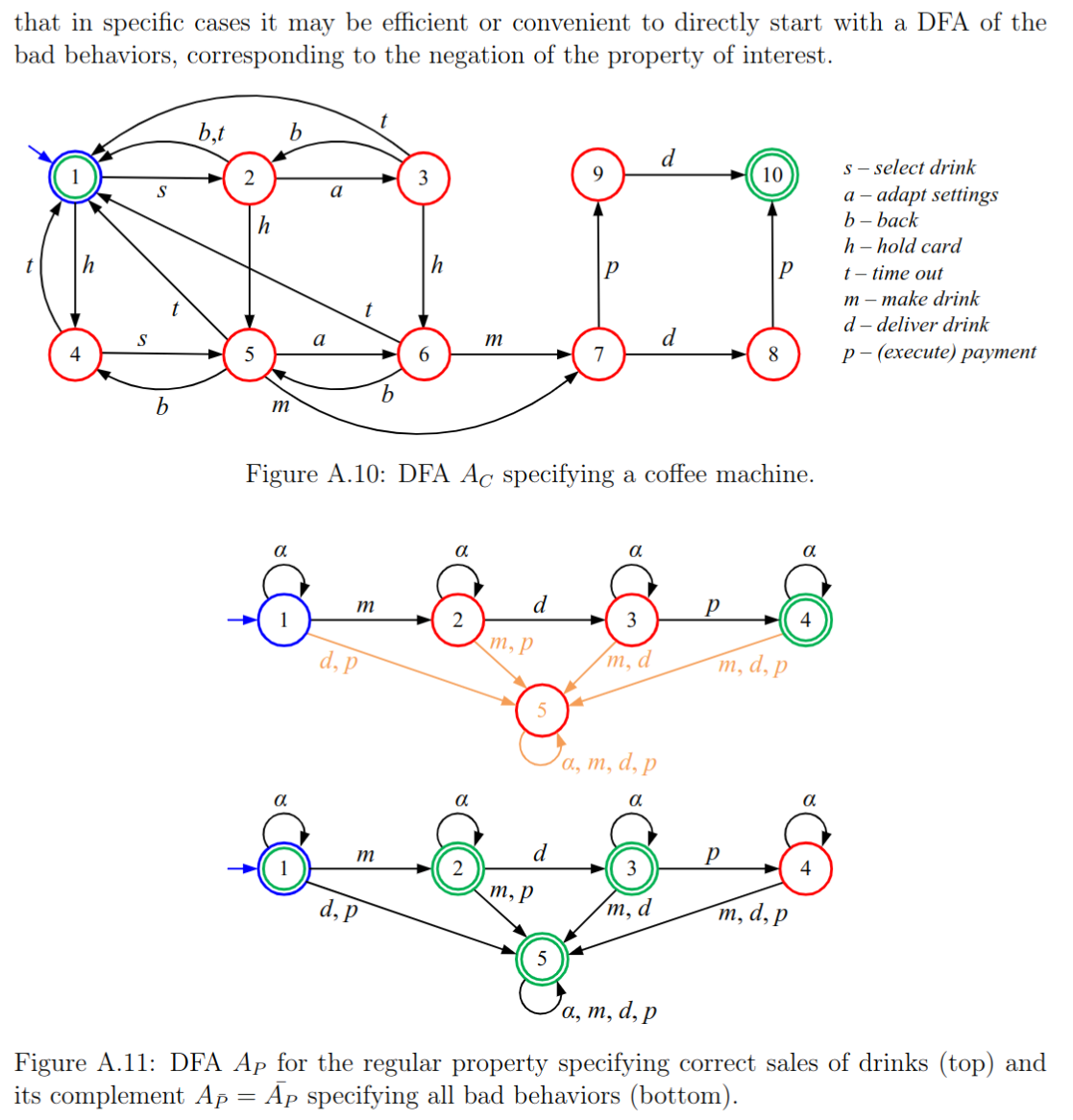
complement → invert normal states to final states and final states to normal states.
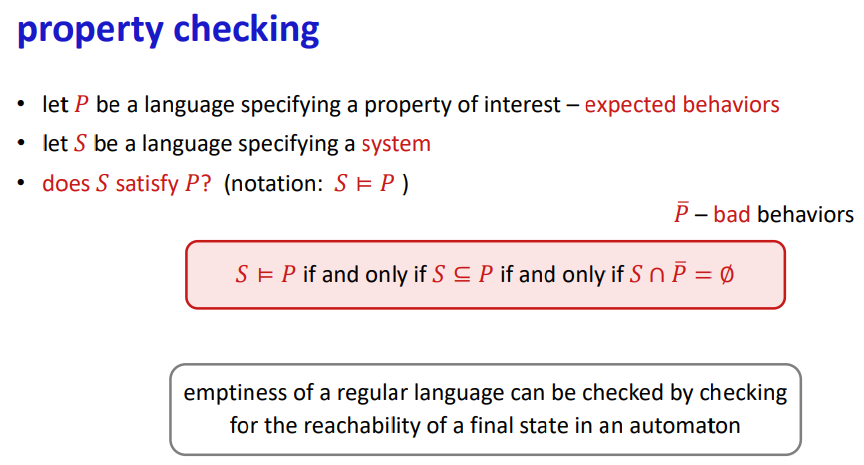
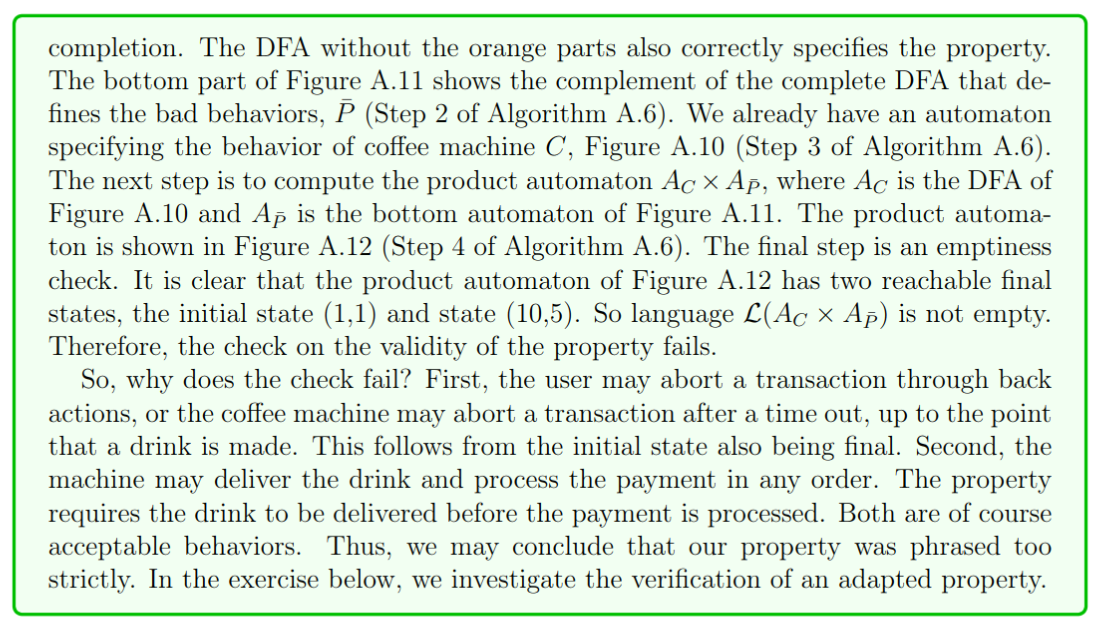
use logic to the determine the fact that final system is empty language, the one below is not empty since it has final states so does not satisfy
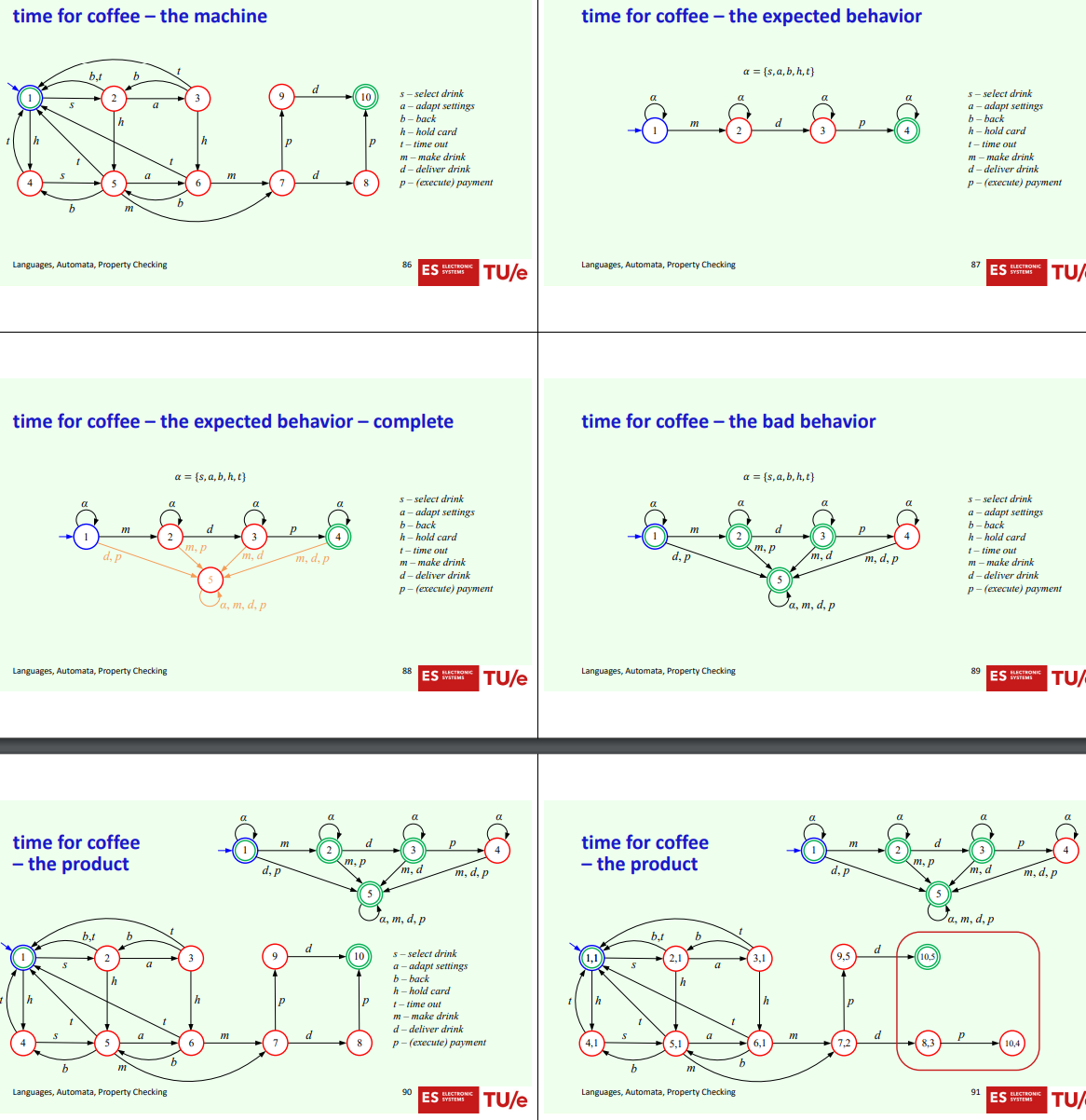
must not have final states…
Omega-regular language - Wikipedia
Omega language - Wikipedia
- a set of infinite words over some alphabet
. - one infinite word abstracts infinitely many finite behaviors.
- useful when behavior is unbounded.
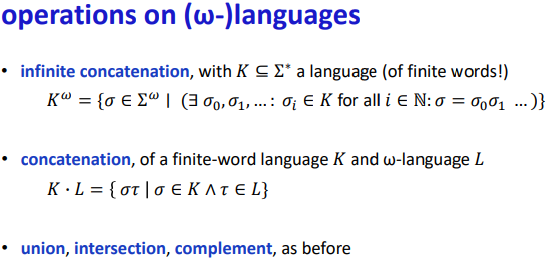
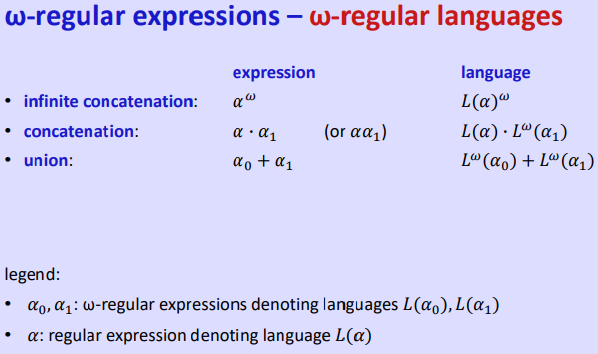
-regular expressions pattern:
legend:regular expressions
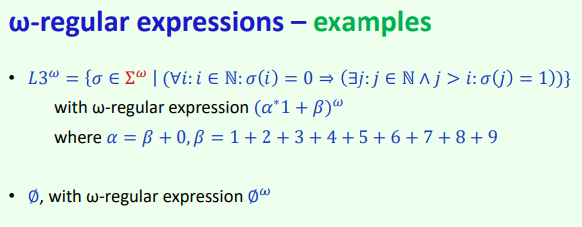
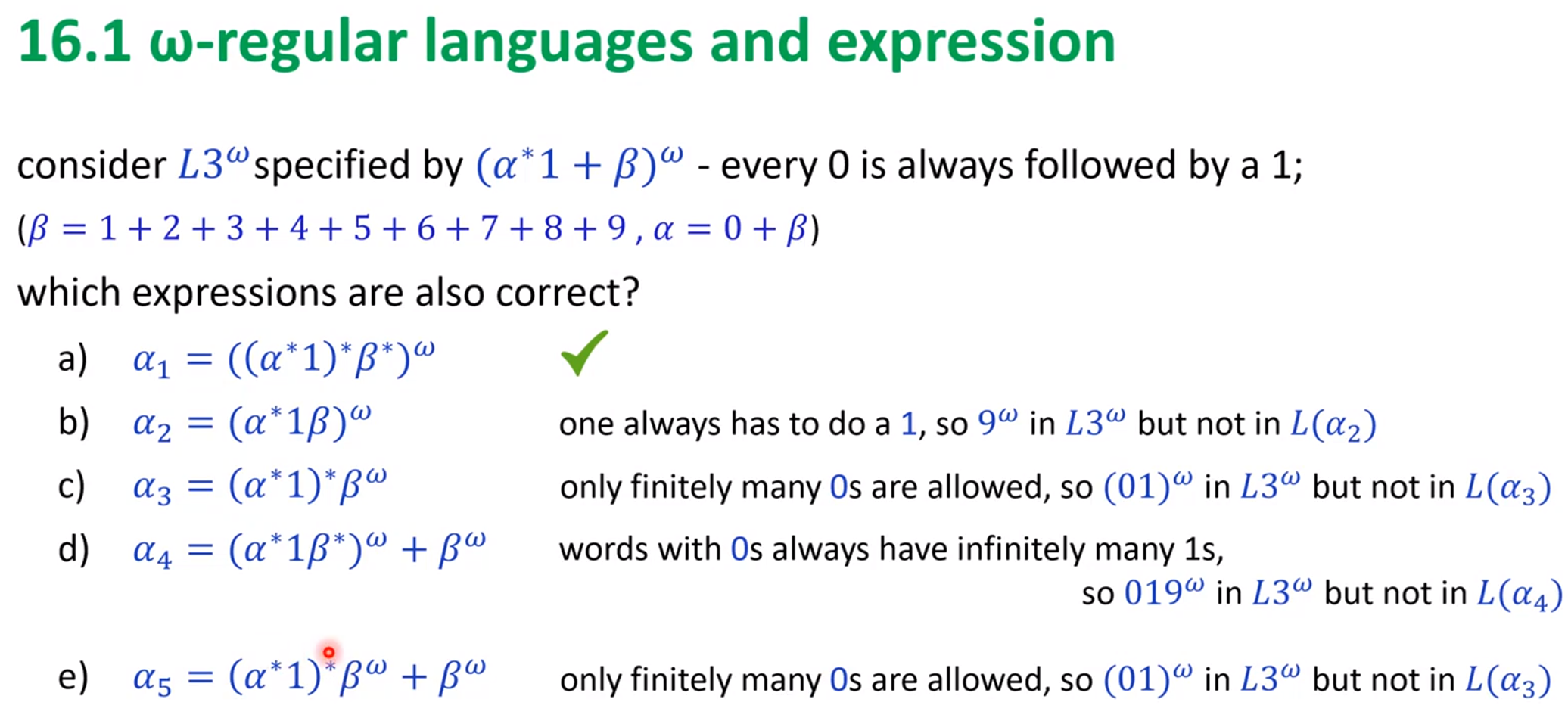
the * is all finite repetitions, whileinfinite repetitions, they are complementary.
Büchi Automata A.4.2
Topic: Finite State Machines and Automata
Büchi automaton - Wikipedia
either accepts or rejects some infinite inputs:
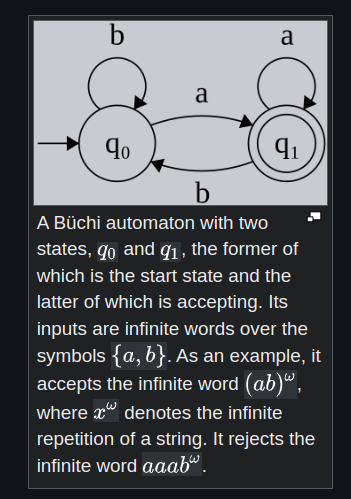
- indefinite automata…
- Büchi automaton is an NFA but with different acceptance conditions
-regular expressions and NB(Buchi)A both define precisely the class of -regular languages
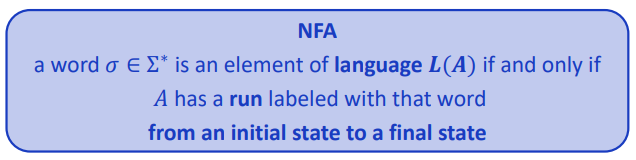
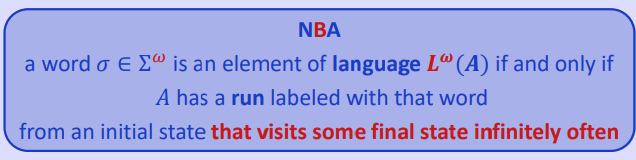
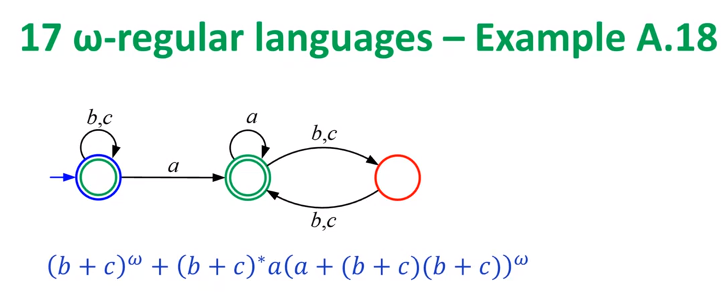
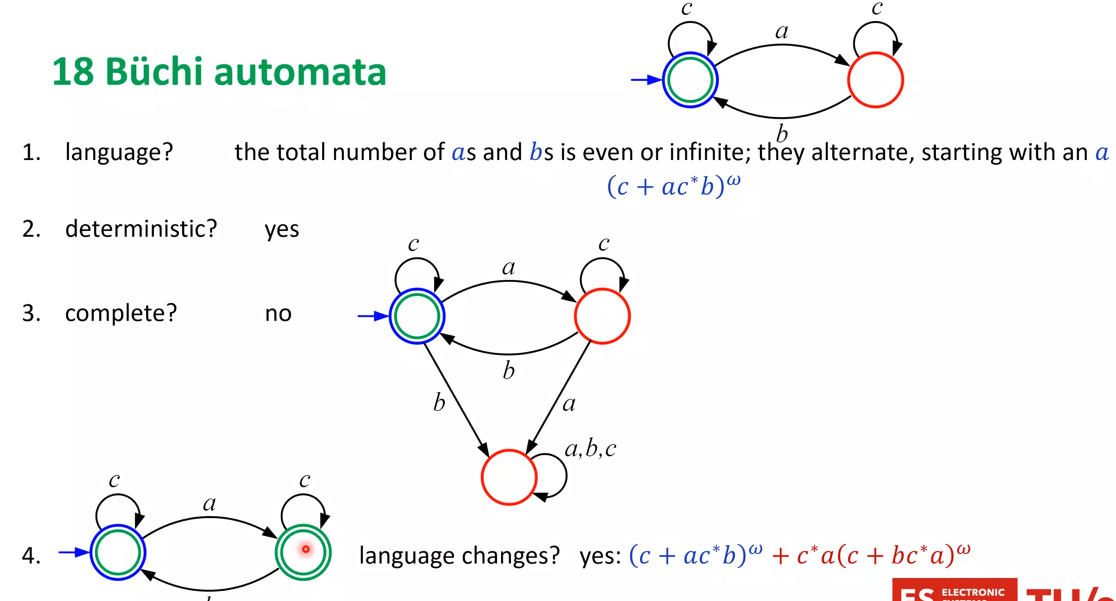
infinity happens in finite states…
complete means all symbols used…
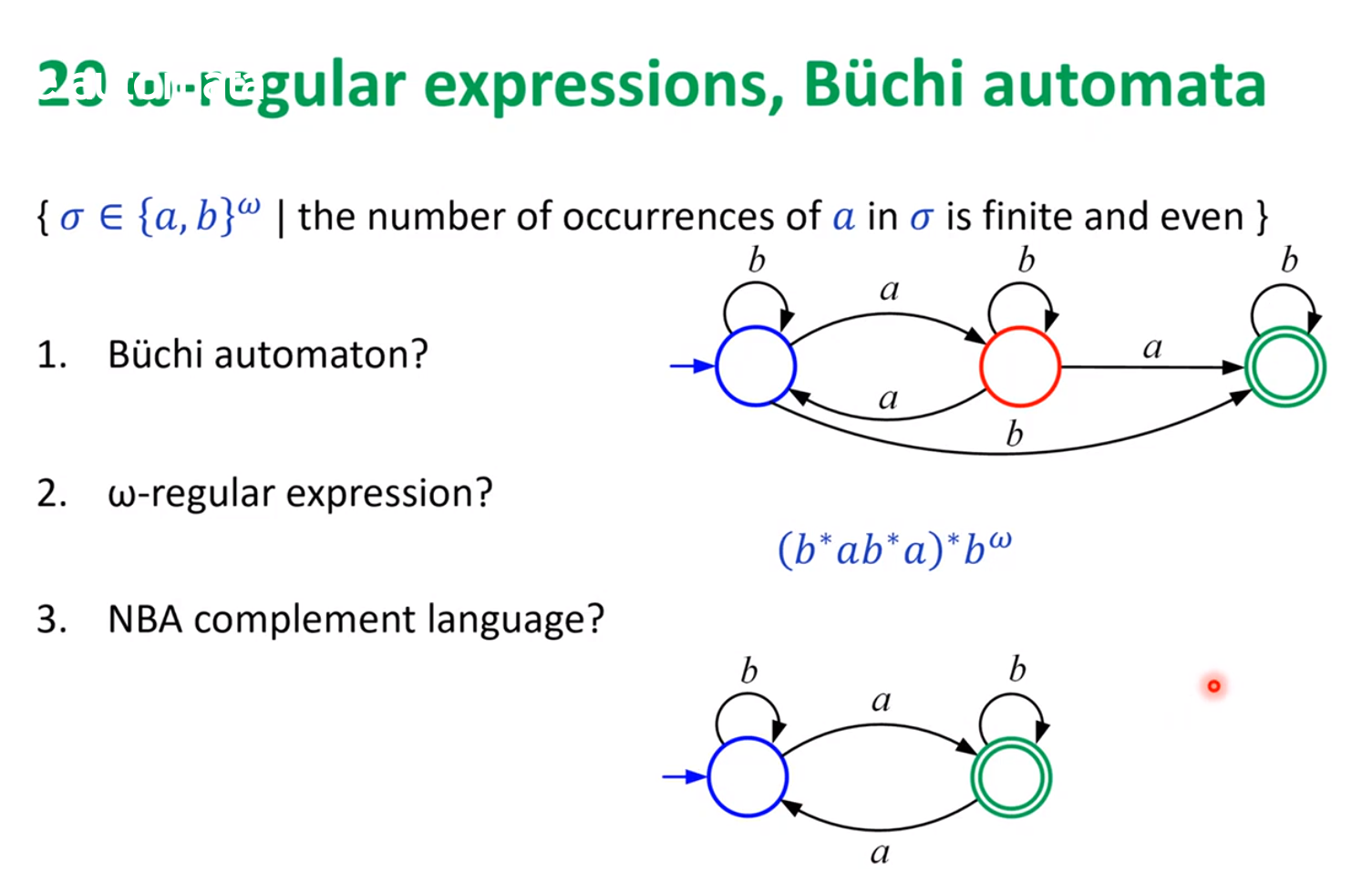
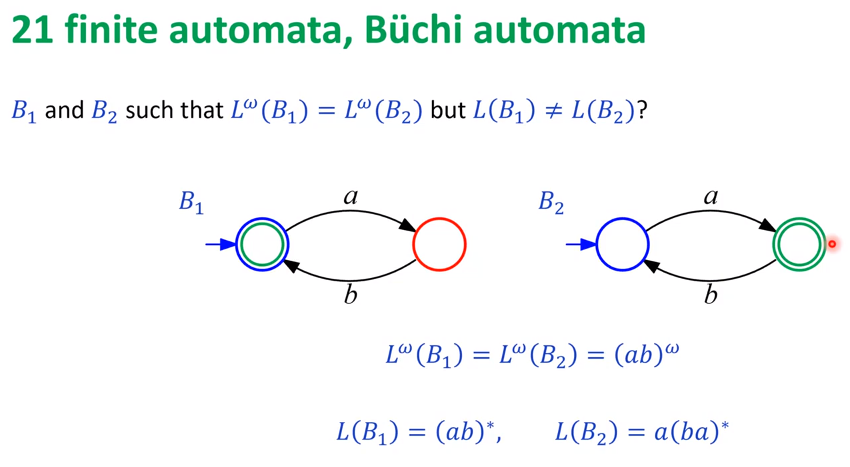
ending on a different final state makes a difference as shown above…
Week 3: A.4
Expressiveness A.4.3 & A.4.4
DBA: deterministic Buchi Automaton.
an
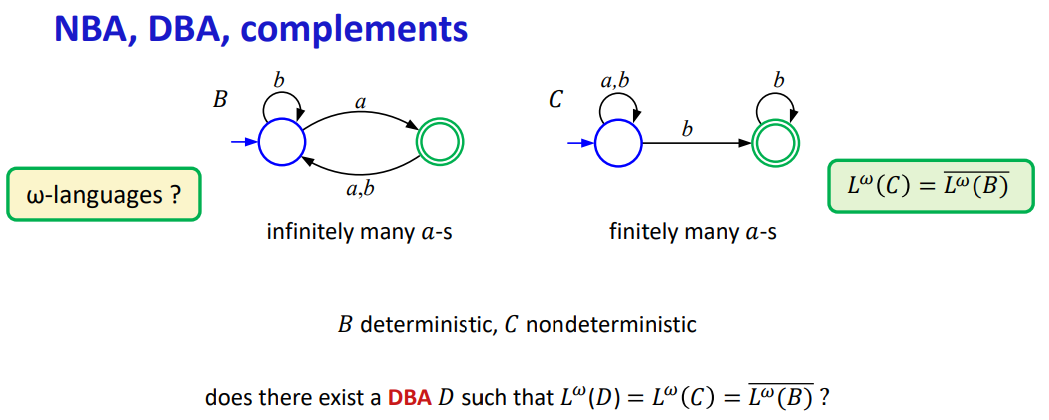
expressiveness of DBA:
- DBA are strictly less expressive than NBA
- deterministically Büchi-recognizable languages are not closed under development
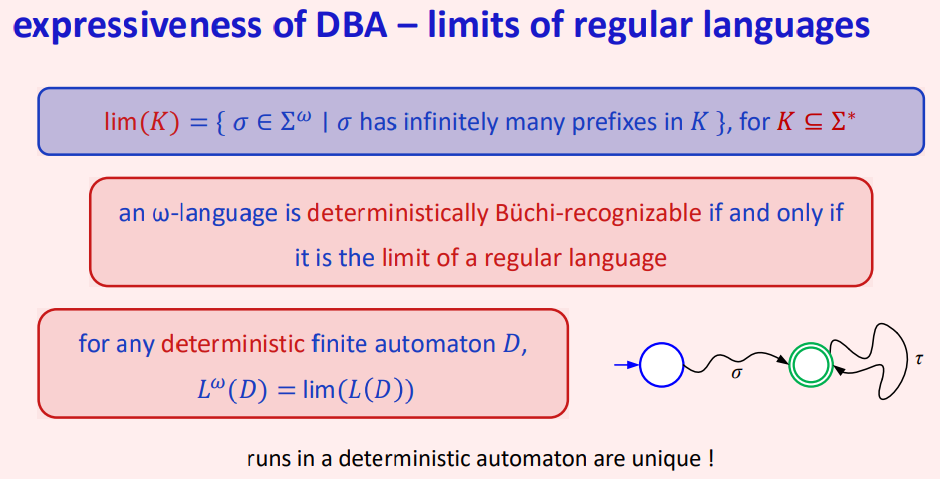
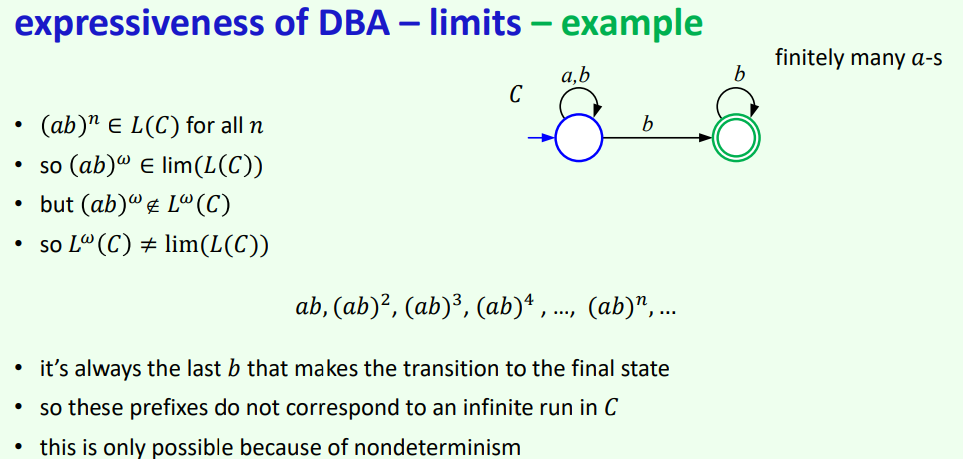
The above proves that DBA can only exists if there is limit of a regular language…
class of
non-regular
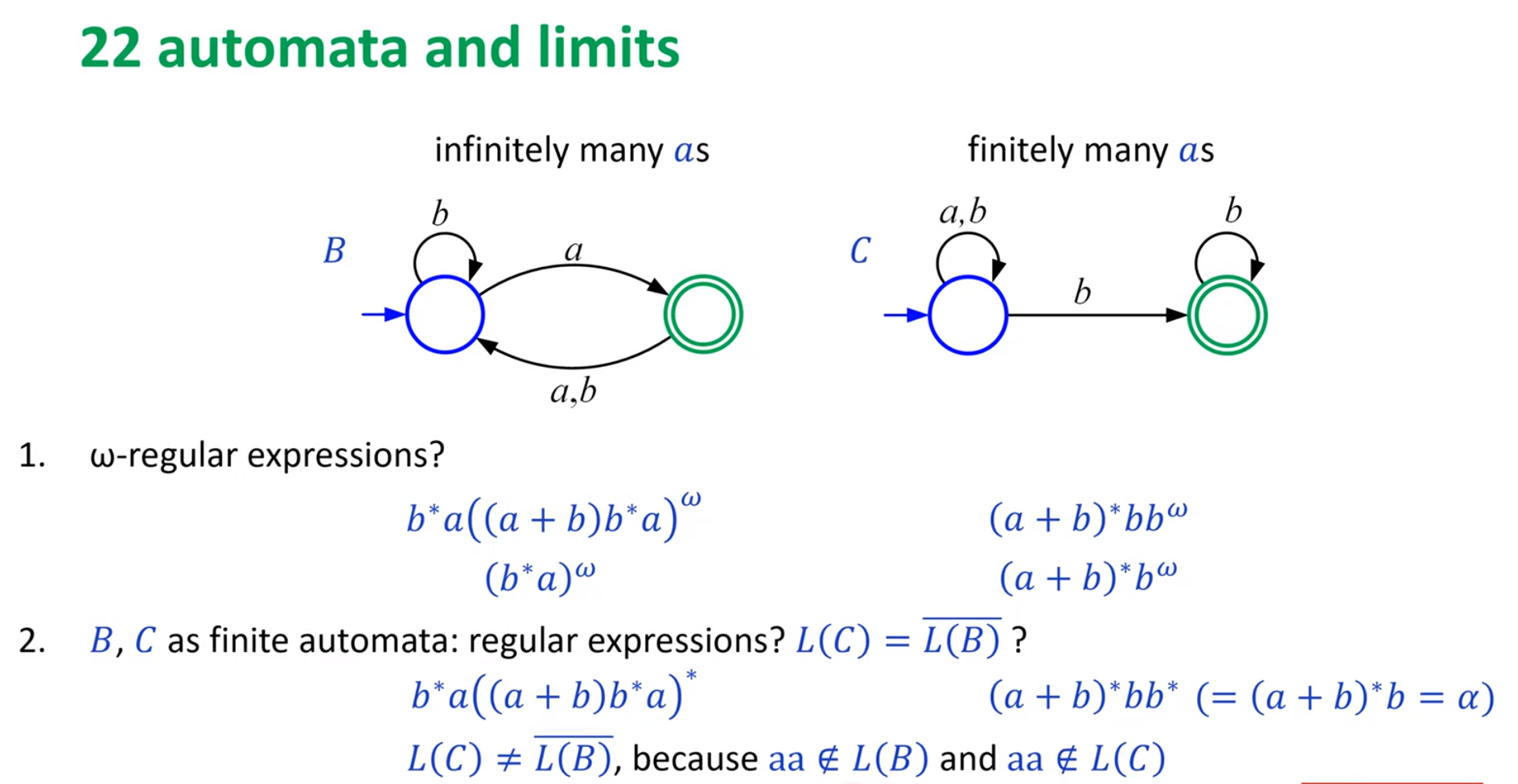
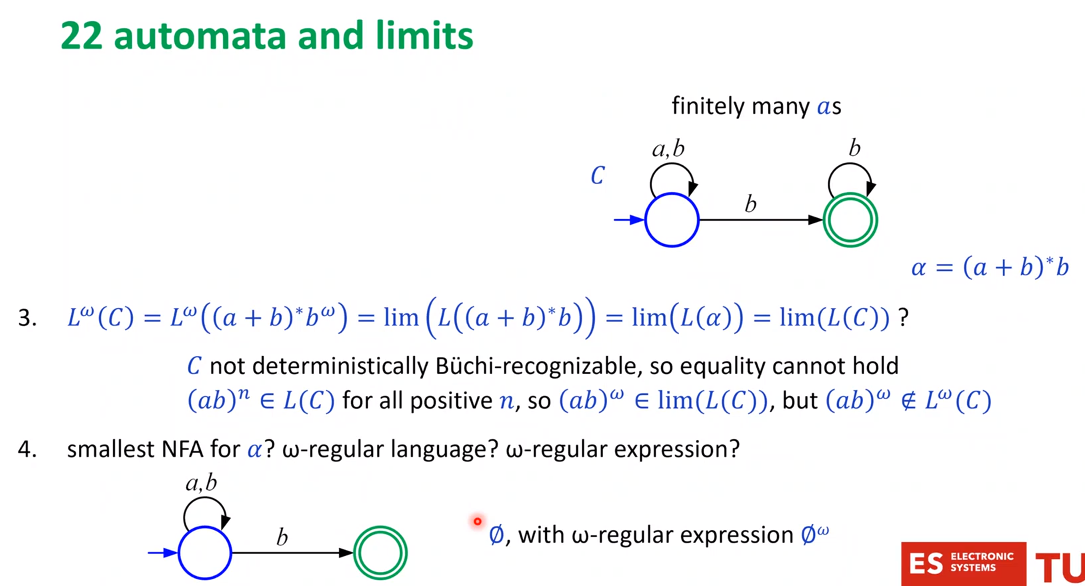
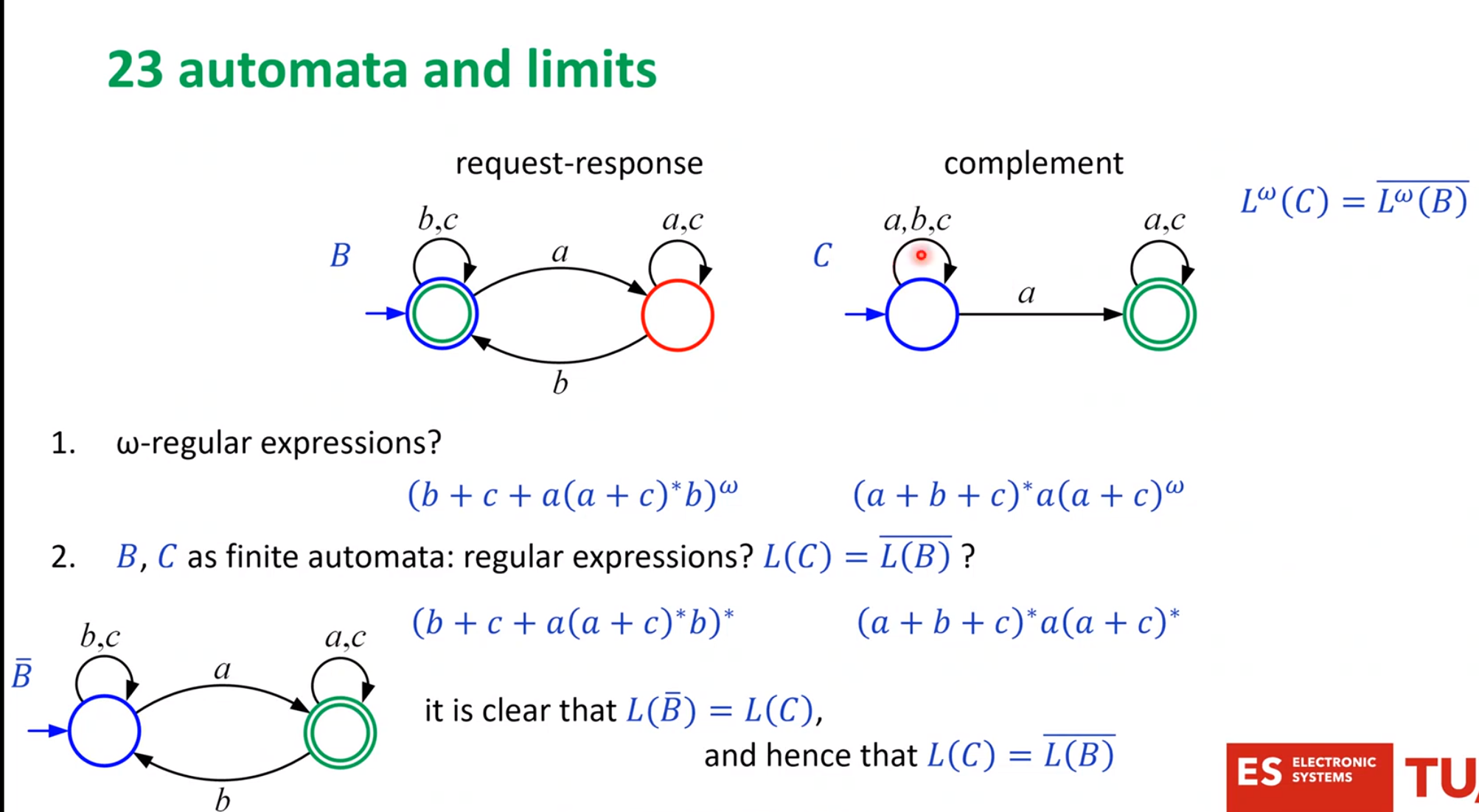
we can see that if languages are each others complements in infinite context IT DOESNT imply they are in finite context
!!! unbounded chain of finite words converges to an infinity allowing to say that
Conversions A.4.5
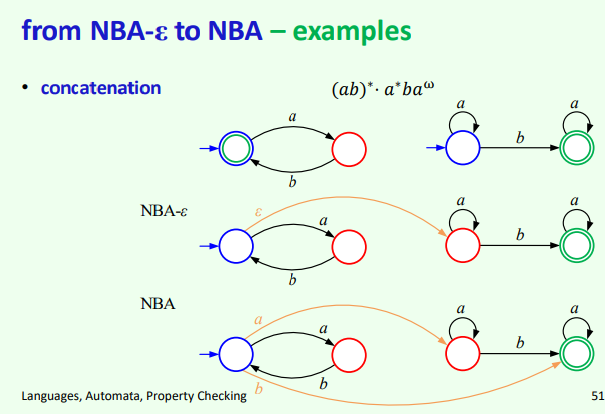
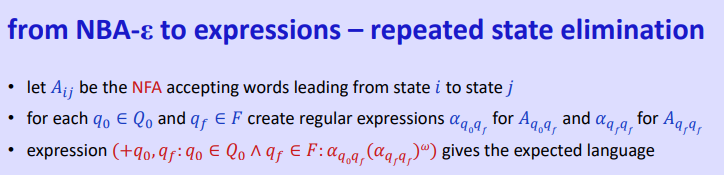
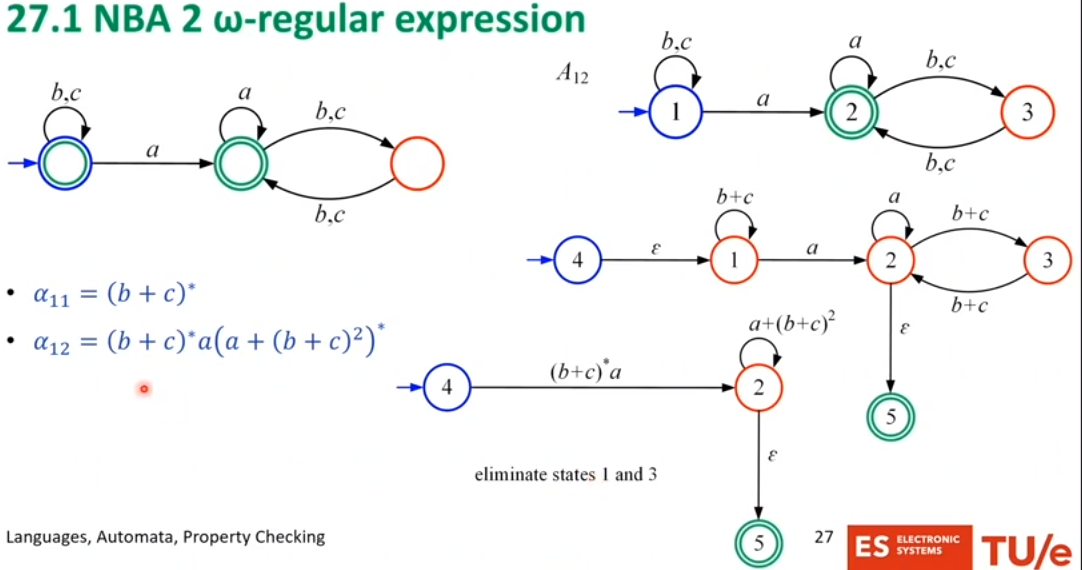
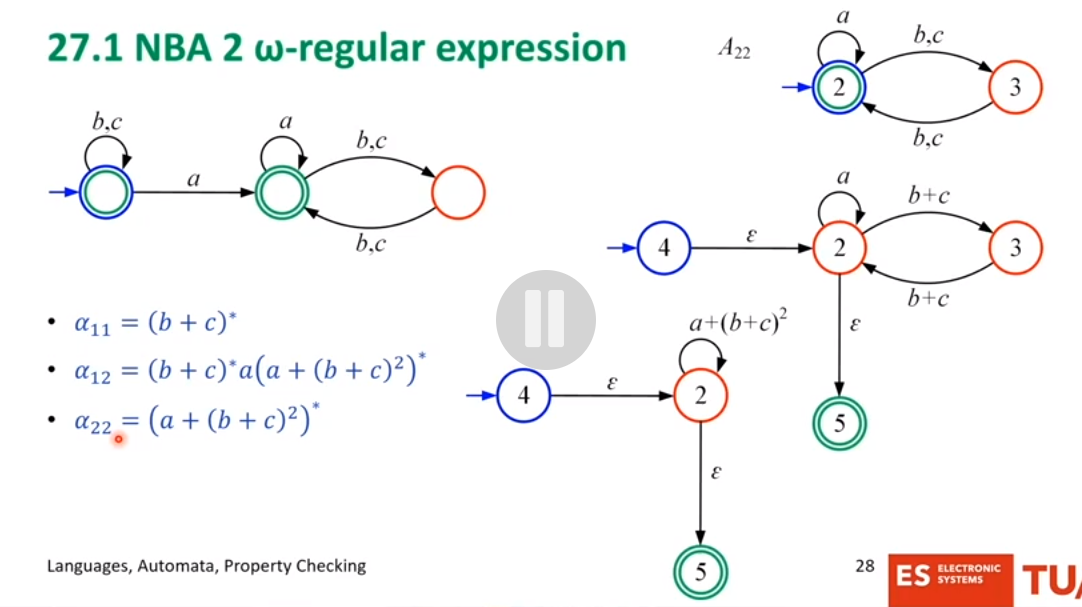
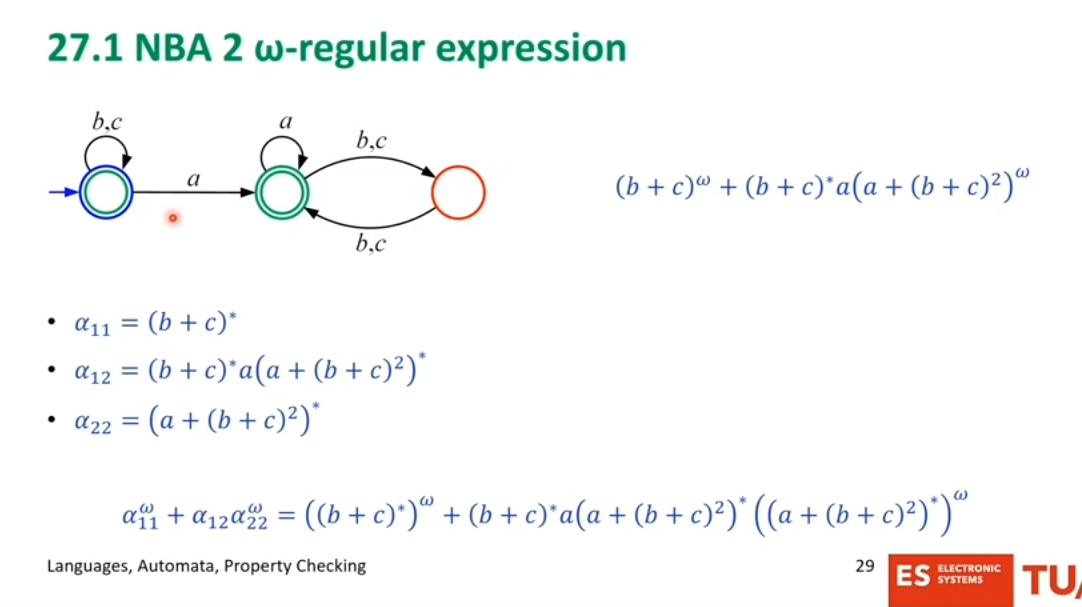
similar to finite word language conversions…
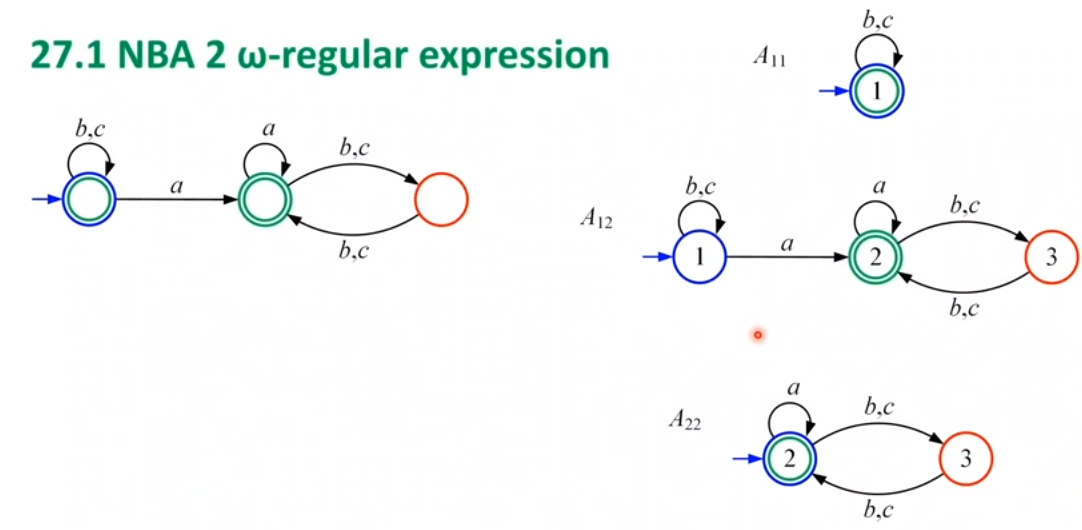
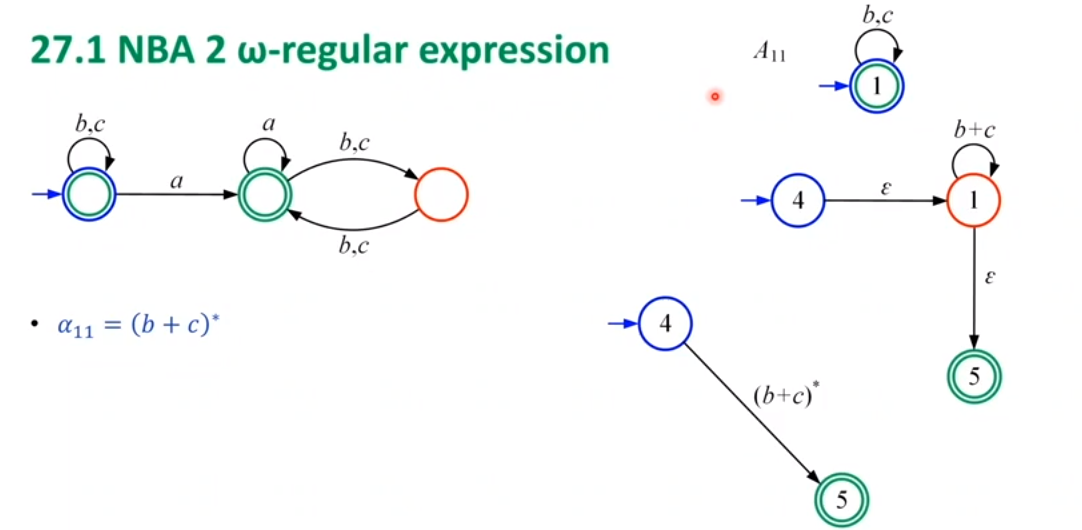
split into 3 parts, make sure they are epsilon included, and then start elimination.
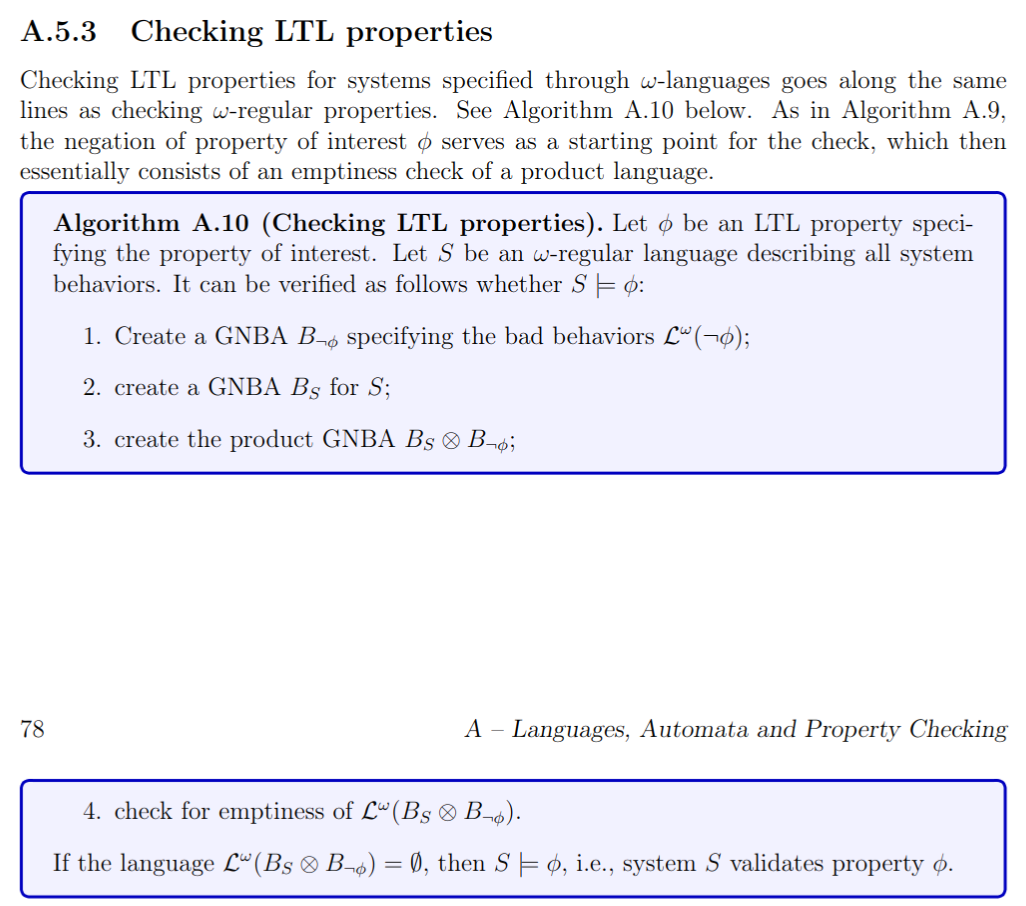
Property Checking A.4.7
- similar to finite language property checking…
- emptiness of a regular language can be checked by checking for the reachability of a final state in an automaton.
- But emptiness of an ω‐regular language can be checked by a nested depth‐first search on the automaton checking for the reachability of a final state and a cycle back to that final state.
- but complement of ω‐regular languages is not practical.
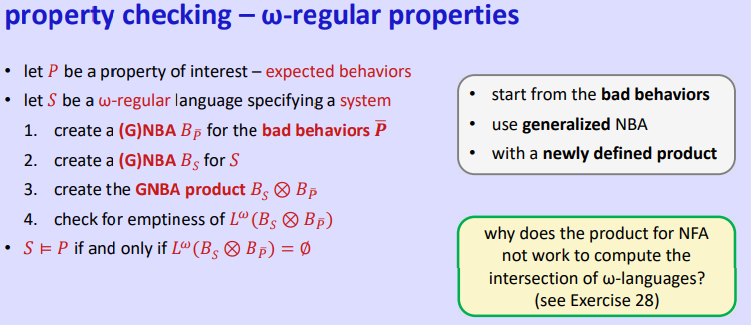
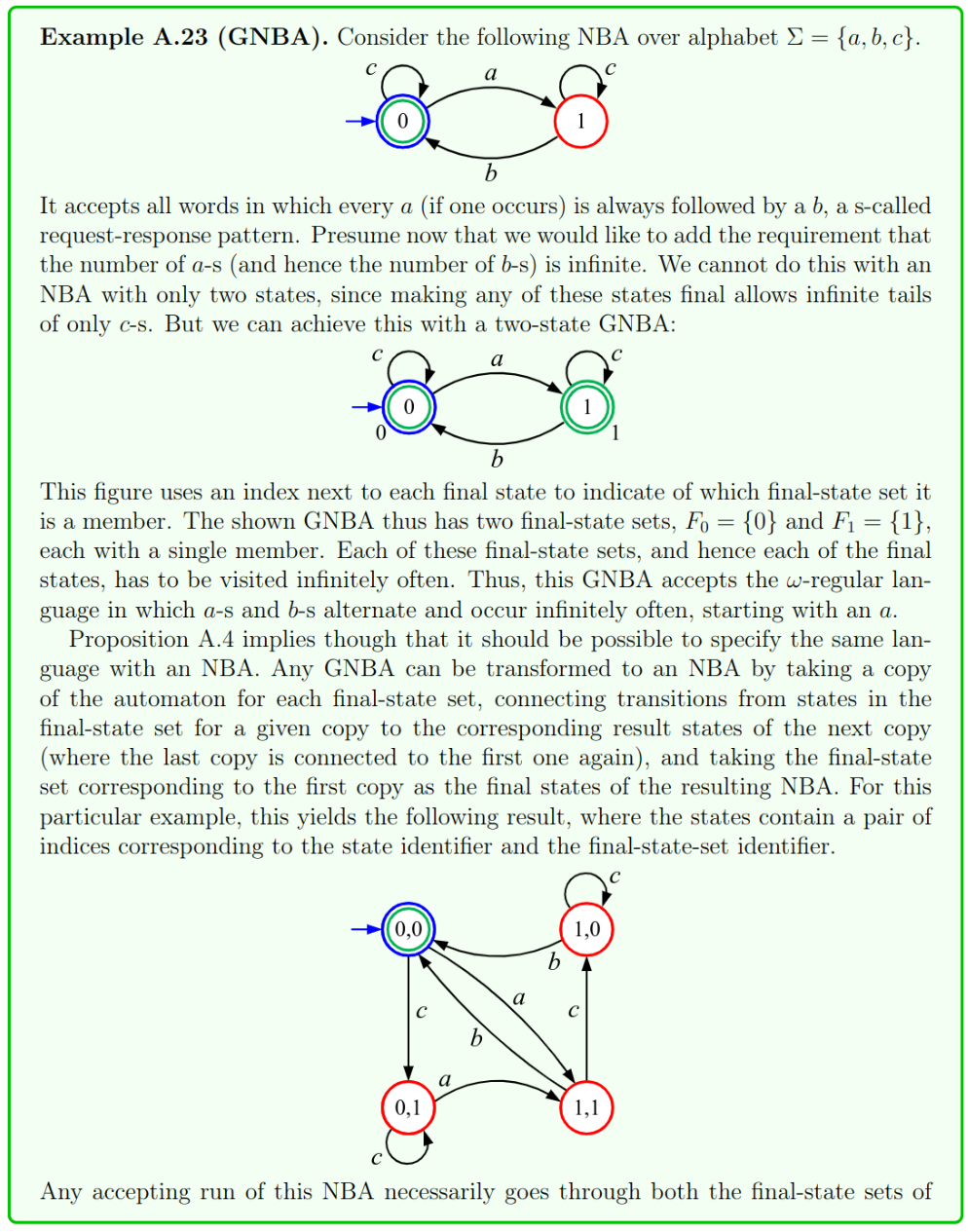

a GNBA is an NBA but with multiple sets of final states…
GNBA vs NBA:
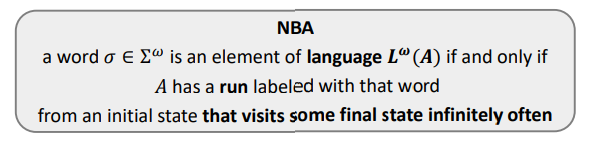
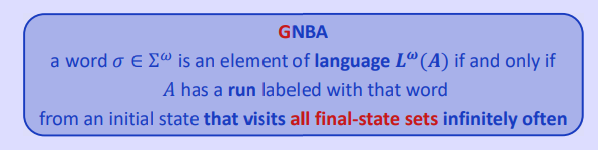
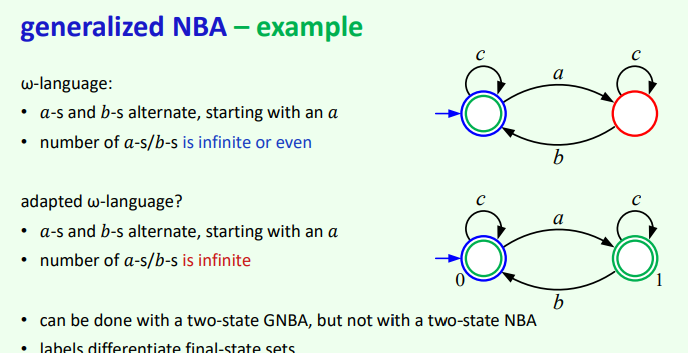
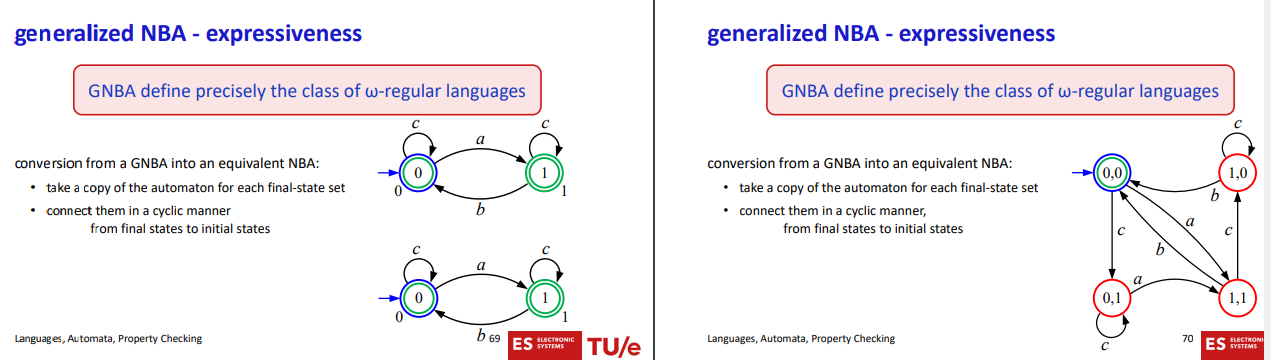
empty language means that there is at least one state which is not visited infinite amount of times…
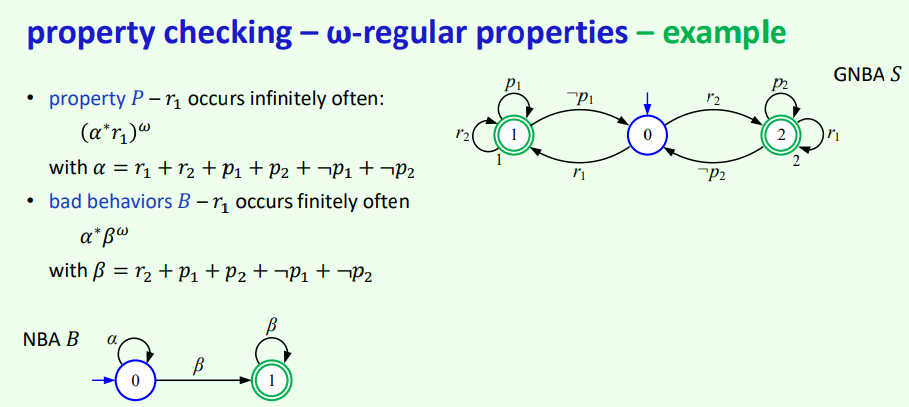
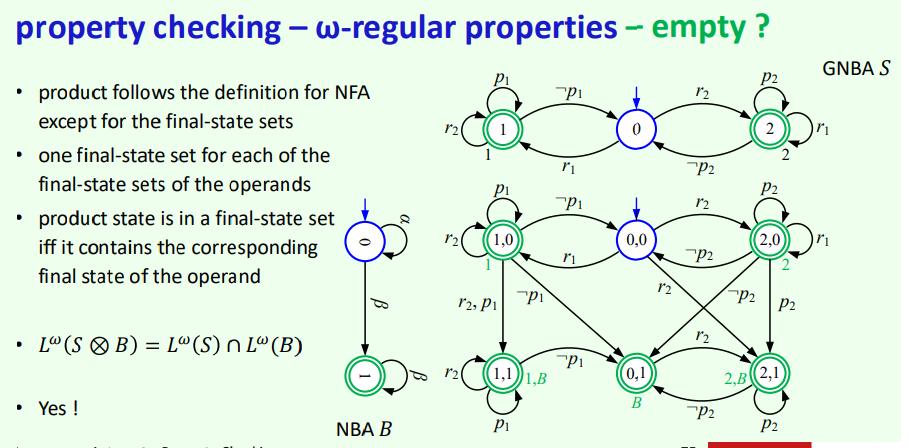
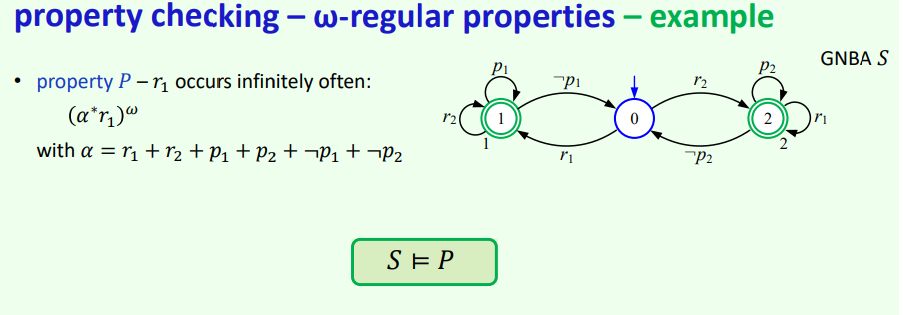
Week 4: A.5
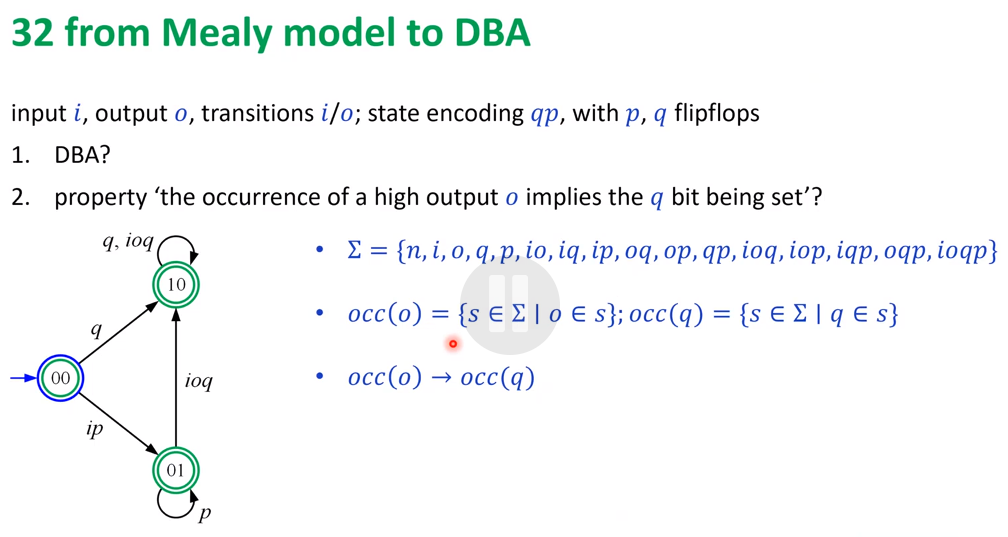
Logic and Property Checking A.5.1 & A.5.3
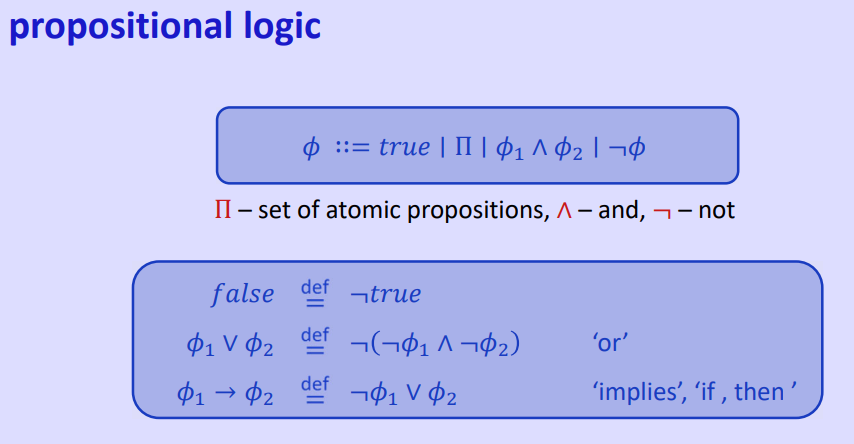
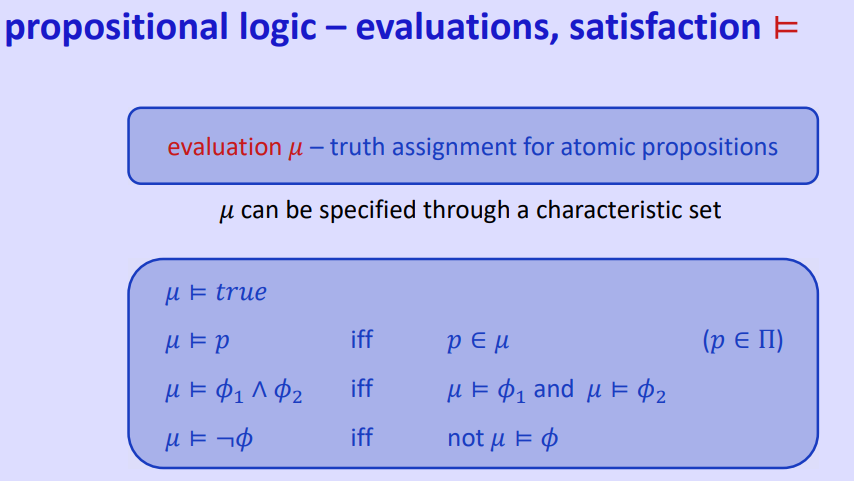
propositions over an alphabet of symbols
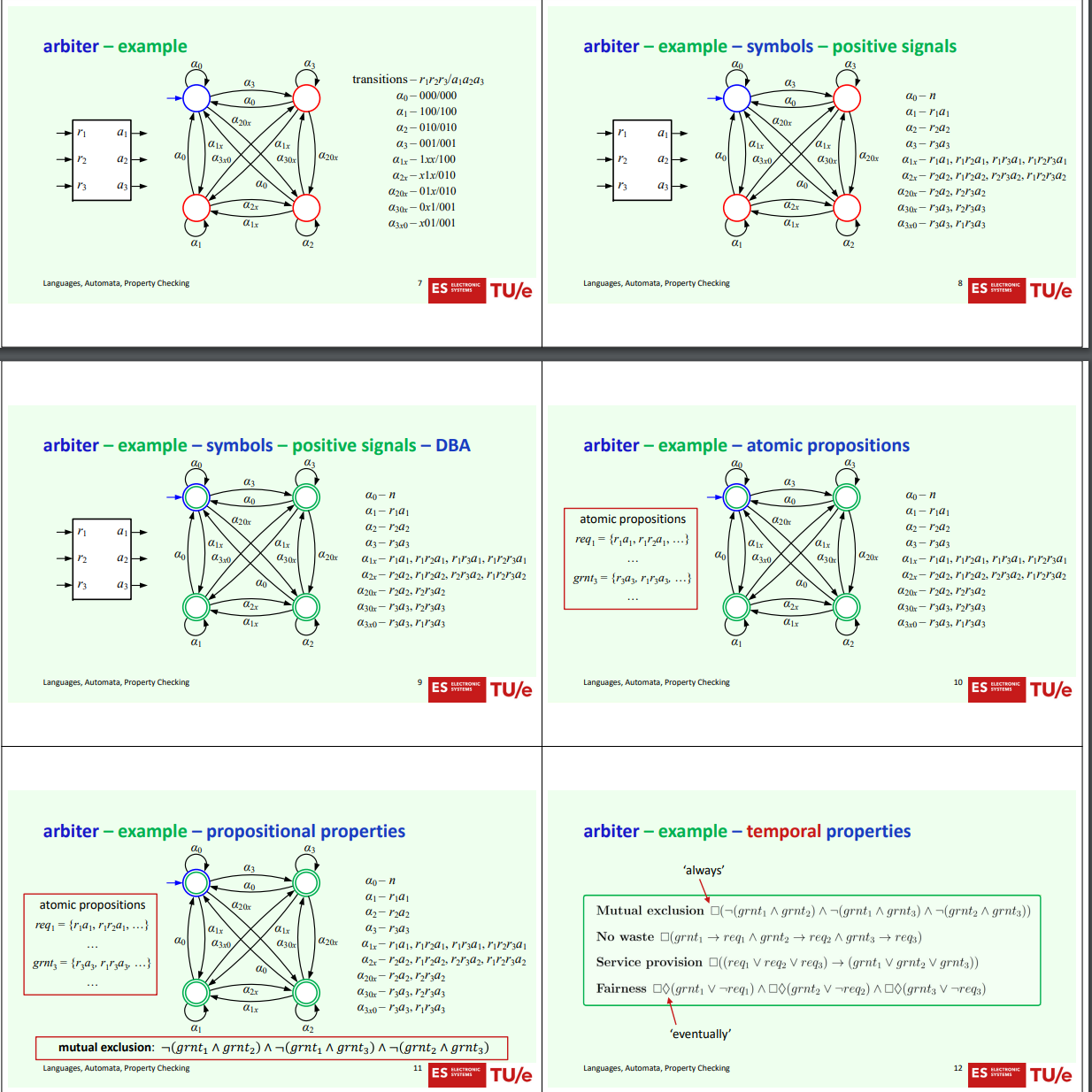
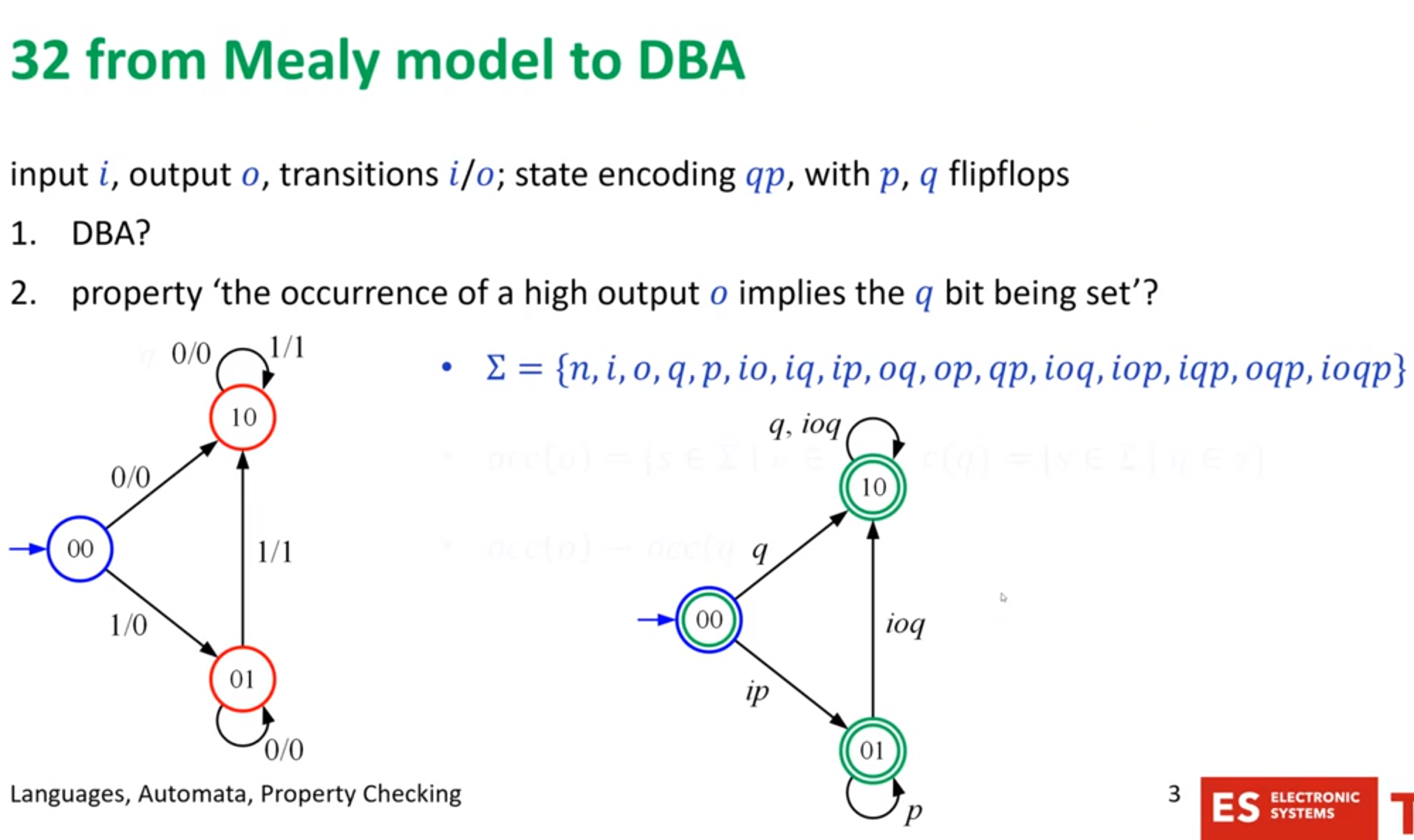
- atomic propositions Π are sets of symbols from Σ characterizing those symbols that satisfy the proposition
Module B: Markov Modeling, Discrete-Event Simulation
Week 4: B.1 & B.2 & B.3
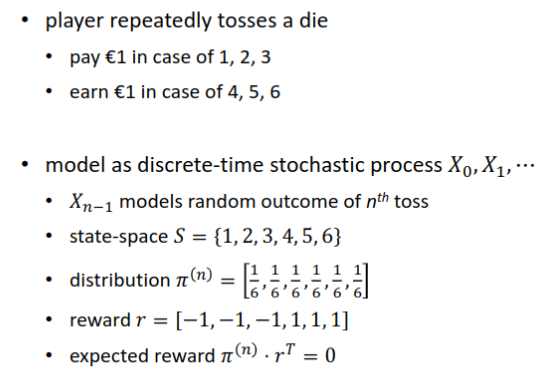
Discrete-time Stochastic Processes B.1
Topic: Probability and Random Variables
random state of a system at time finite set of states, state-space probability that system in state at time where realization of probability distribution of

reward and random variable denotes reward that is earned at time set of possible realization of probability reward earned at expected reward earned at and is row vector also
sum of all values that can occur, of the value that occurs, times the probability that that value occurs. Expected value probability…
Markov Chains B.2
Topic: Probability and Random Variables
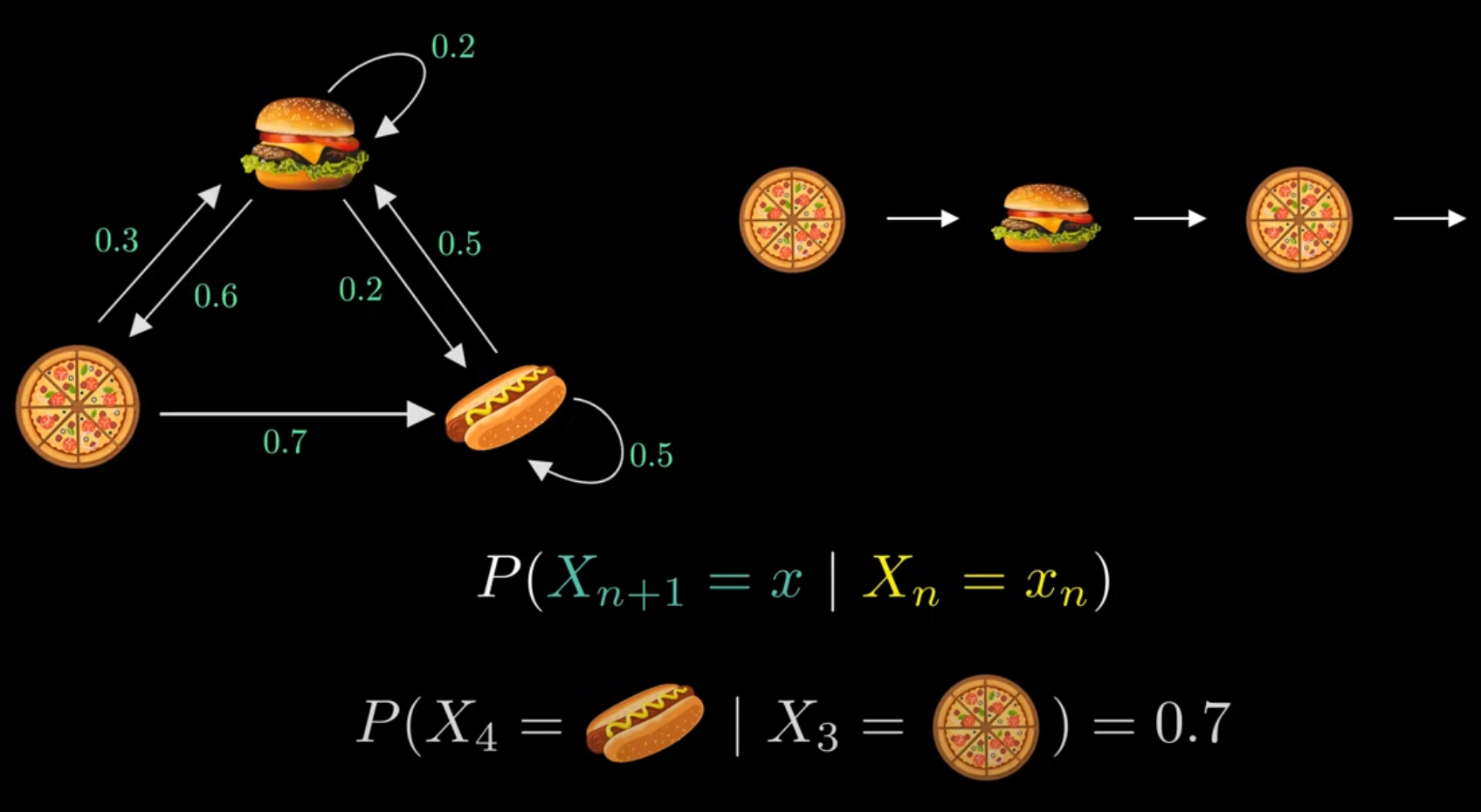
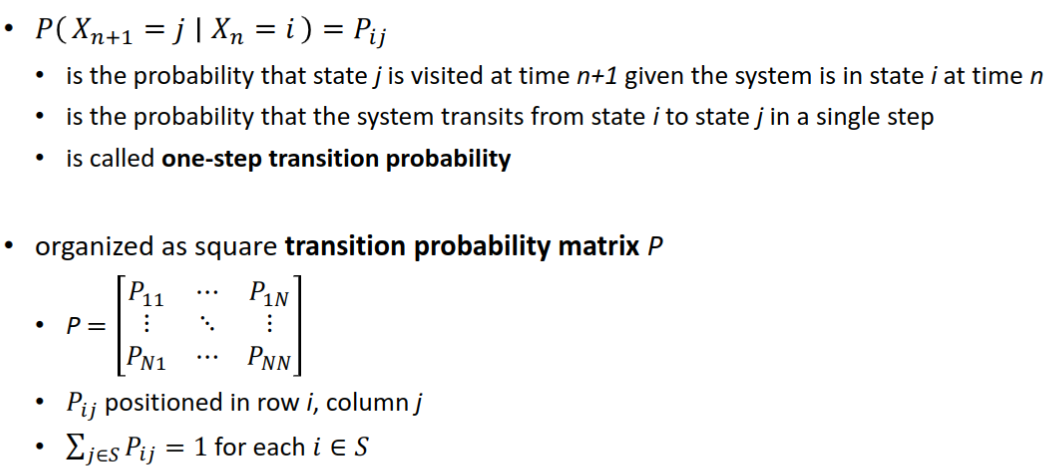
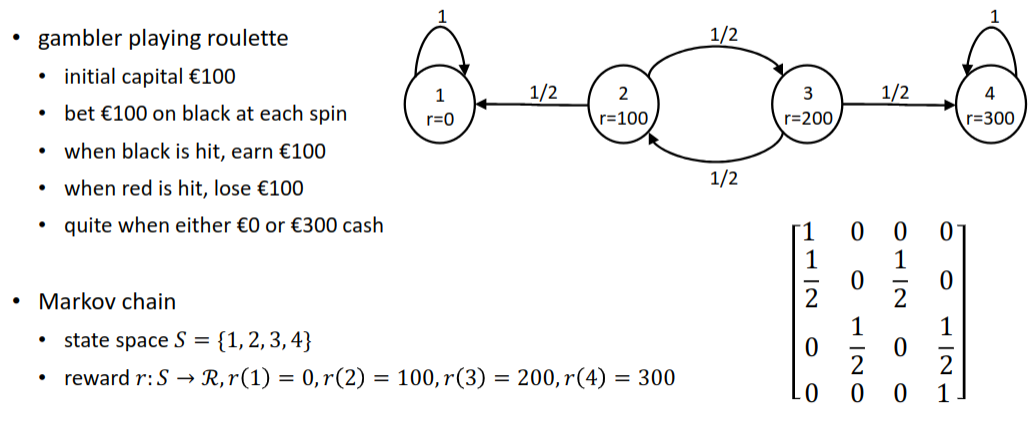
markov chain is time homogeneous
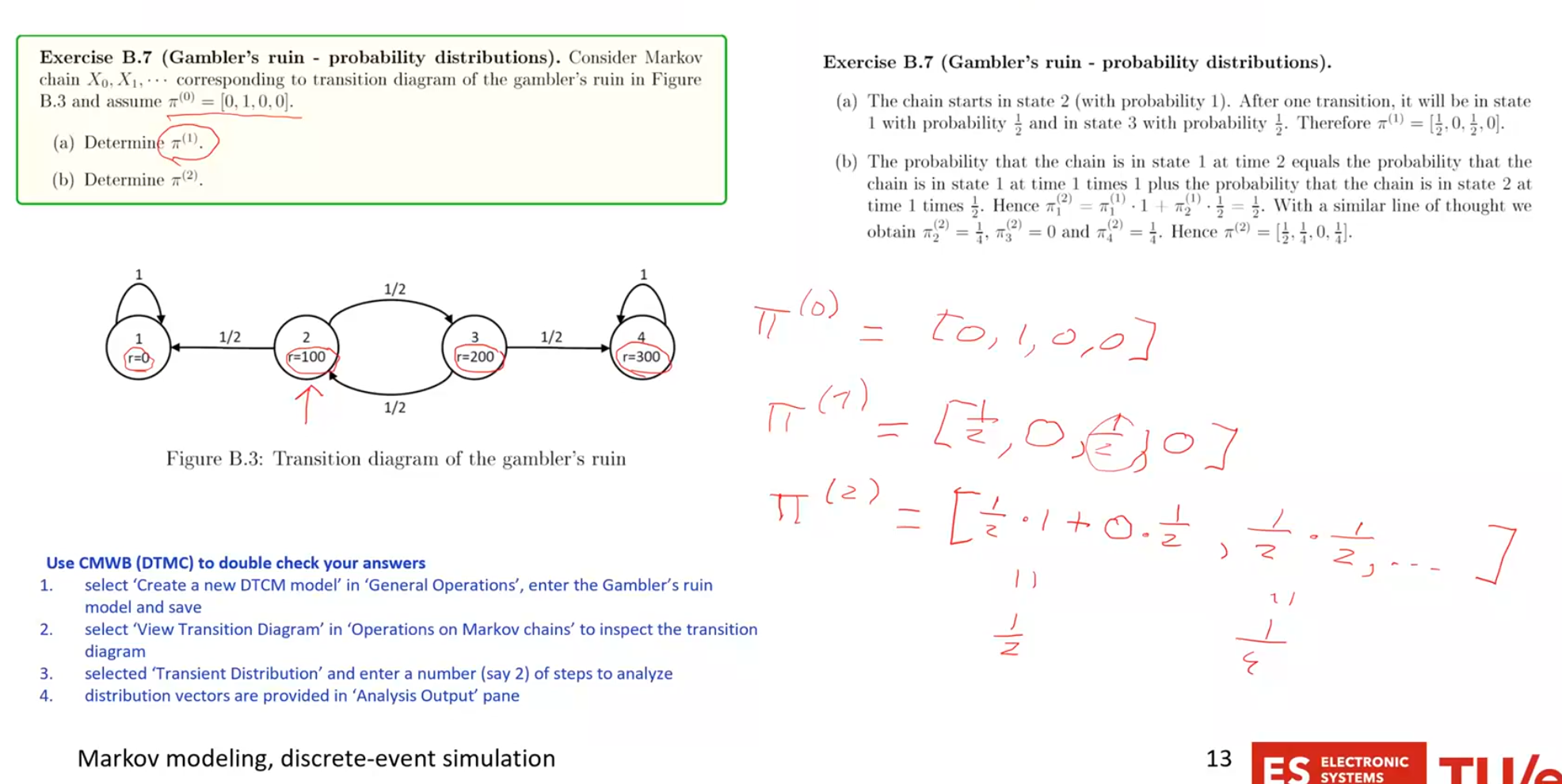
Transient Analysis B.3
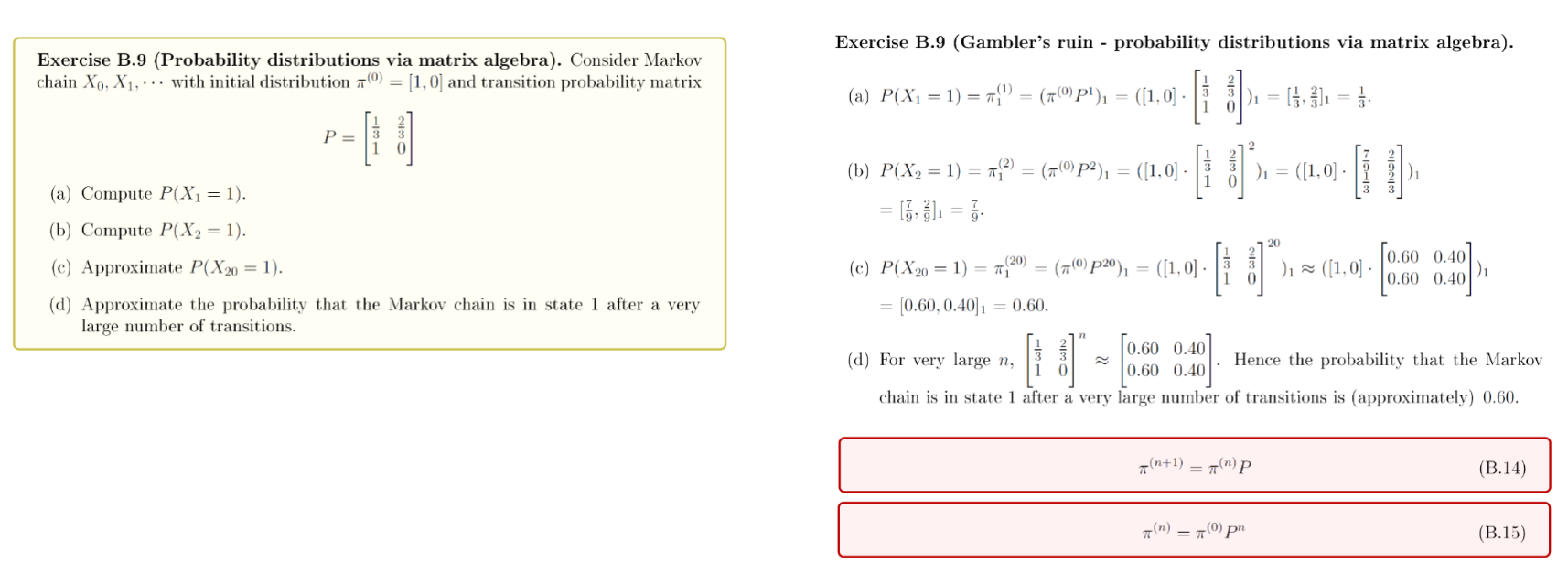
- law of total probability:
- So distribution vector:
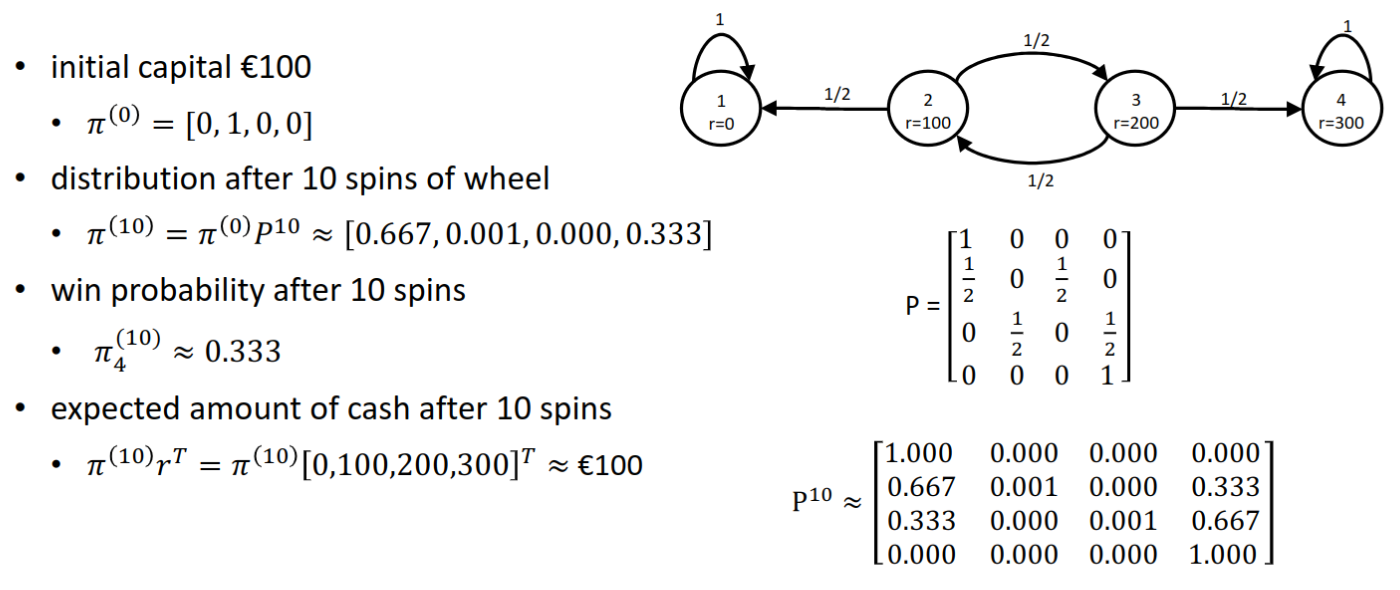
Transition Probability of Something Occurring:
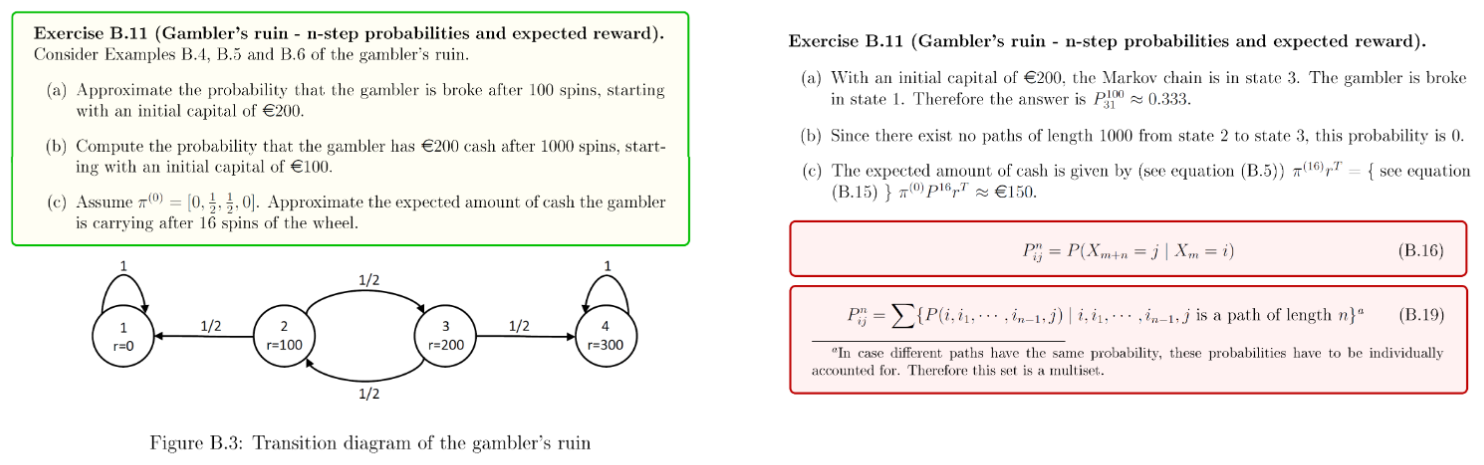
- n-step transition probability from i to j:
- sum of probabilities of paths:
- sum of probabilities of all paths from
to of length - path is a sequence of states
number of transitions made
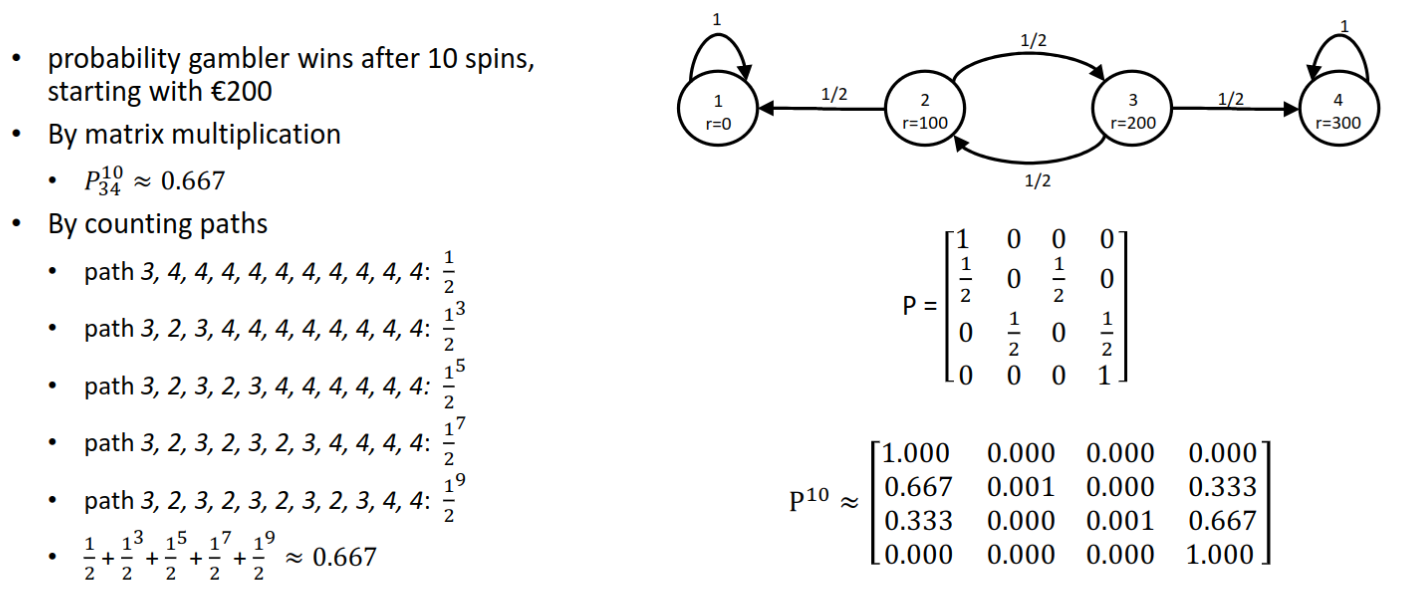
(row(i) 3 column(j) 4) = 0.667
- sum of probabilities of all paths from
Week 5: B.4 & B.5 & B.6
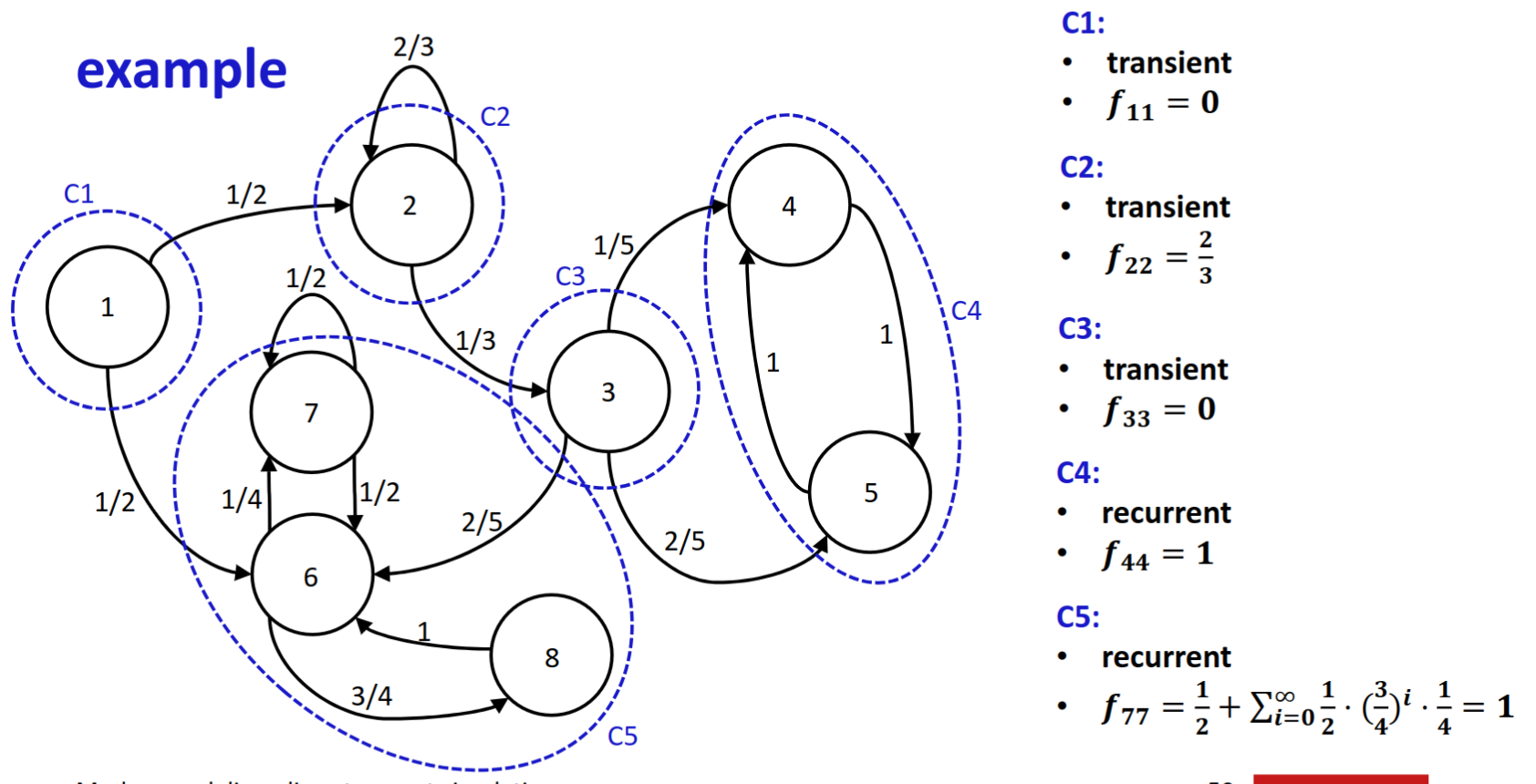
State Classification B.4
-
-
means start atand return to -
recurrent iff
infinitely returns in one or more steps -
transient iff
eventually won’t be visited -
both are class properties also could be closed
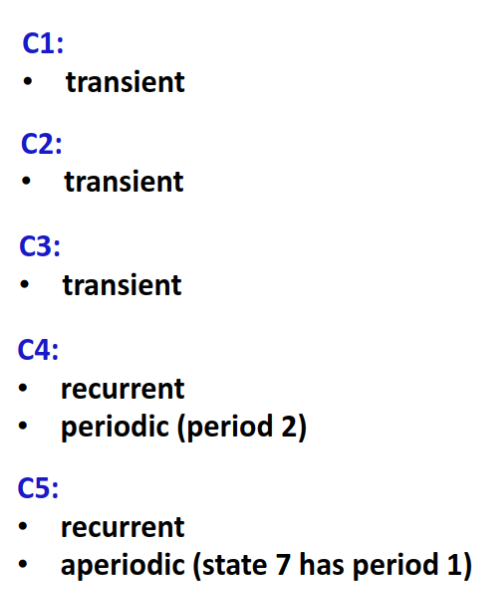
-
periodic
if visited not visited -
aperiodic
always visited from time -
also class properties
-
aperiodic class
and all states →
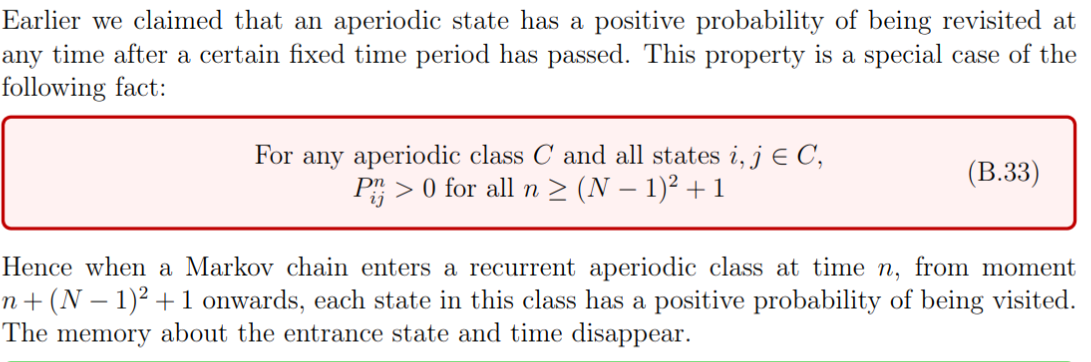
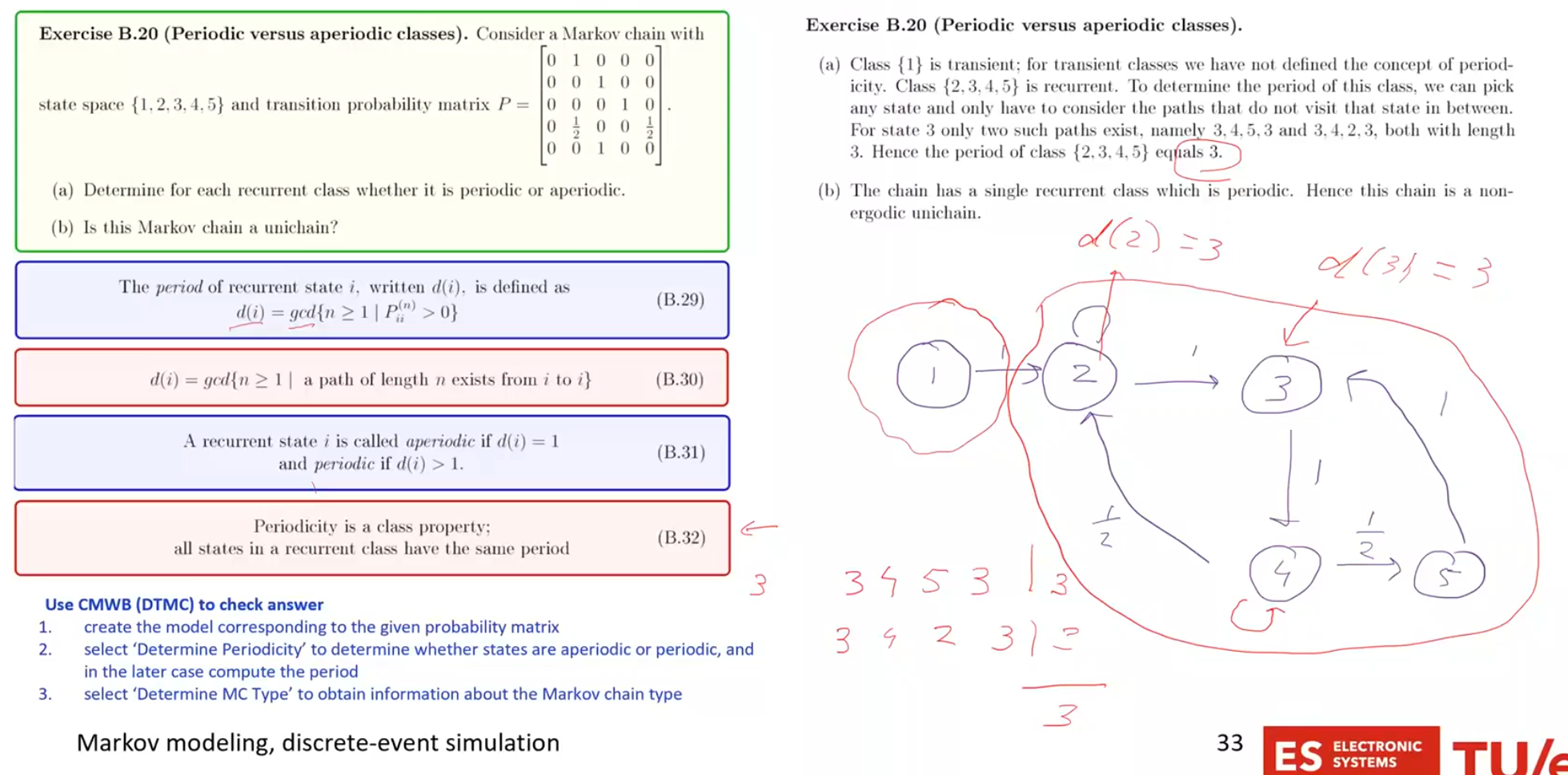
if recurrent state with a self loop then → aperiodic otherwise periodic
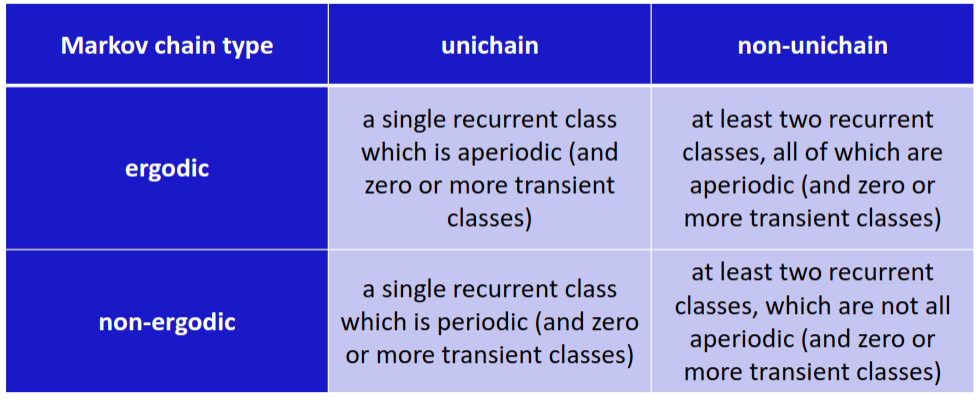
- ergodic recurrent & aperiodic
- unichain single recurrent & zero or more transient
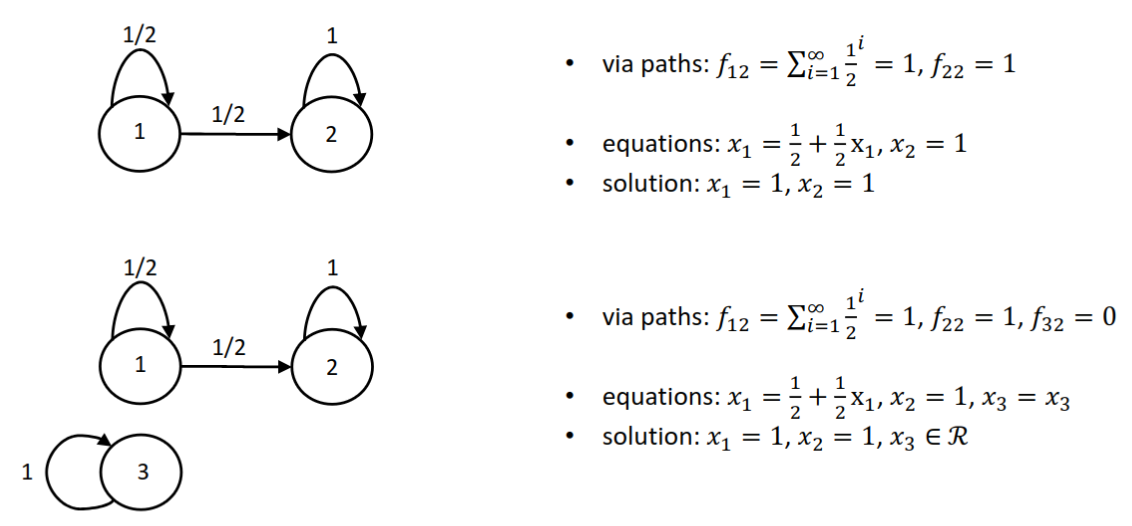
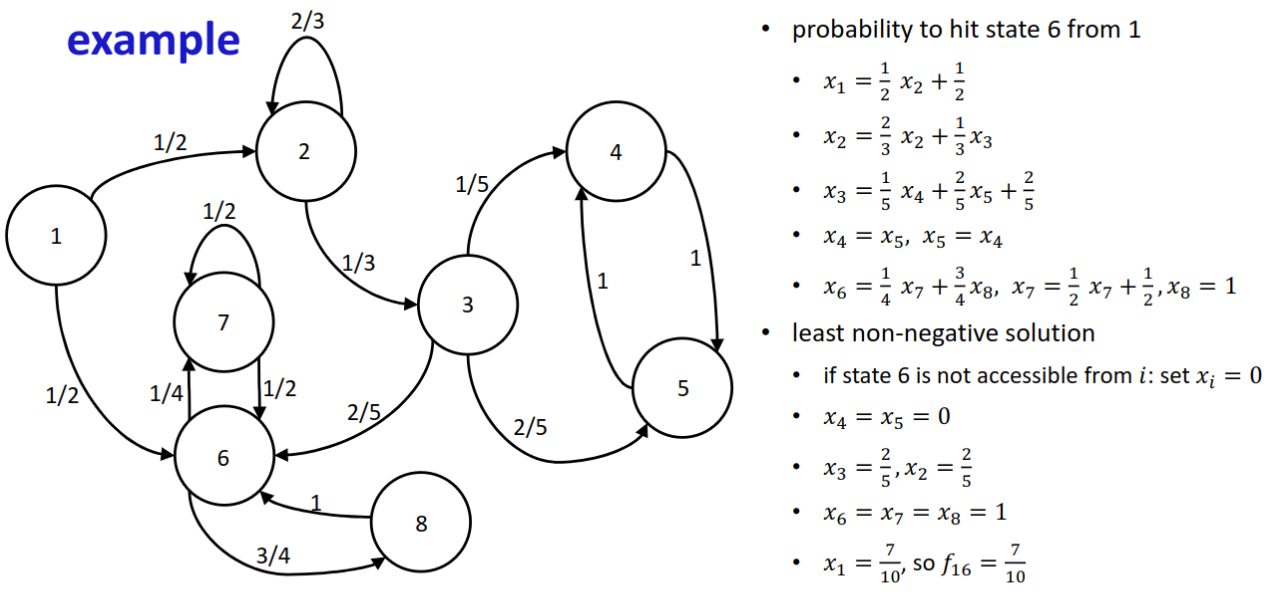
Hitting Probabilities B.5
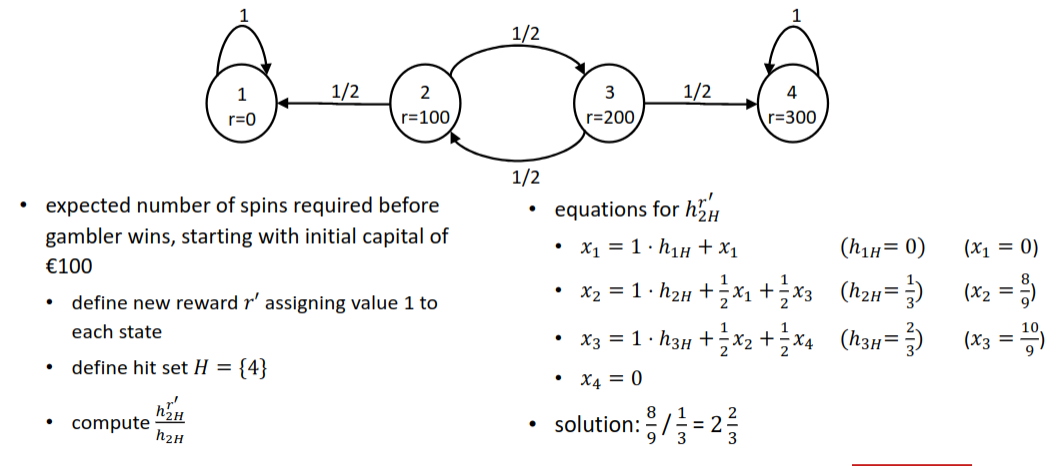
- hit probability that state
ever visited starting - system of linear of equations as solution
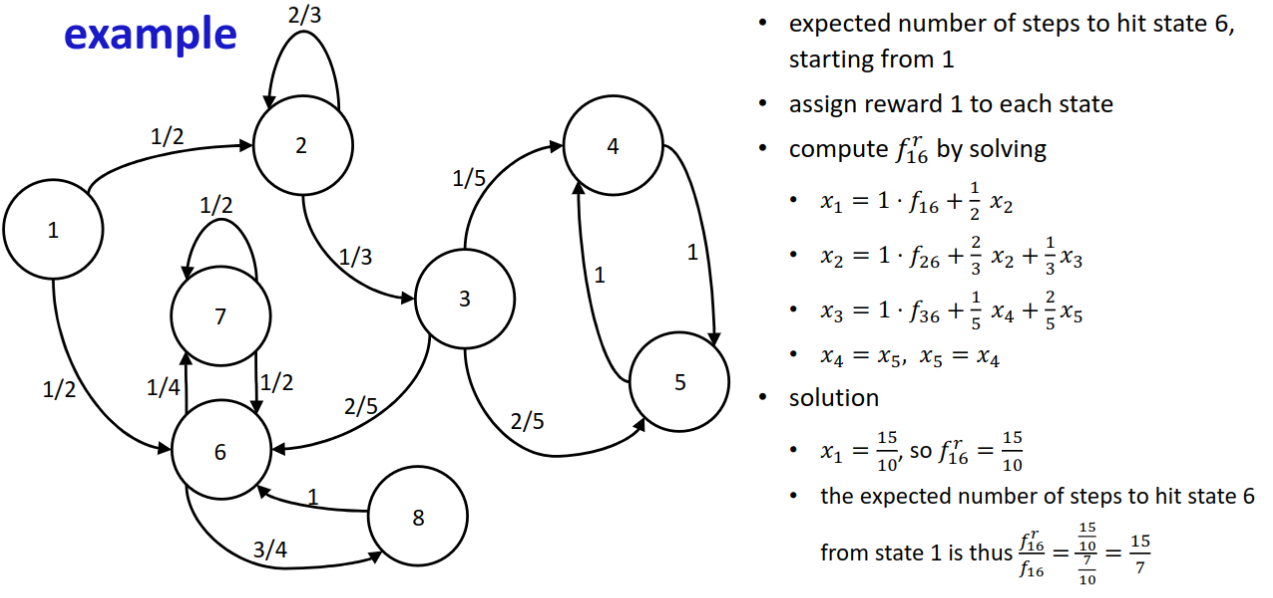
probability-weighted average of cumulative rewards
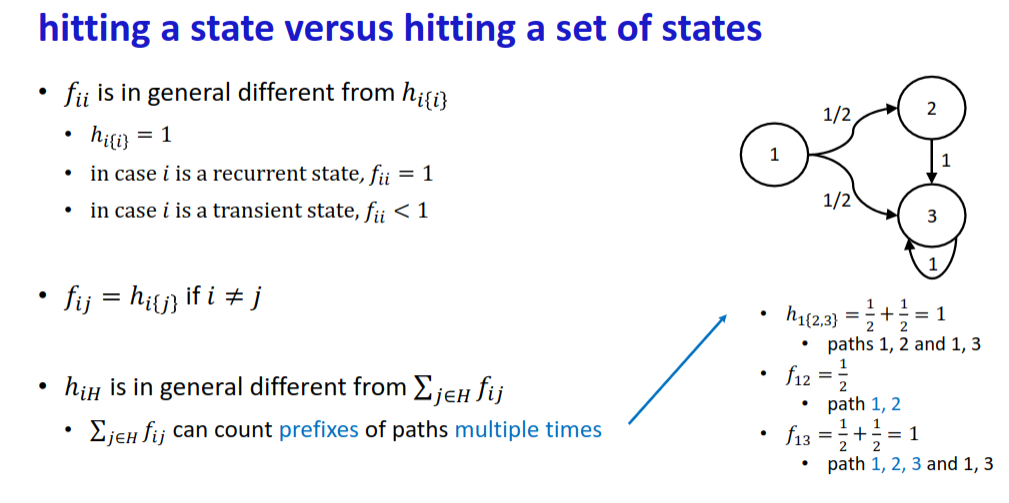
set of states:
probability to hit a set of states


Long-run Analysis B.6
-
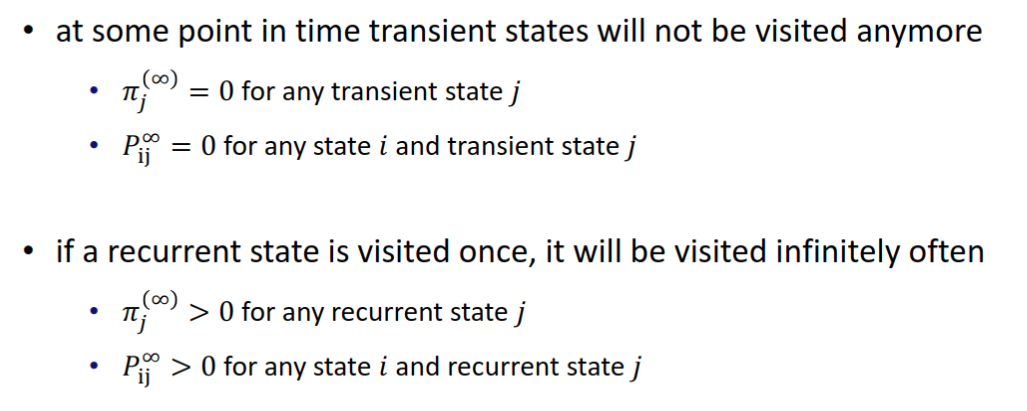
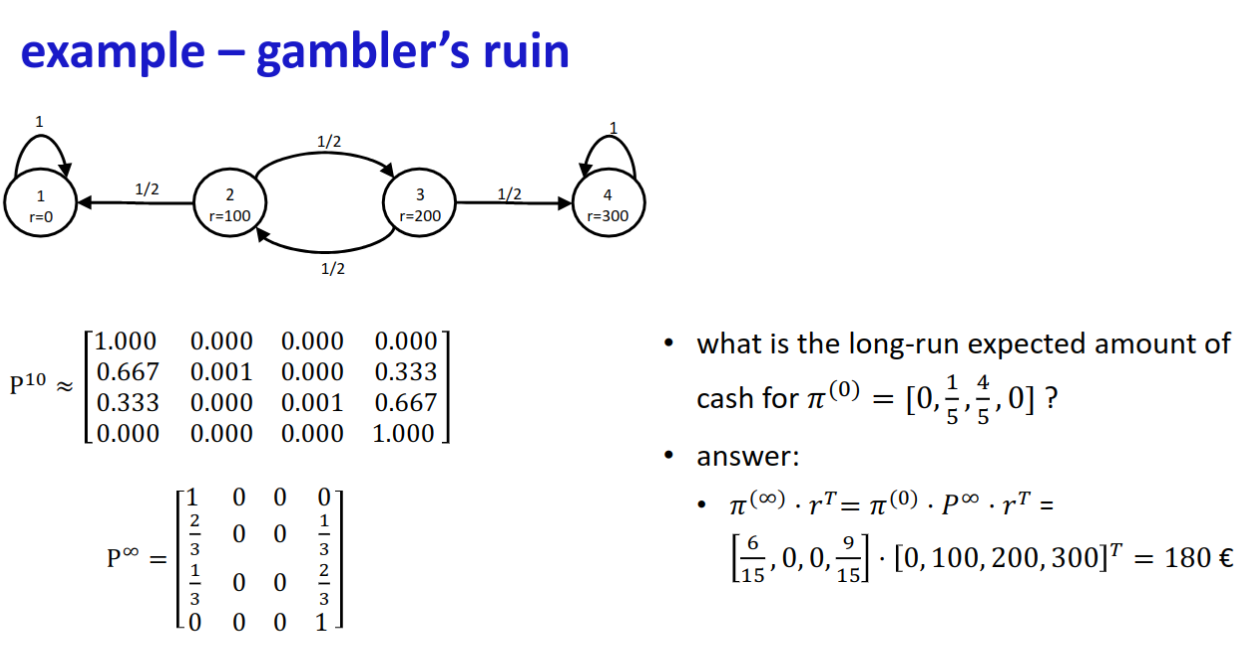
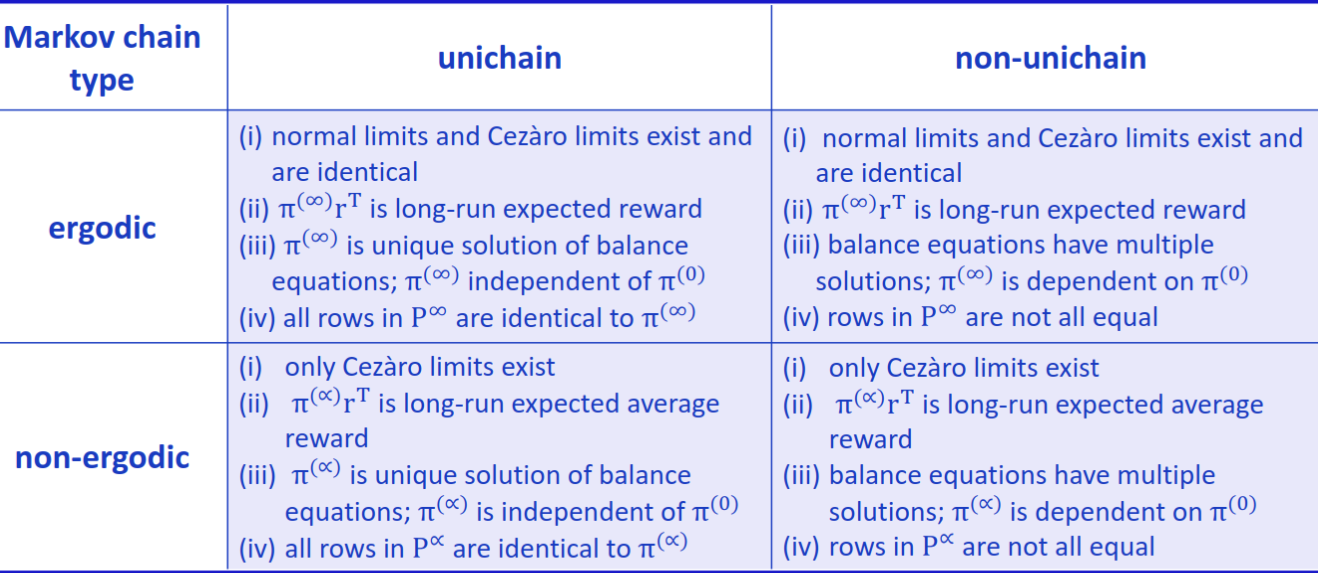
converge in distribution: ergodic unichain
-
-
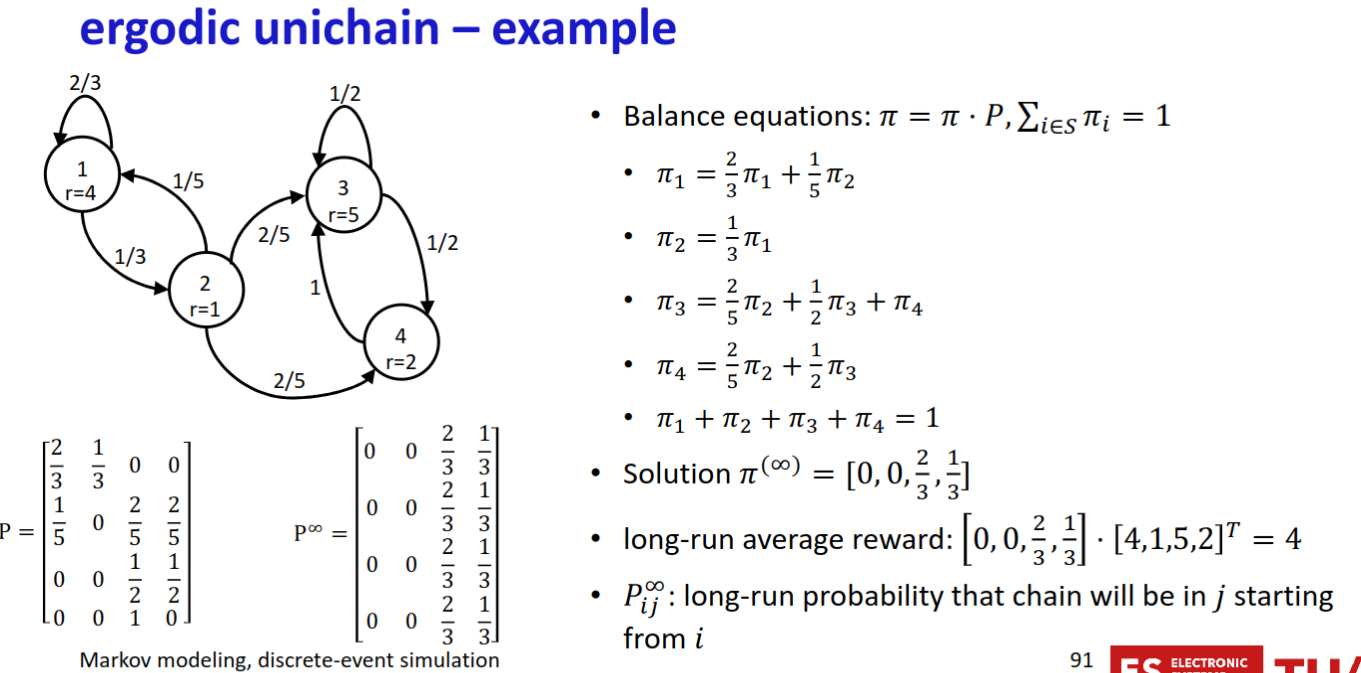
balance equation
which have stationary solution which exist iff chain is unichain -
-
We can see that first 2 are transient and are zero in long run… 4 units in markov chain average reward…
-
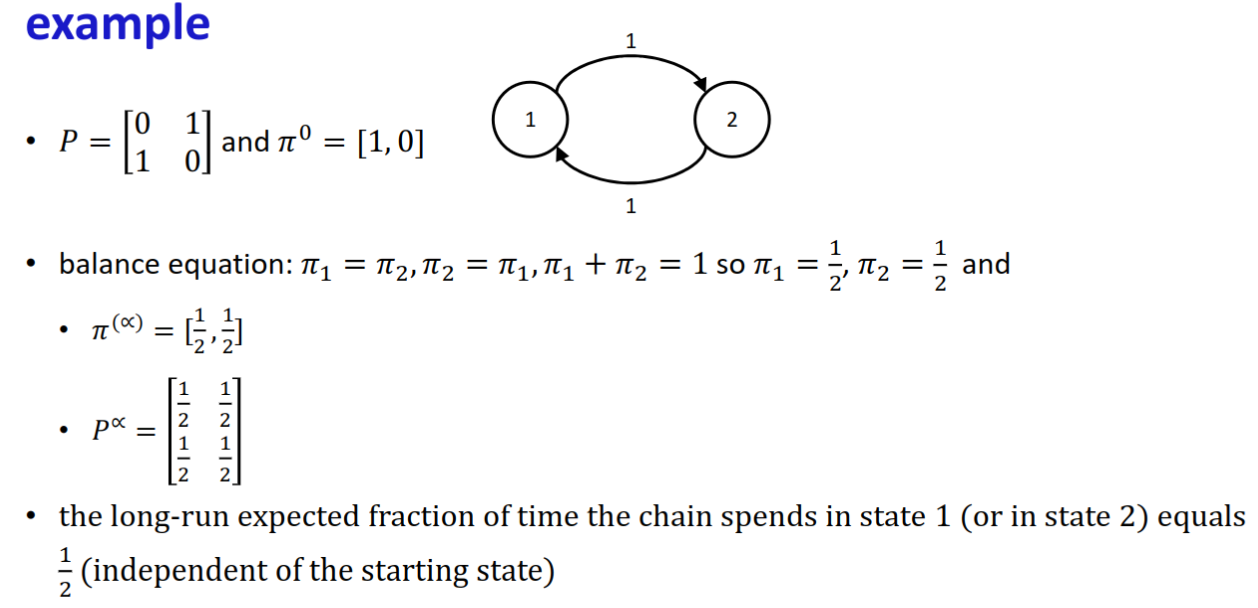
non-ergodic unichain those limits dont exist, still has a unique stationary solution: cezaro limit
-
cezaro limit:
long-run expected fraction of time the chain spends in state -
long-run expected fraction of time the chains spends in state , given that it started in -
each row
-
long run expected average reward
Week 6: B.7
Discrete-event Simulation B.7
Discrete-event simulation - Wikipedia
estimaiton theory
goal: estimate
approach: estimate
errors
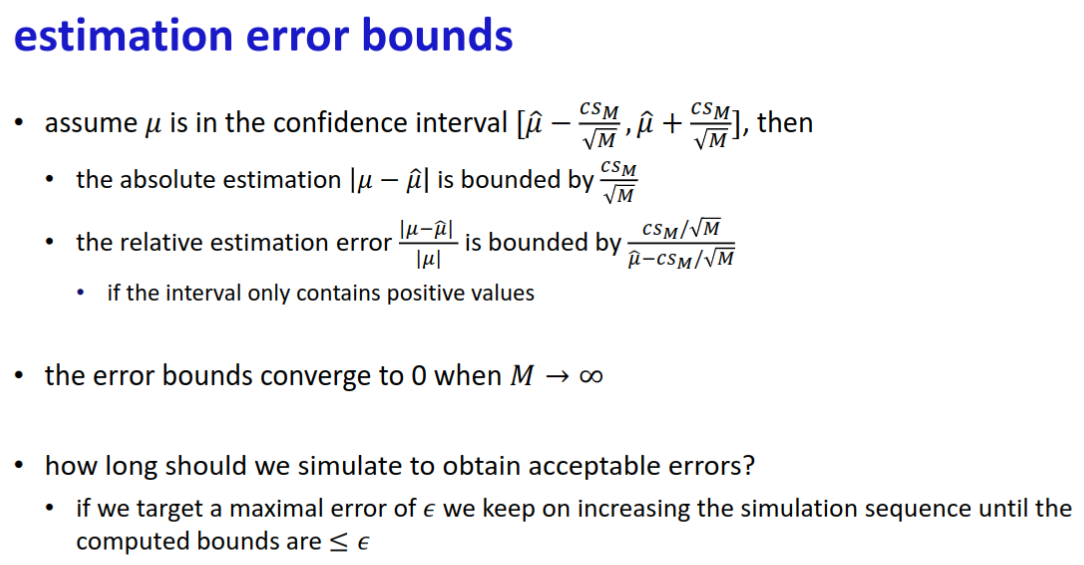
How big M(simulation sequence so acceptable error):
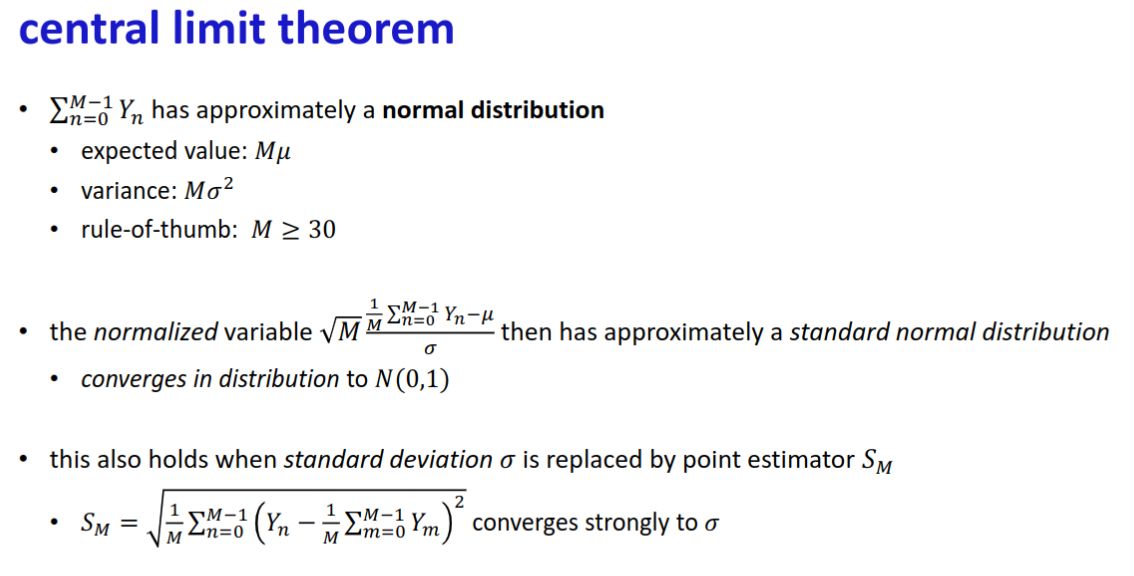
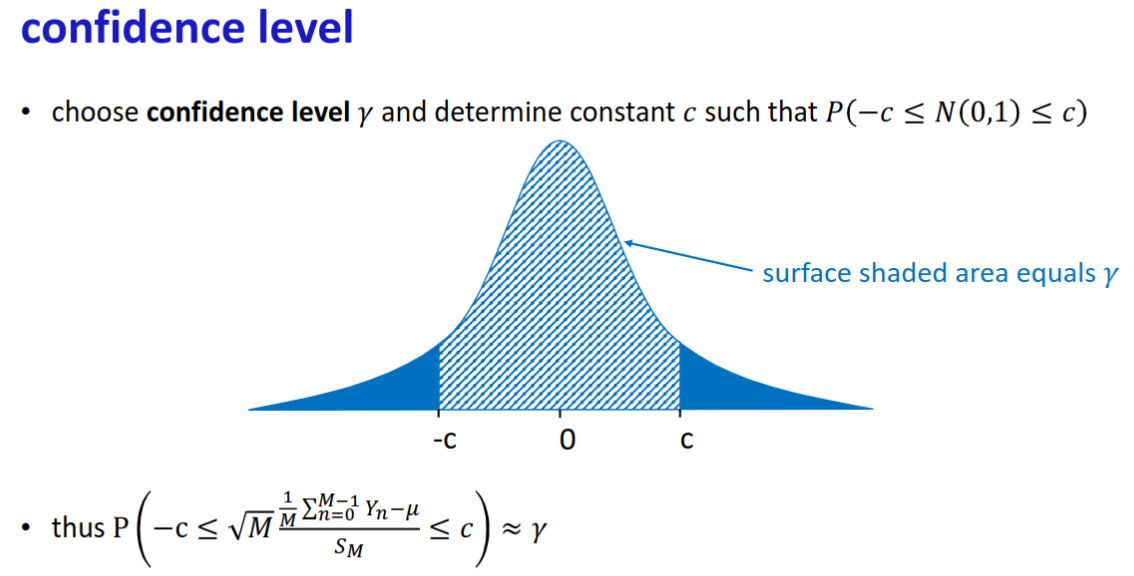

also called the confidence interval…
negative values
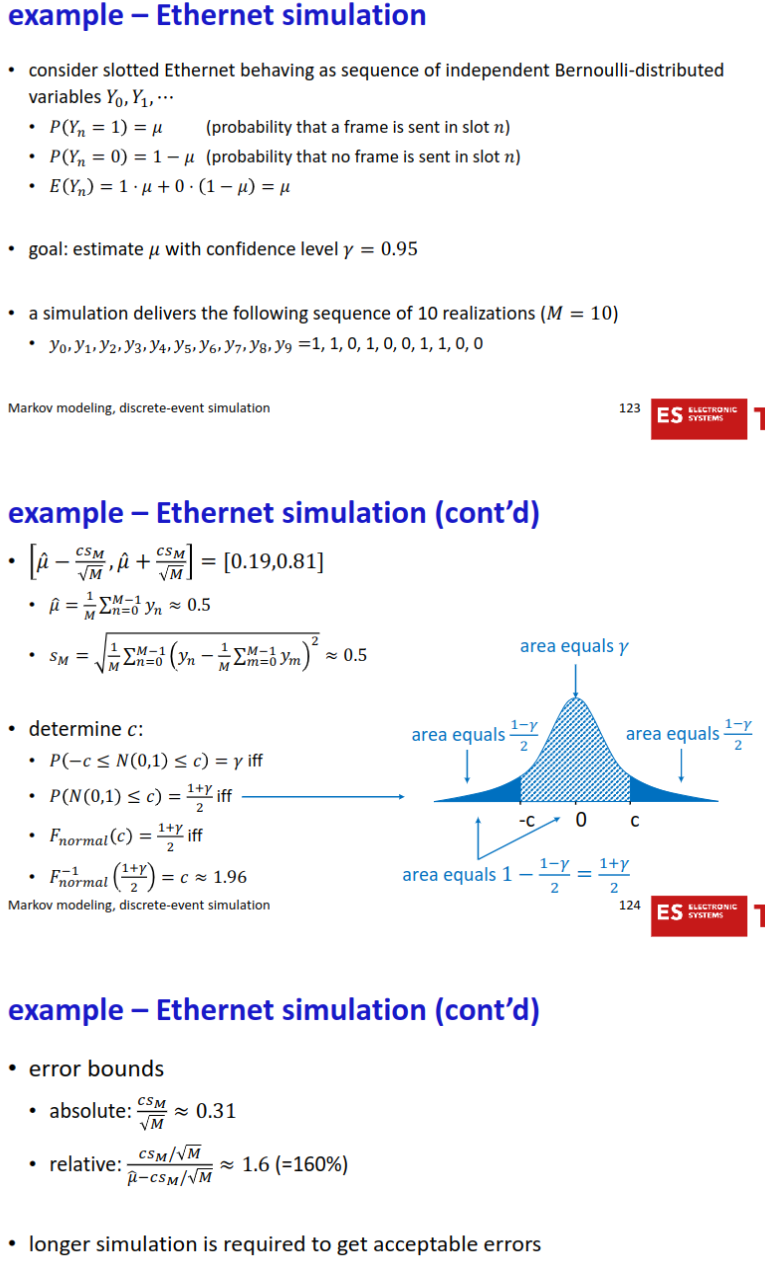
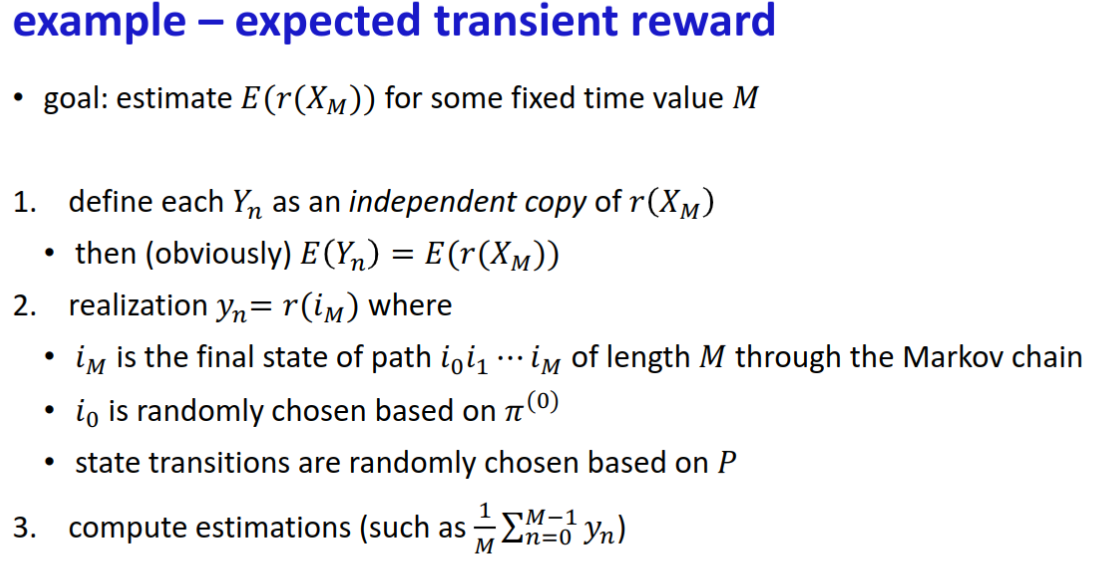
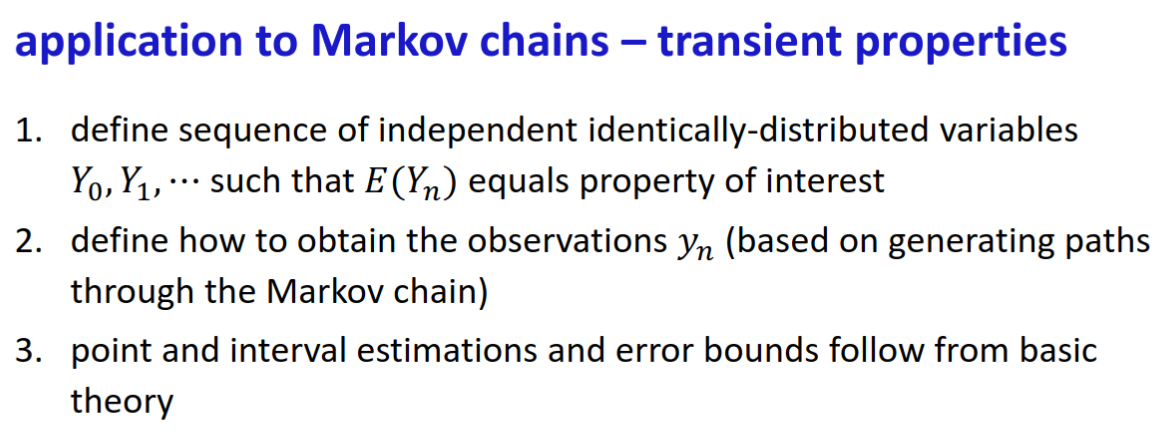
Transient Markov application
markov chain application - transient properties:
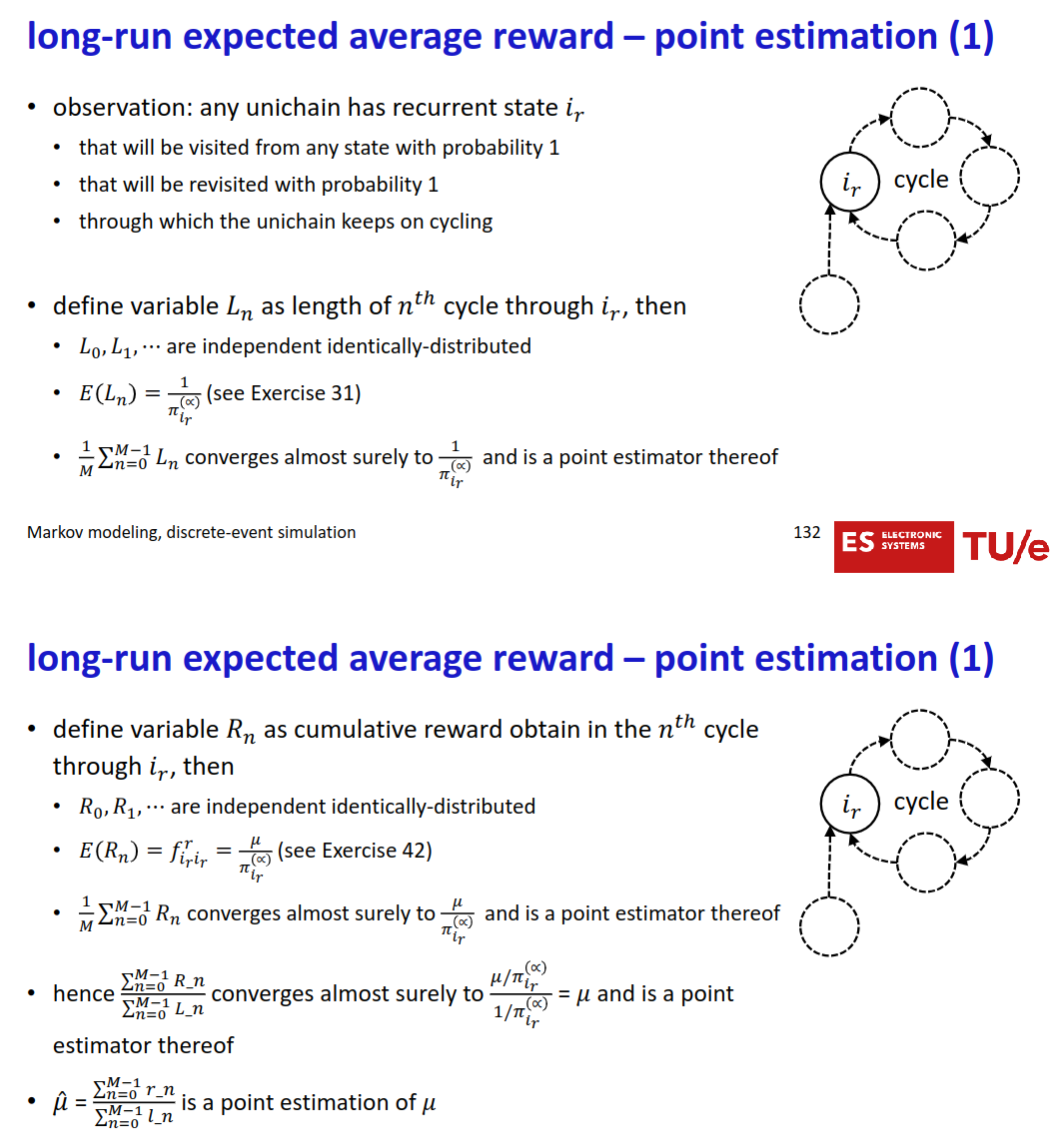
long-run properties
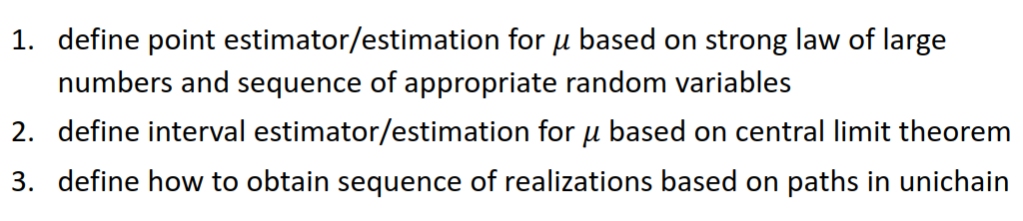
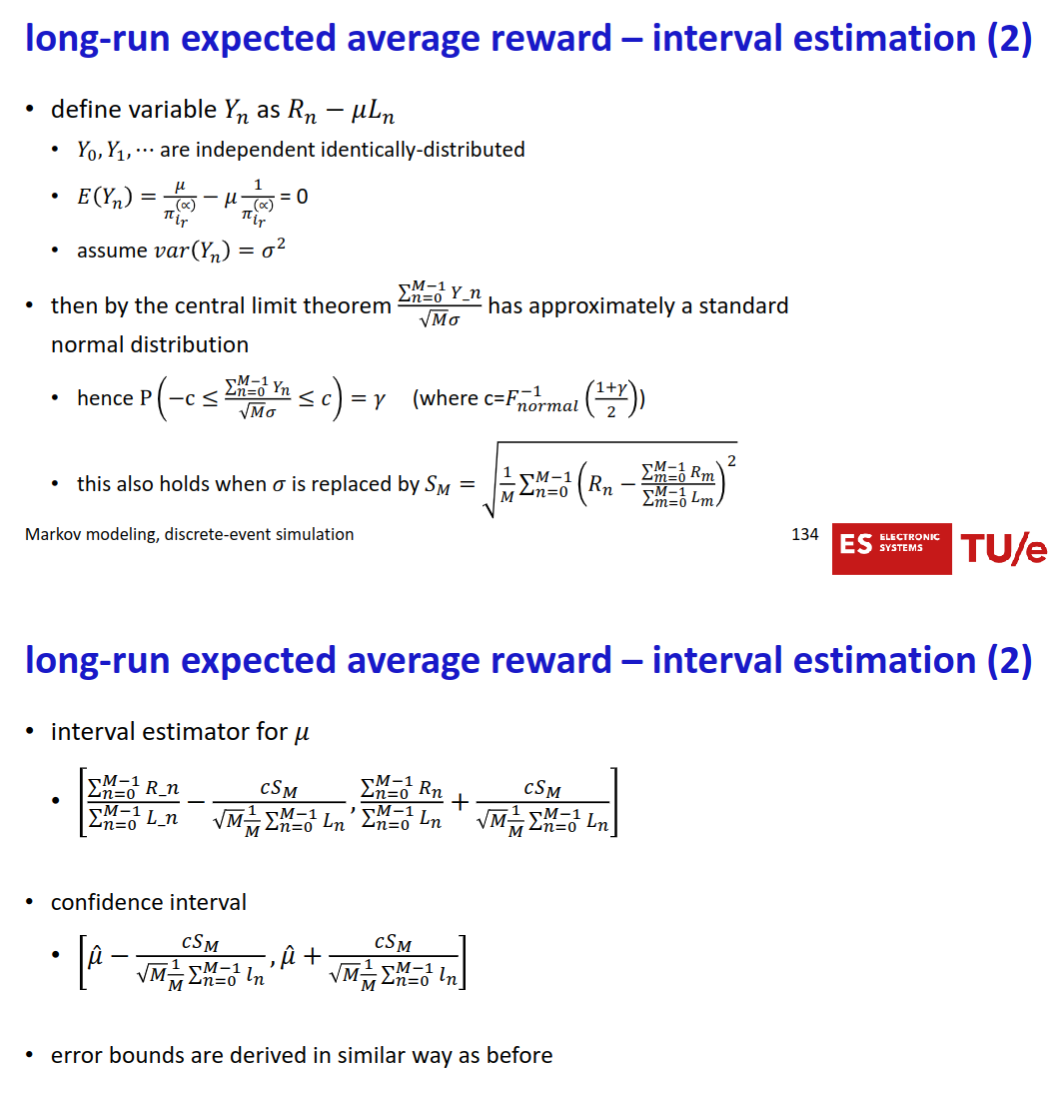
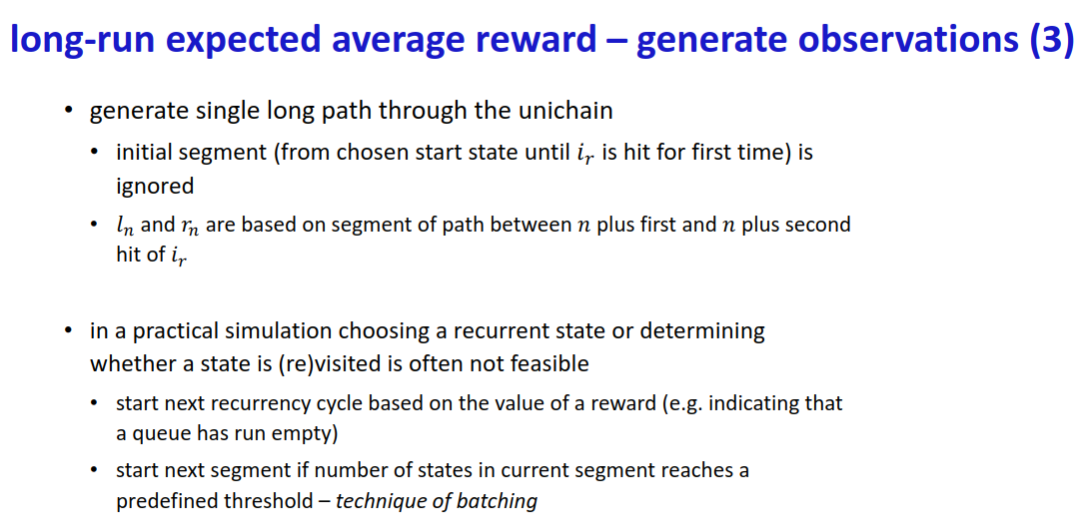
point estimation, interval estimation, generate estimation
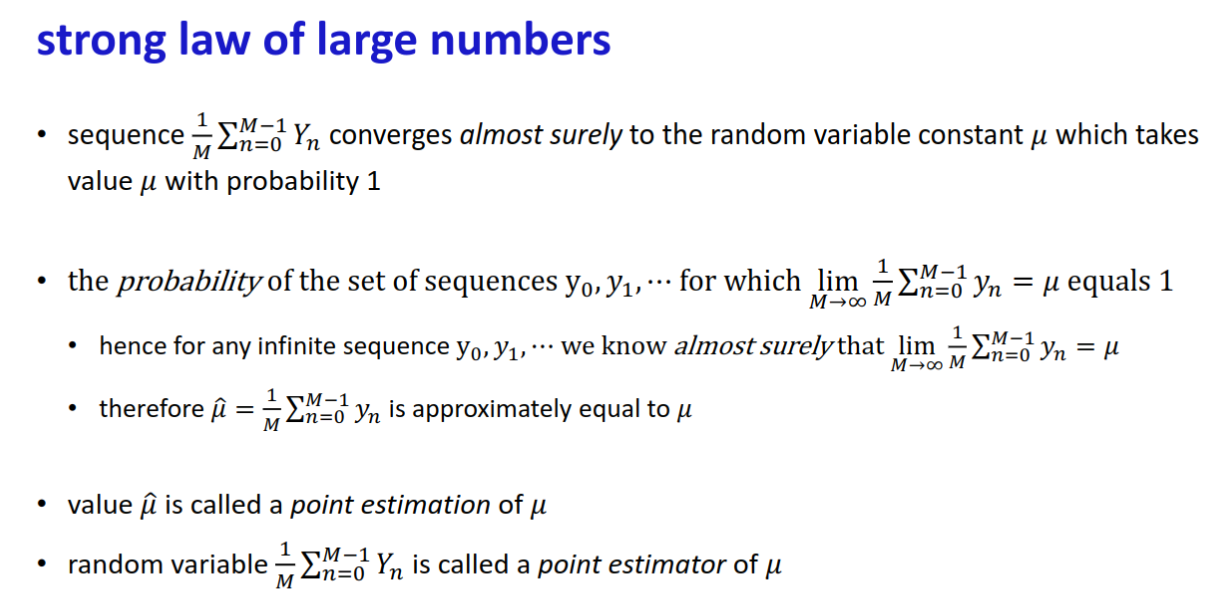
based on strong law of large numbers
based on central limit theorem
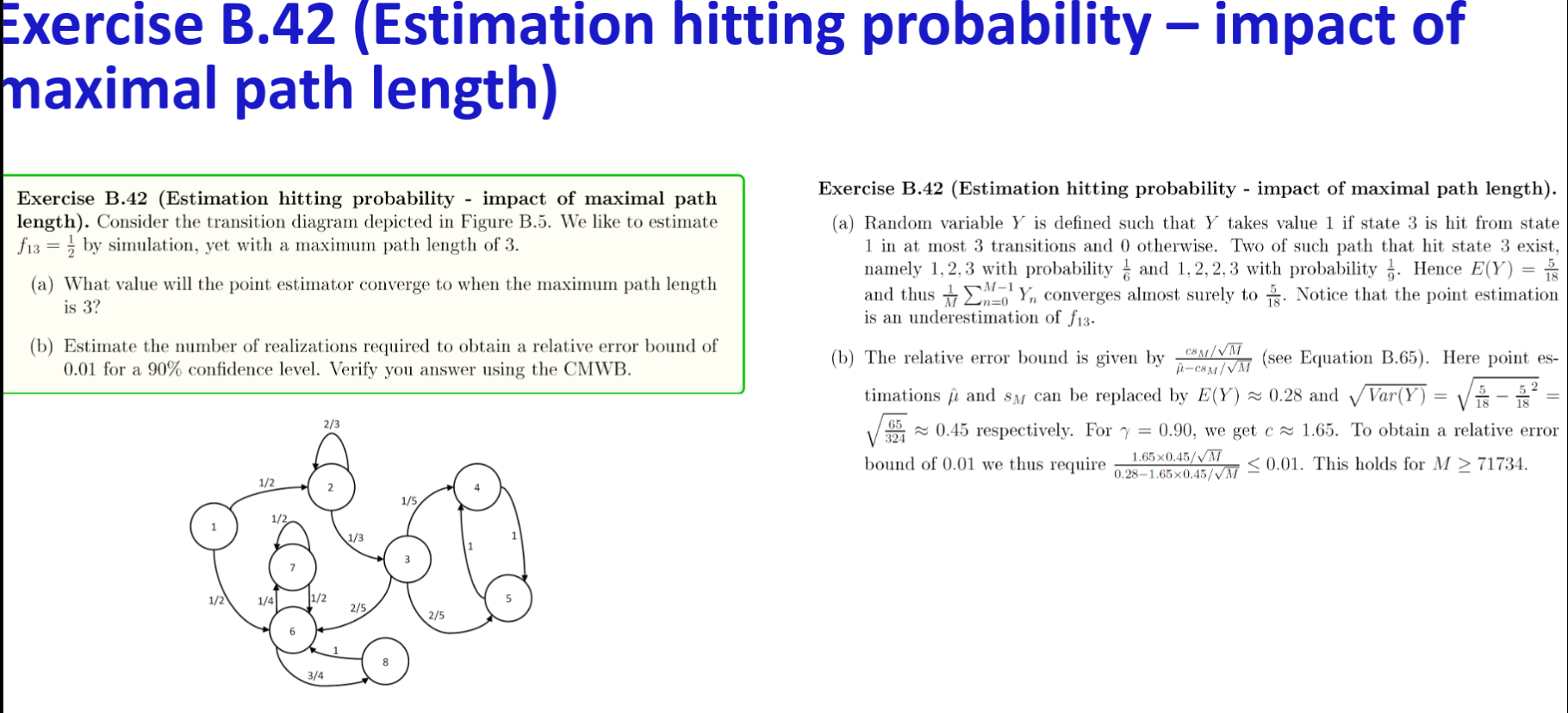
exercises
Module C: Dataflow, Max-Plus Linear Systems, Performance Analysis
Week 6: C.1 & C.2 & C.3
C.1 Timed Dataflow Models
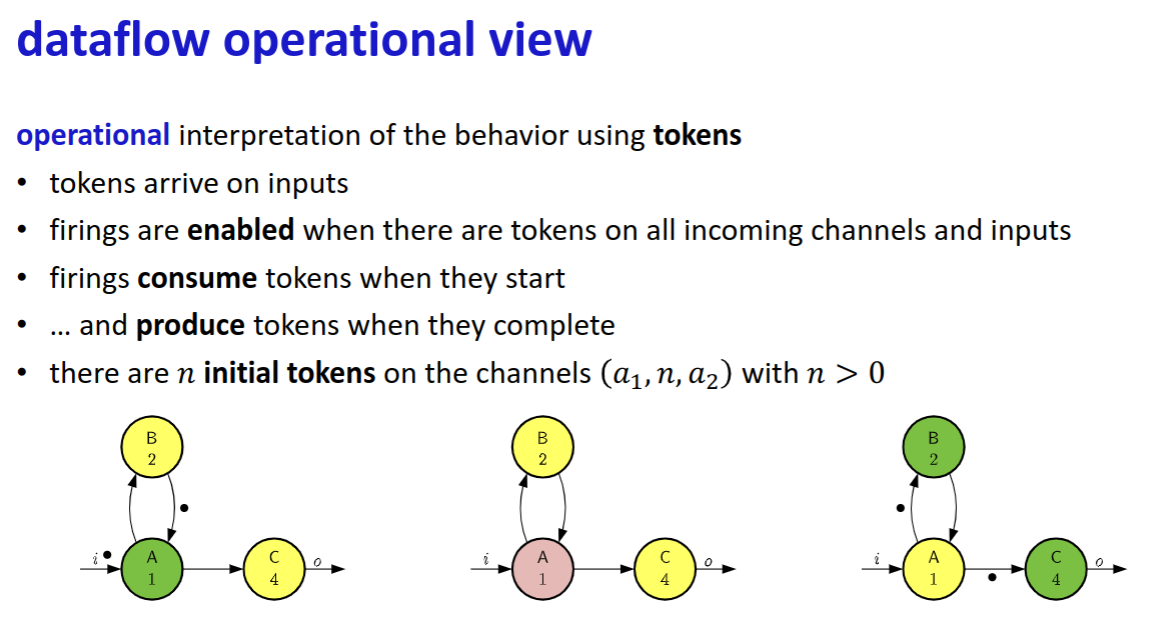
MULTI RATE DATAFLOW CHART OUTSIDE OF SCOPE (CAN BE DESCRIBED IN VECTOR) can be converted to single rate
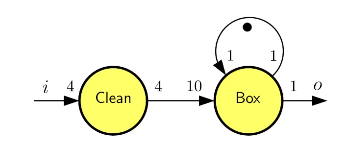
- finite set of actors
- firing durations
(time units) - finite set
of channels - finite set
of inputs with input dependencies - finite set
of outputs with output dependencies
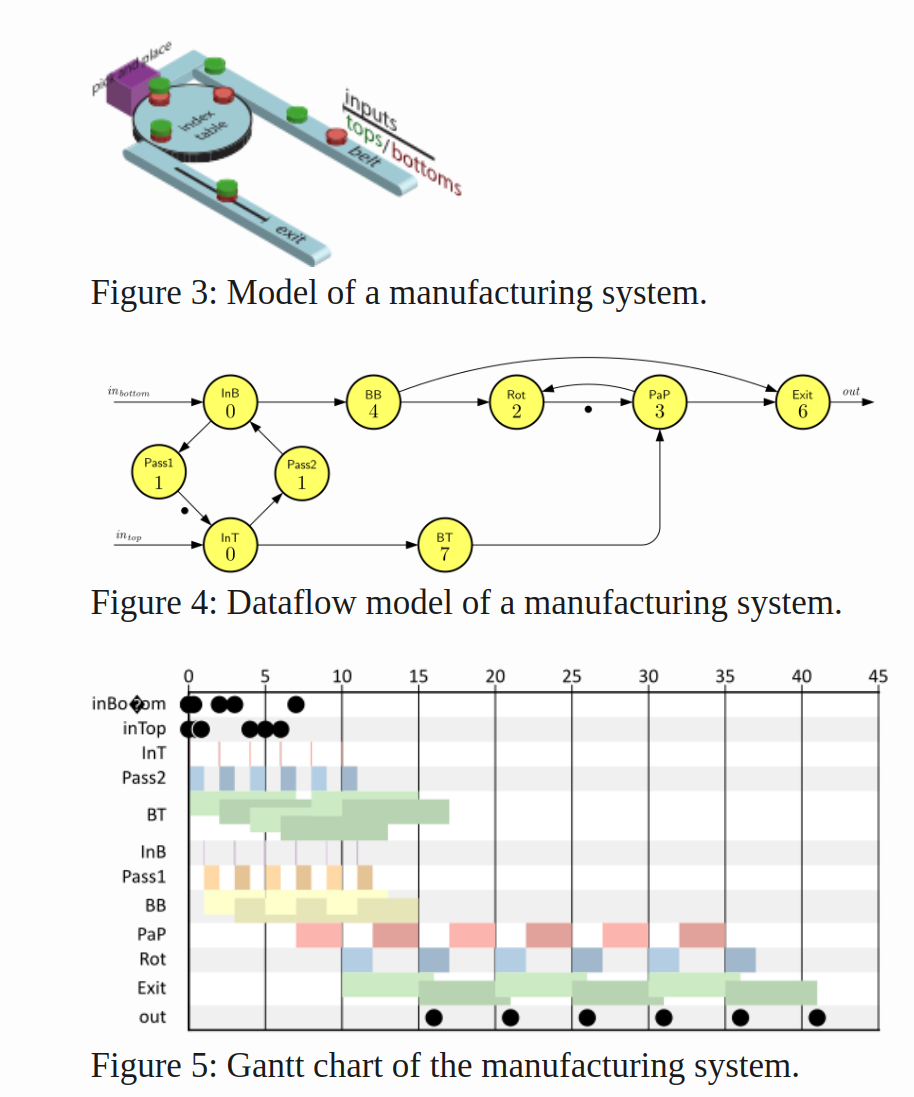
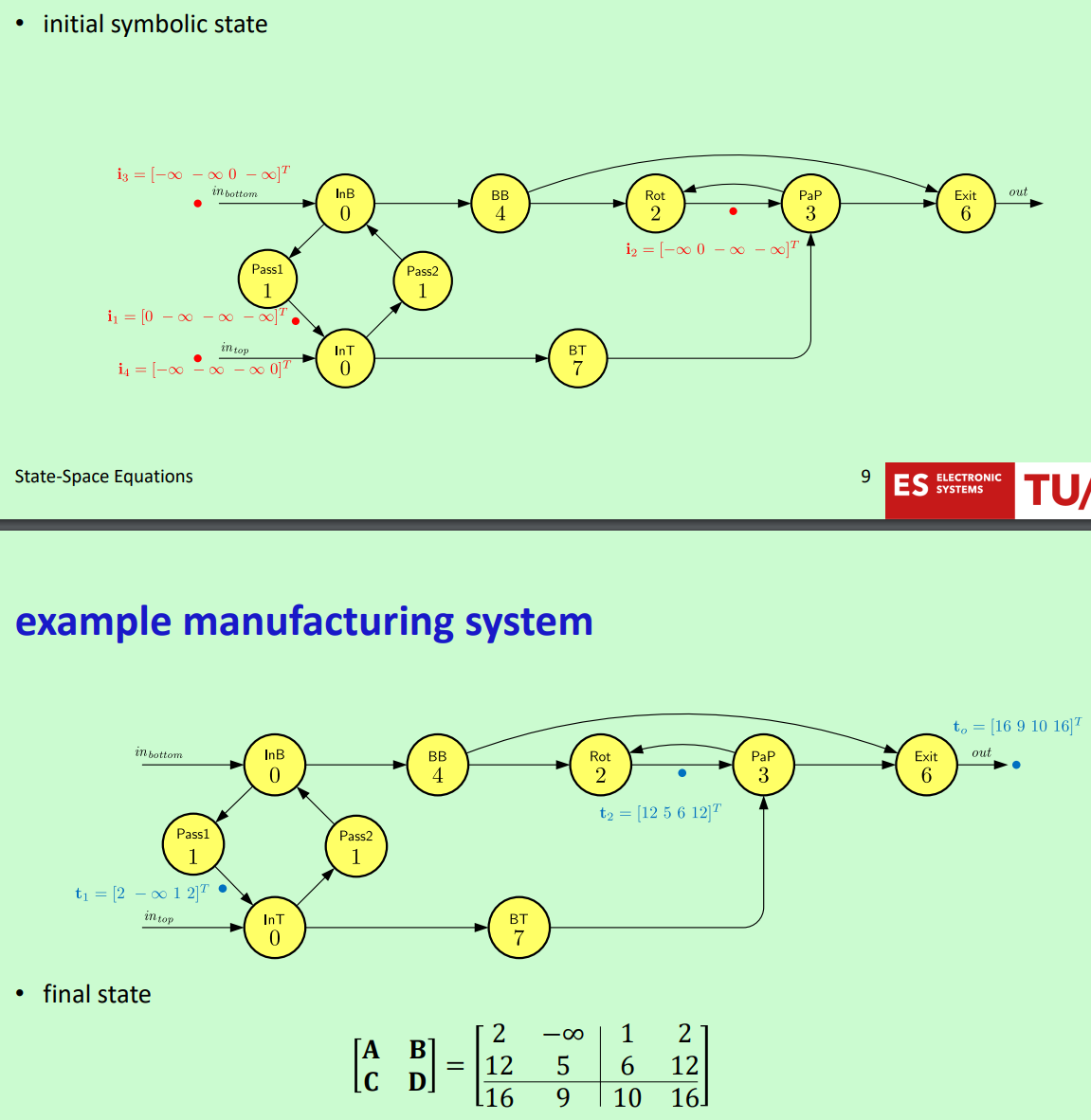
- BT actor models the transport of the top on the belt to the pick-and-place unit, where it is combined with a bottom.
- BB models its transport to the indexing table.
- initial token on the cycle ensures that the first object admitted is a top.
- initial token on the channel from Rot to PaP represents the bottom part that is initially placed in the system.
- dependency from PaP to Rot ensures that the indexing table does not rotate until the pick-and-place operation is complete.
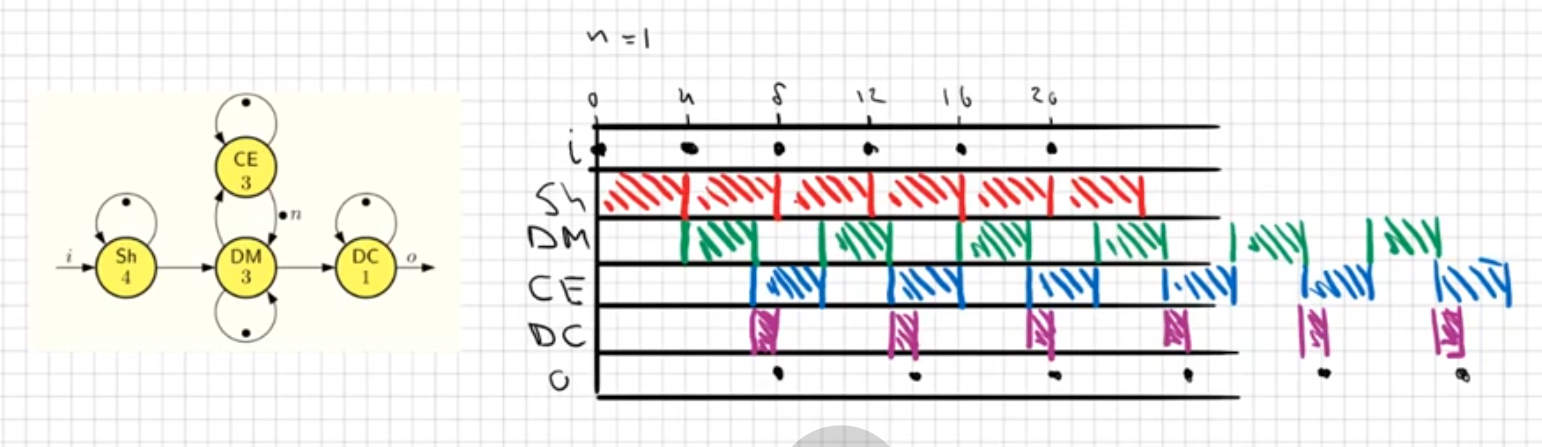
multi token production
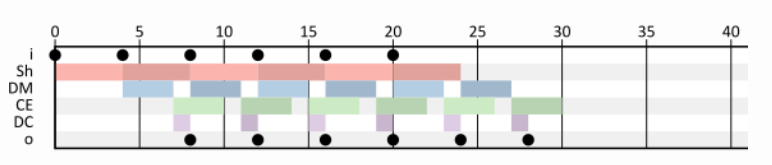
Given the input sequence and the duration of the Sh actor, the decoder cannot decode symbols faster than 1 symbol per 4 time units. With two tokens on the channel from CE to DM, it operates at this maximum rate; with only one token, it does not. So the most recent channel-estimation information that DM can use is two symbols old.
- to have synchronous operation one after the other the actor should have a self referencing channel dependency with a token.
- hot to determine maximal operation: squash the synchronous operation time units as close as possible and then determine the tokens required for that
- 2 units at A trigger I
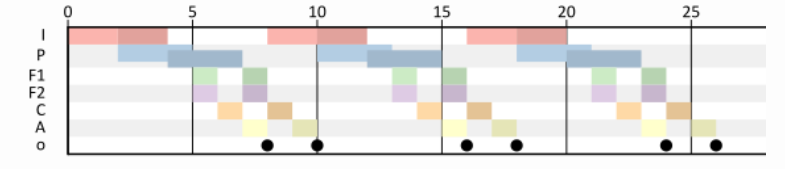
- 4 units at A to trigger I
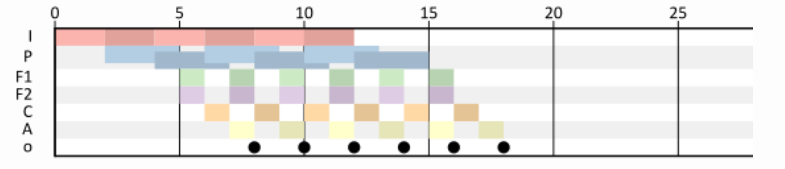
How to ensure order of operation:
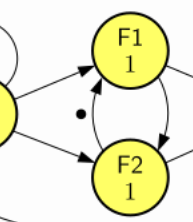
F1 fires first in this case.
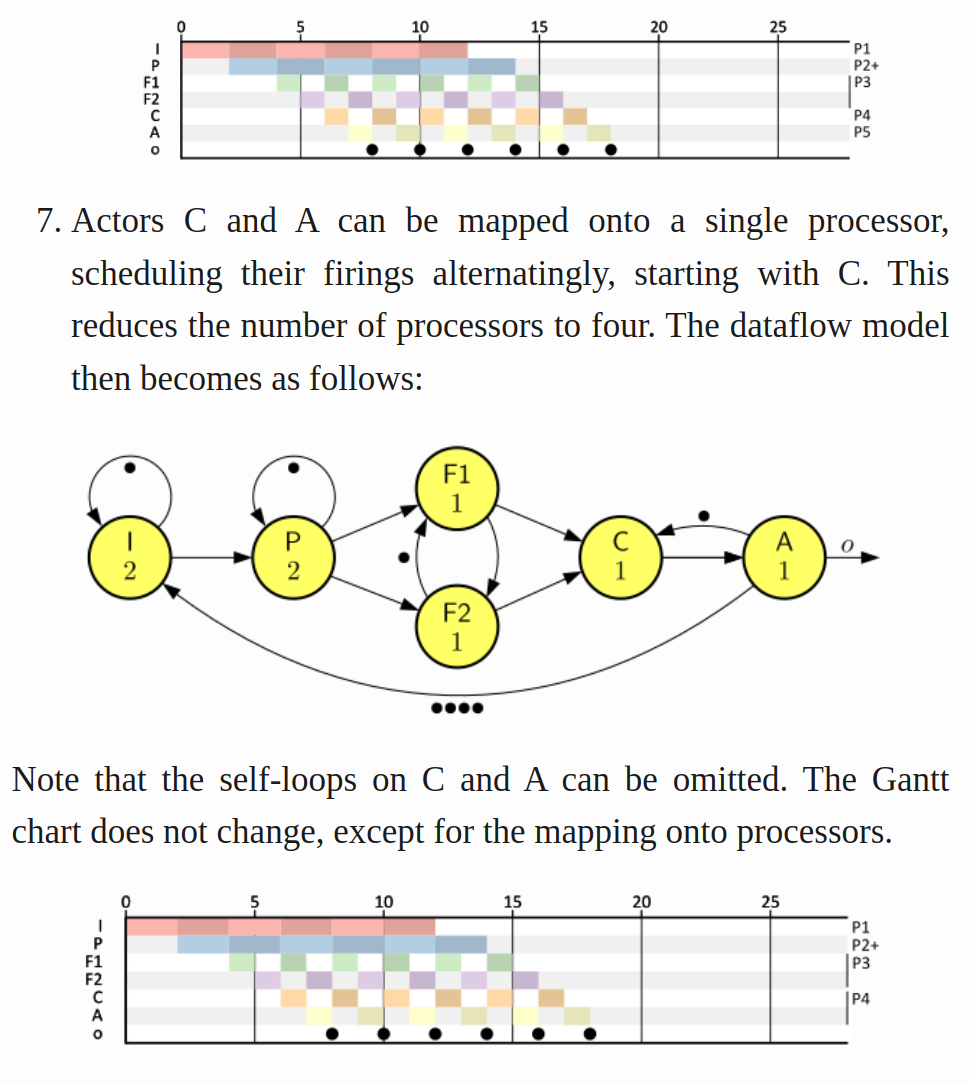
Reducing the number of processors:
C.2 Schedules & Performance
schedule partial function:
schedule
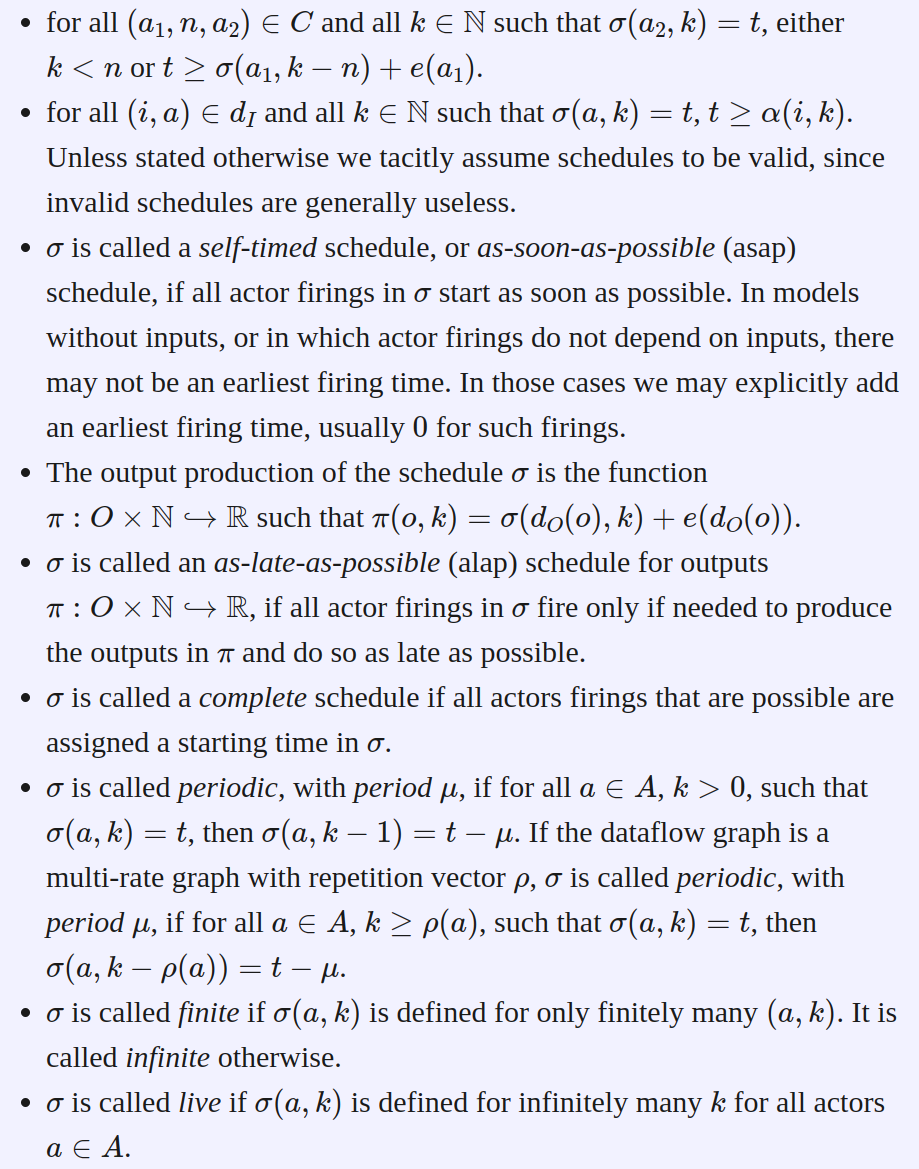
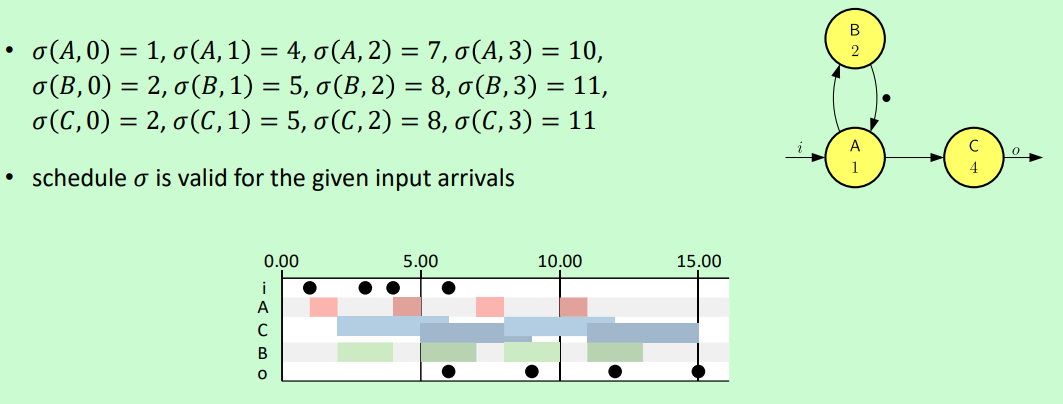
- self-timed schedule: as soon as possible asap
- as late as possible alap
- complete all actor firings assigned starting time
- periodic
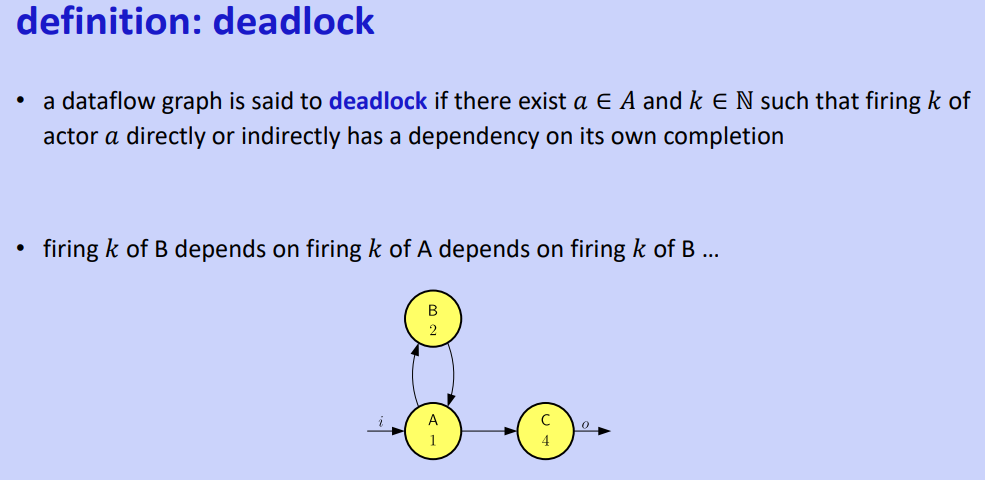
- finite if
- live if
is defined for infinitely many for all actors - example above: periodic:
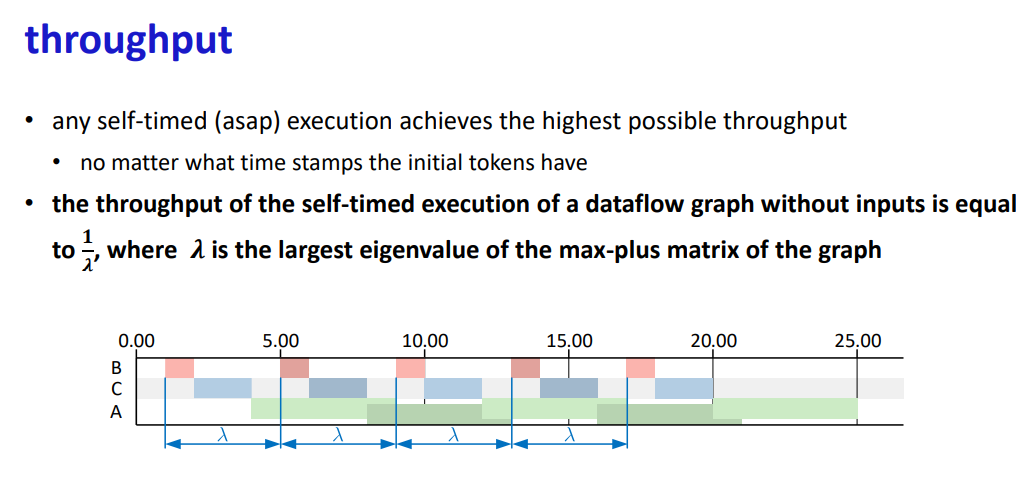
Throughput intuitively refers to the amount of processing that a system can perform, on average, in the long run, per unit of time. It is relevant for indefinite operation. Makespan, in contrast, is a performance metric that can be associated with finite behaviors. It refers to the total amount of time that it takes to complete a job. Finally, latency is a metric that characterizes the time span between the start and the completion of the processing of individual elements.
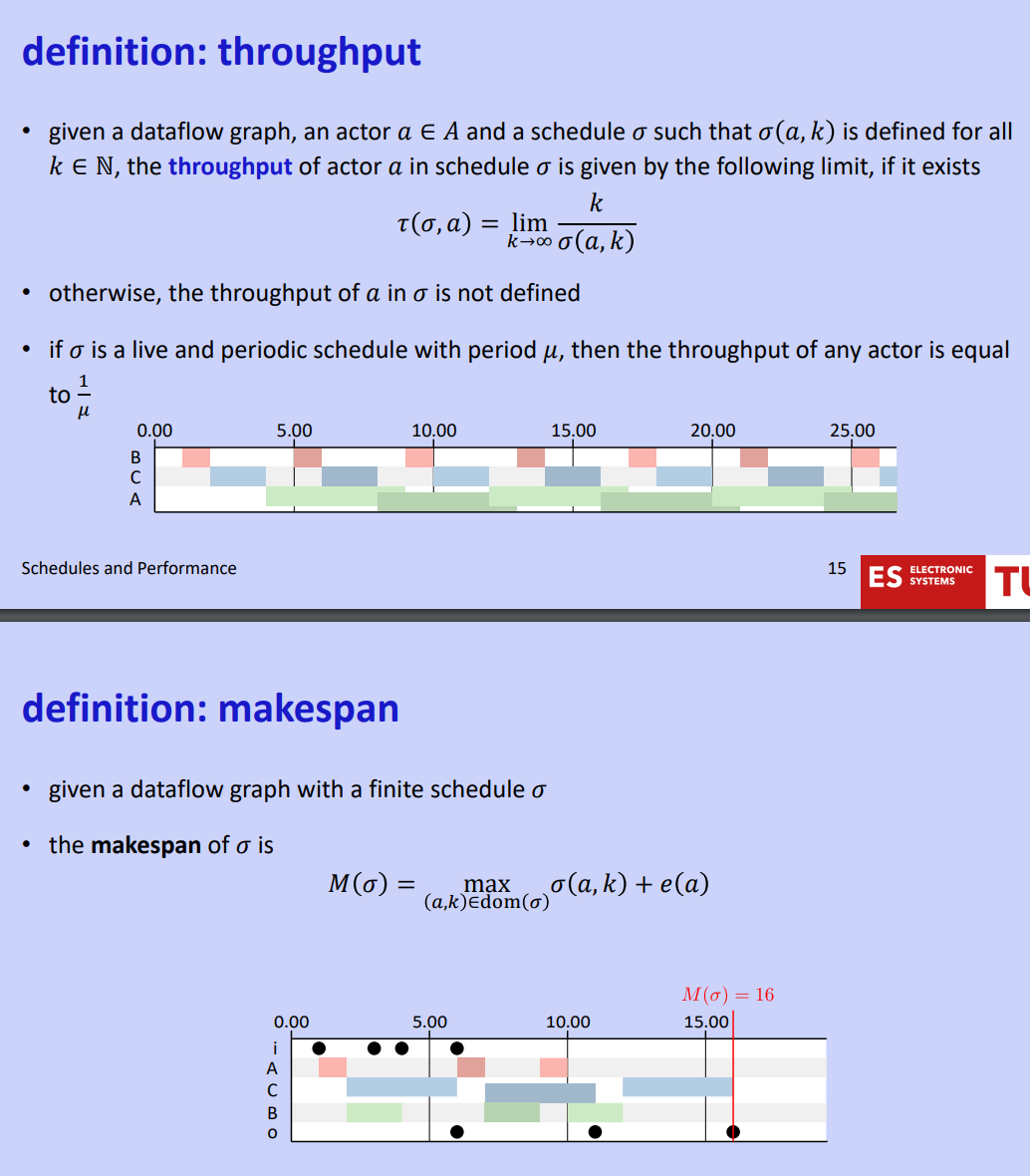
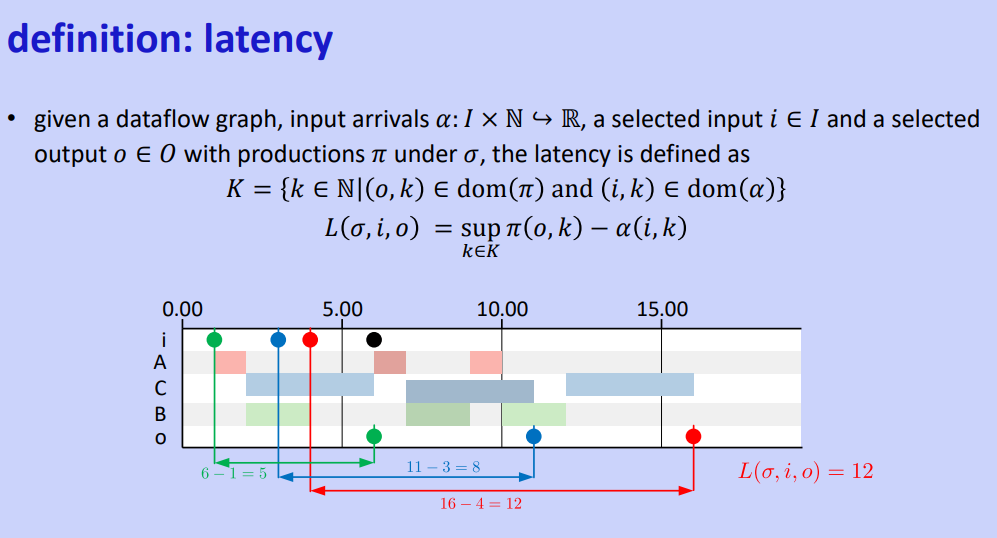
non periodic throughput example:
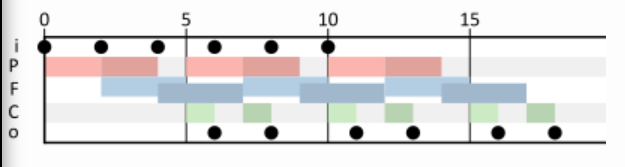
Actor C fires 2 times per 5 time units, so the throughput is
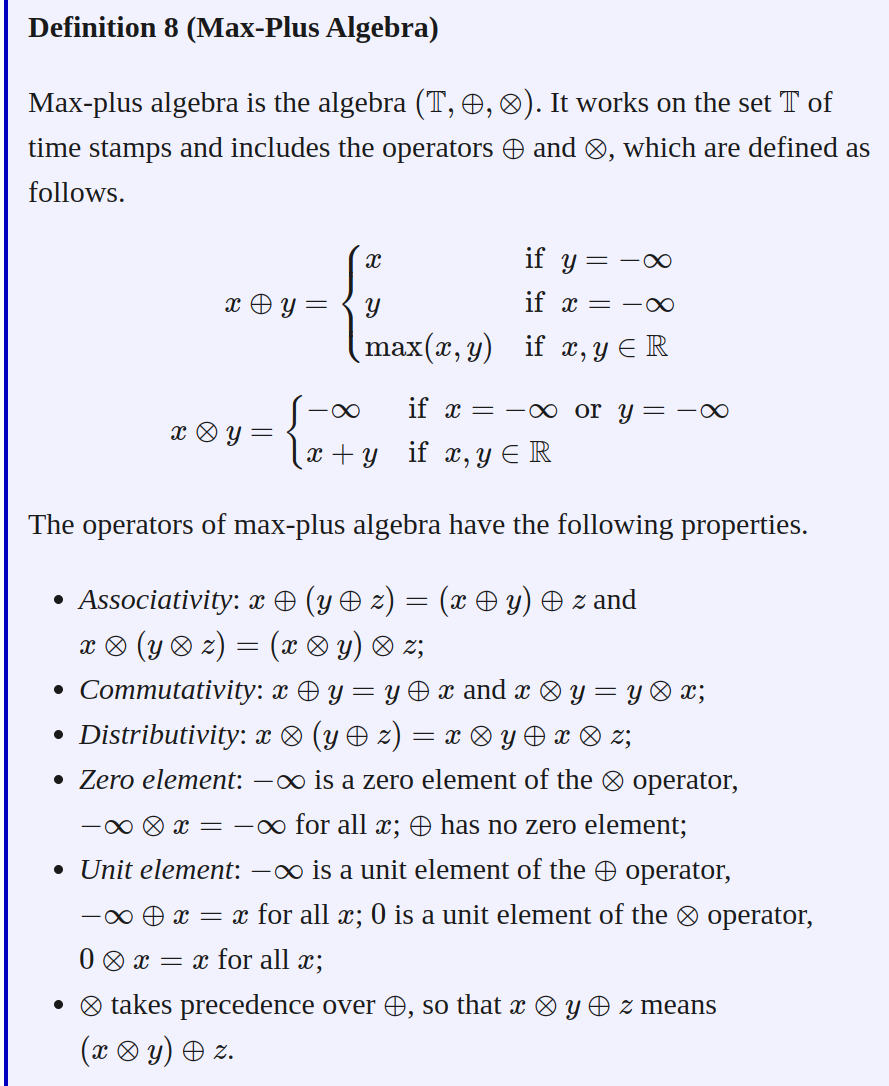
C.3 Max-plus Algebra
time stamp os value from set
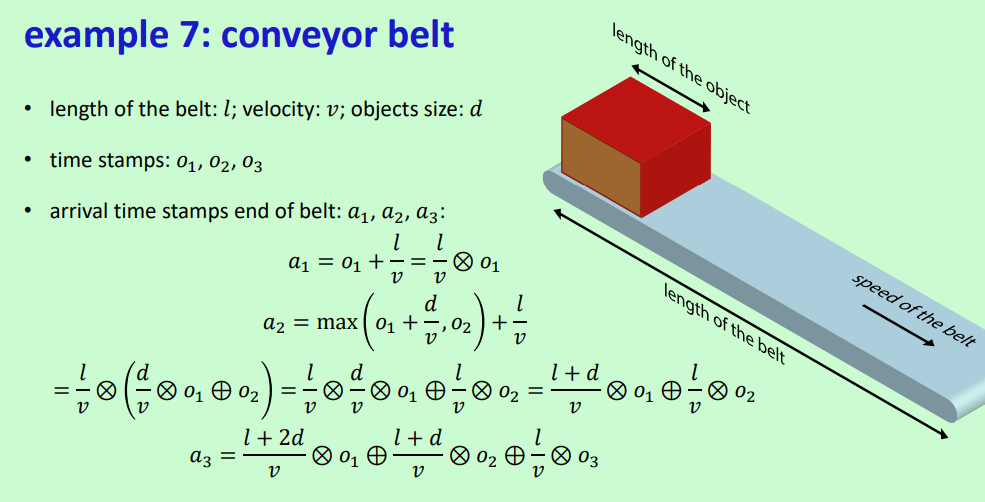
- compute time stamp:
- assume self-timed firing of
with 2 inputs:
Week 7: C.4 & C.5 & C.6 & C.7 & C.8
C.4 Max-plus-linear Systems
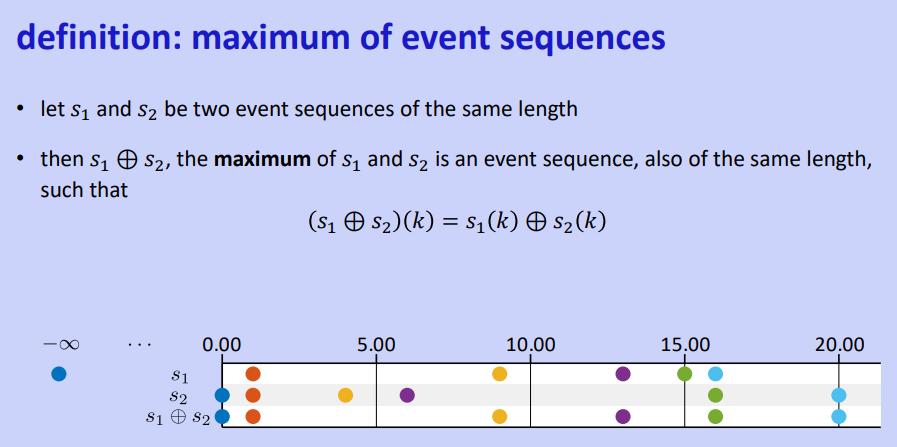
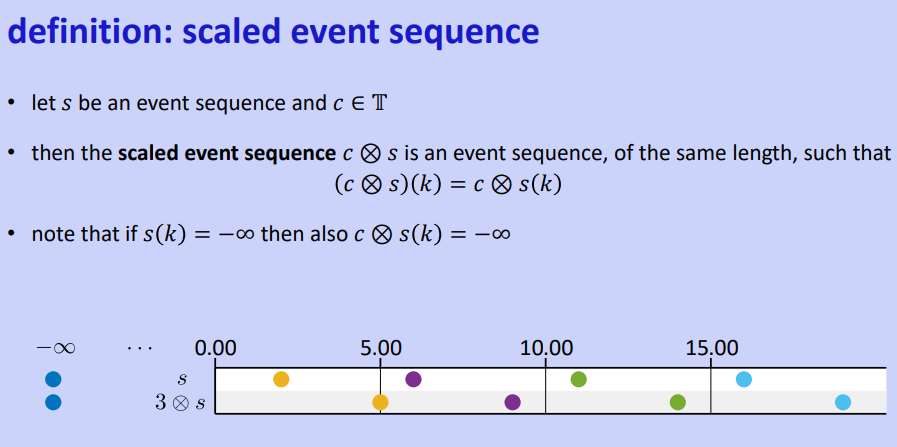
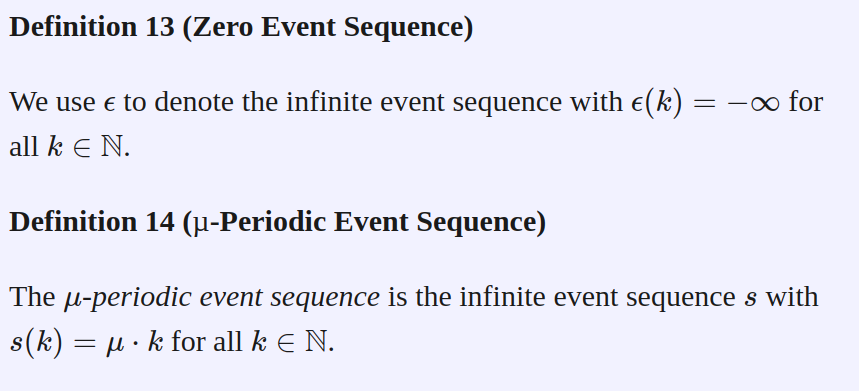
event sequence:
note event sequence does not require order:
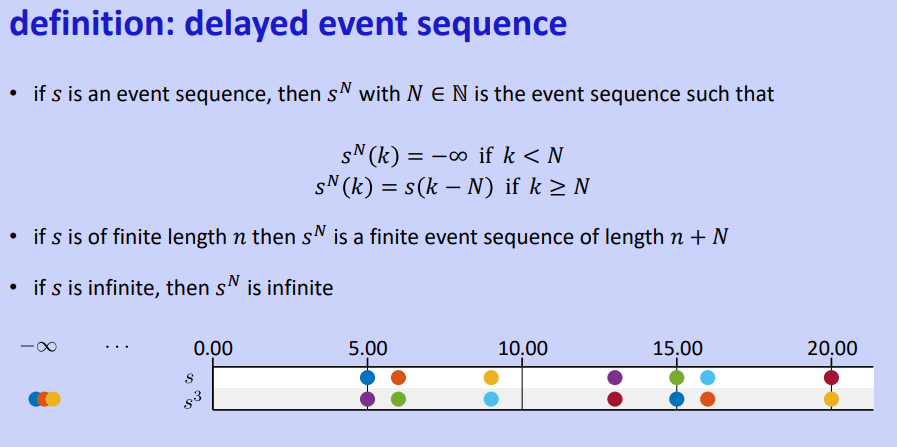
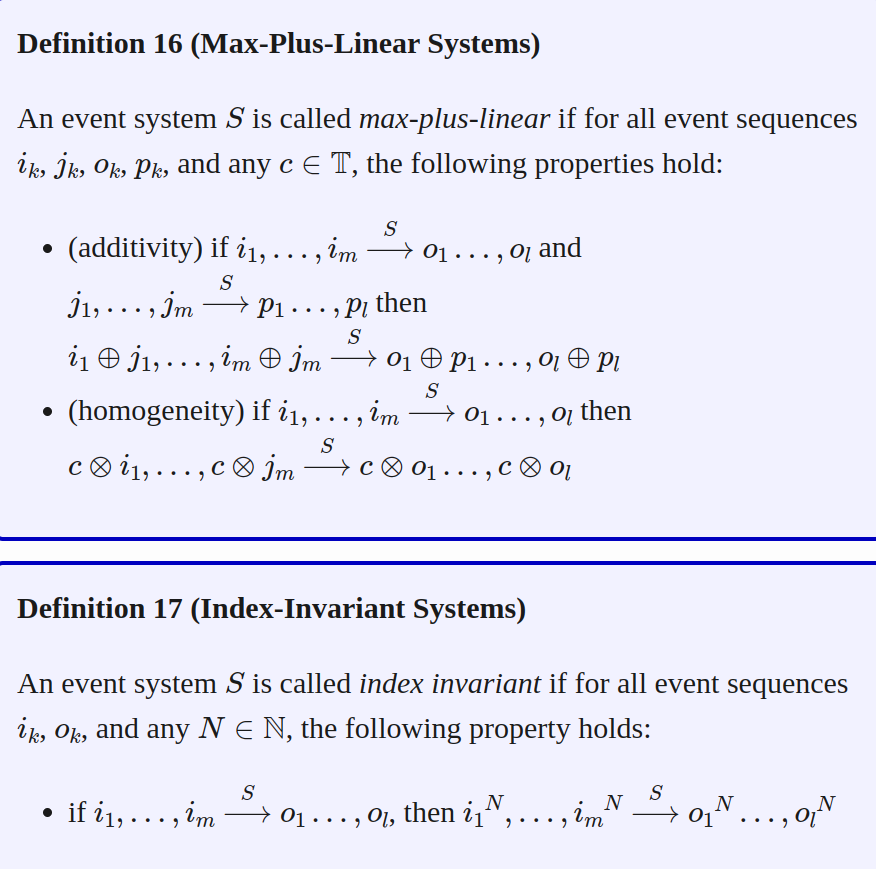
we operate always with index invariant systems since we have single rate dataflows…
superposition
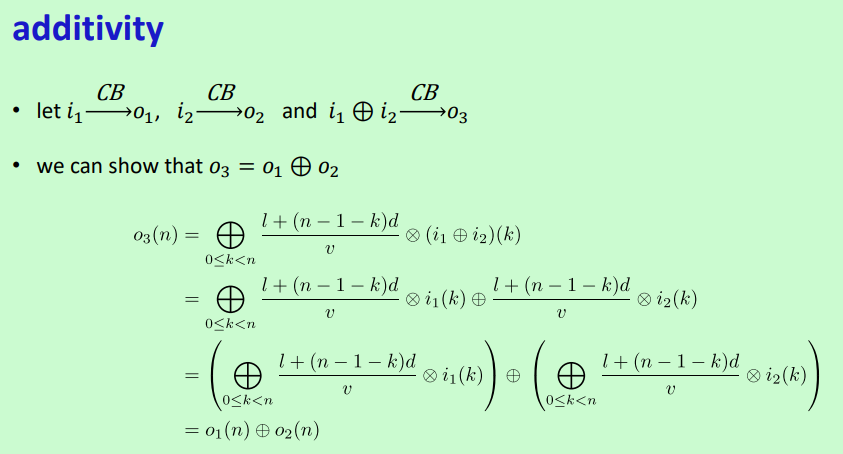
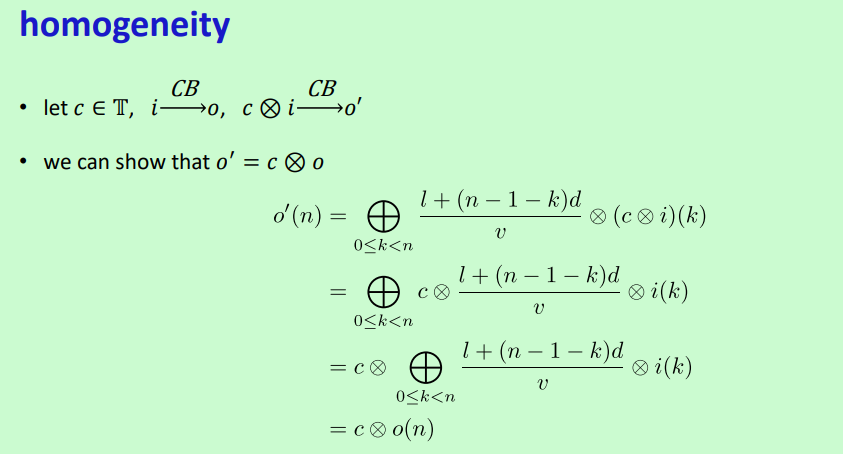
- a linear system has the superposition property
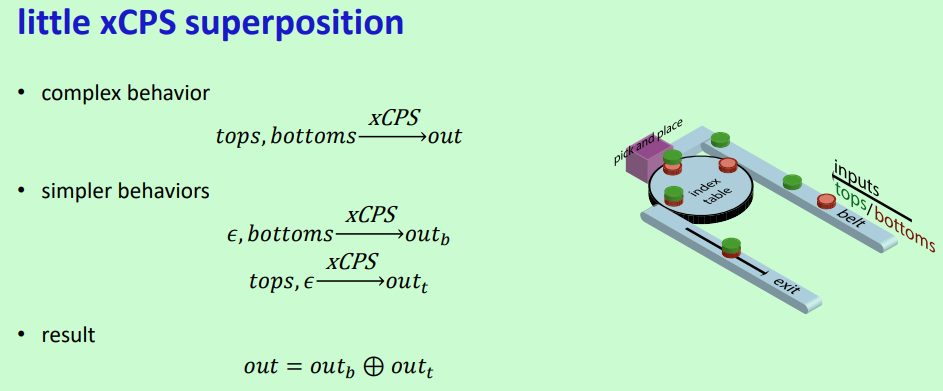
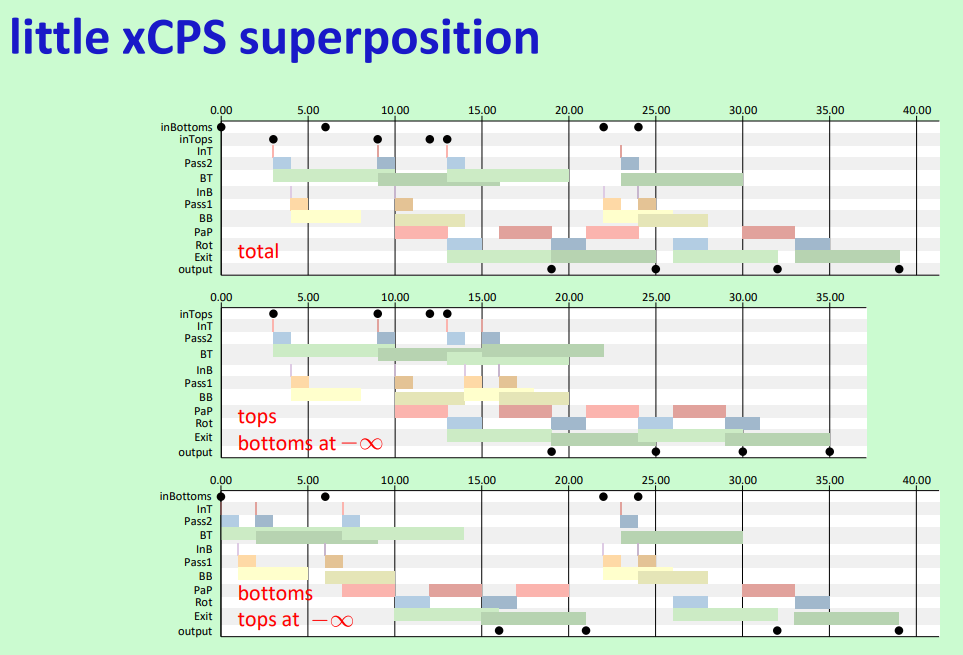
- if a complex stimulus (input) can be described as the maximum (⊕, superposition) of two or more simpler stimuli, then
- analyze the responses to the simpler stimuli separately
- determine the superposition (max) of the separate responses
- divide-and-conquer strategy
- typically among different inputs of the system
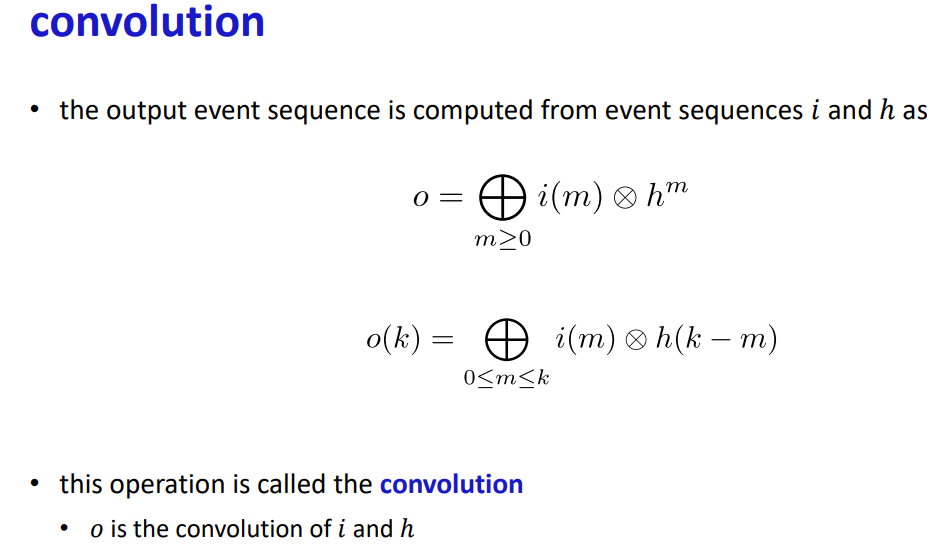
C.5 Impulse Response
- impulse sequence: is an event sequence
such that and for - impulse response: of event system
is the event sequence such that and multiple inputs and/or outputs - an impulse is the smallest part of an event sequence
- every event sequence is the maximum of scaled and delayed impulses
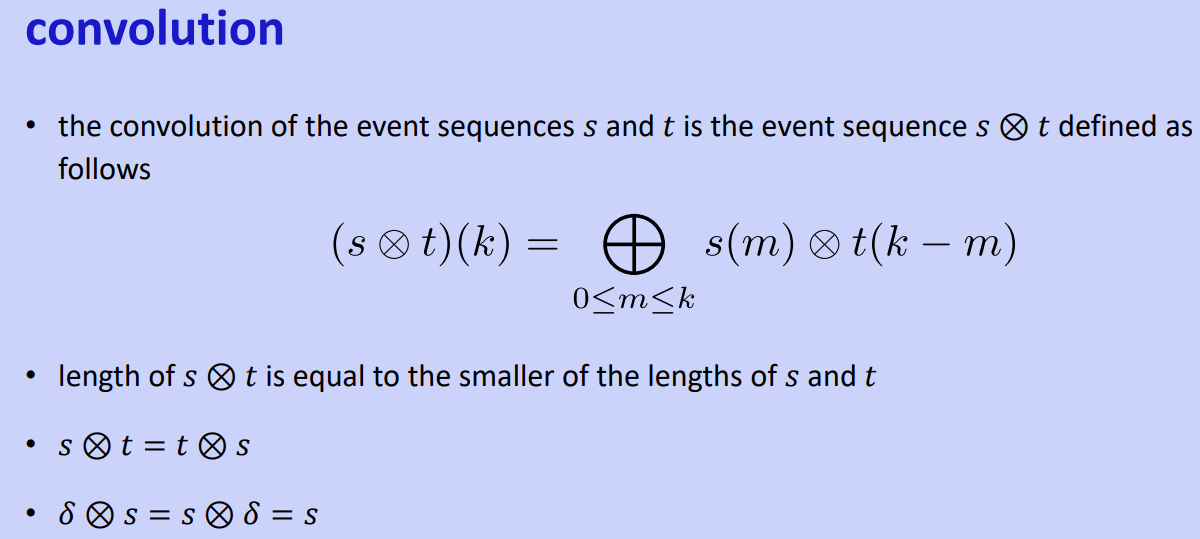
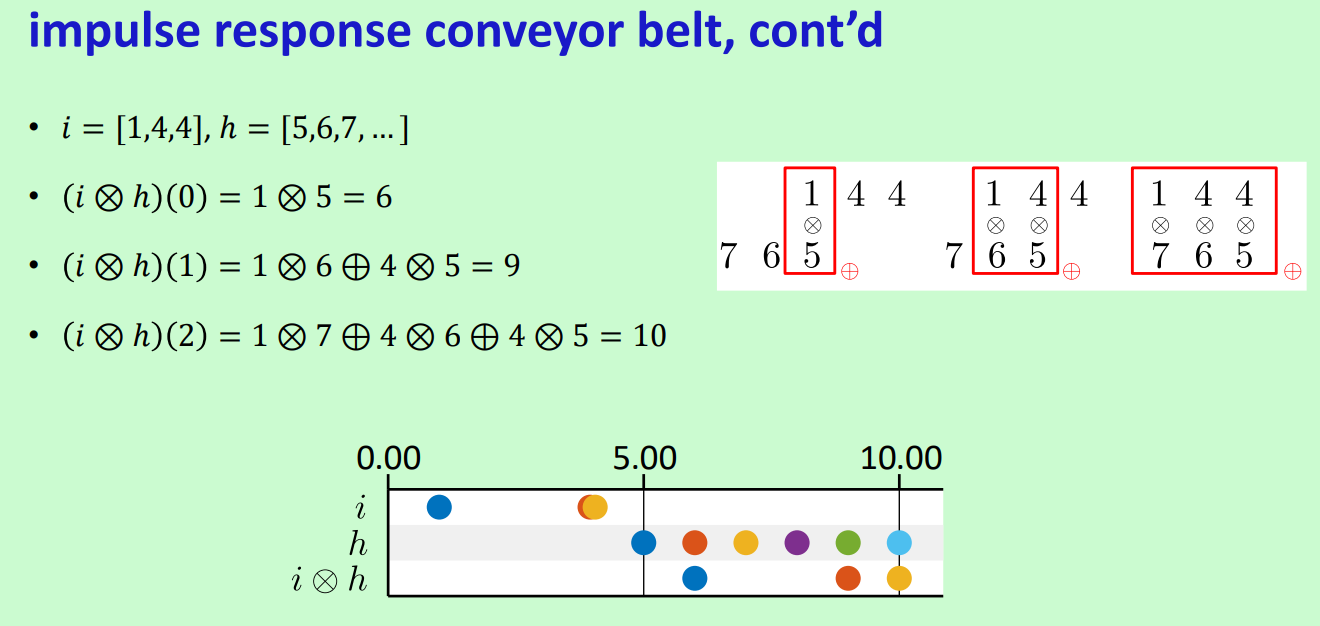
- linear and index-invariant event systems are completely characterized by their impulse response
If
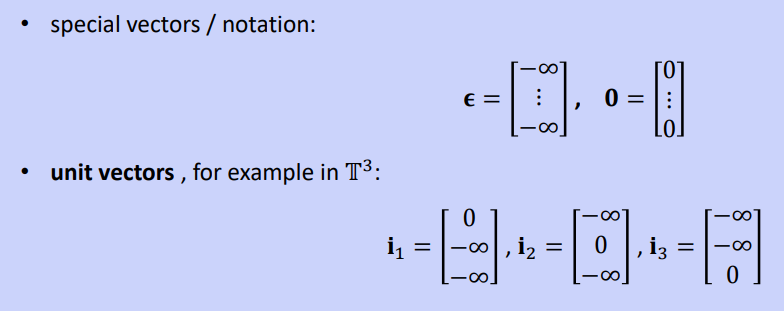
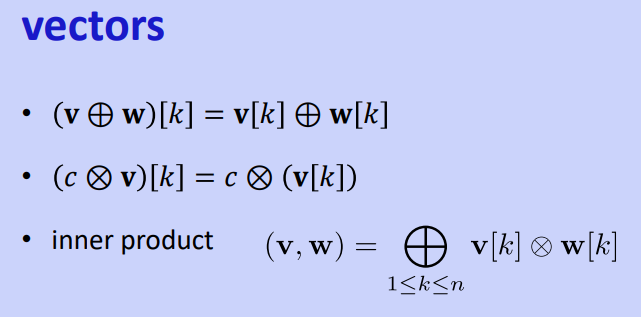
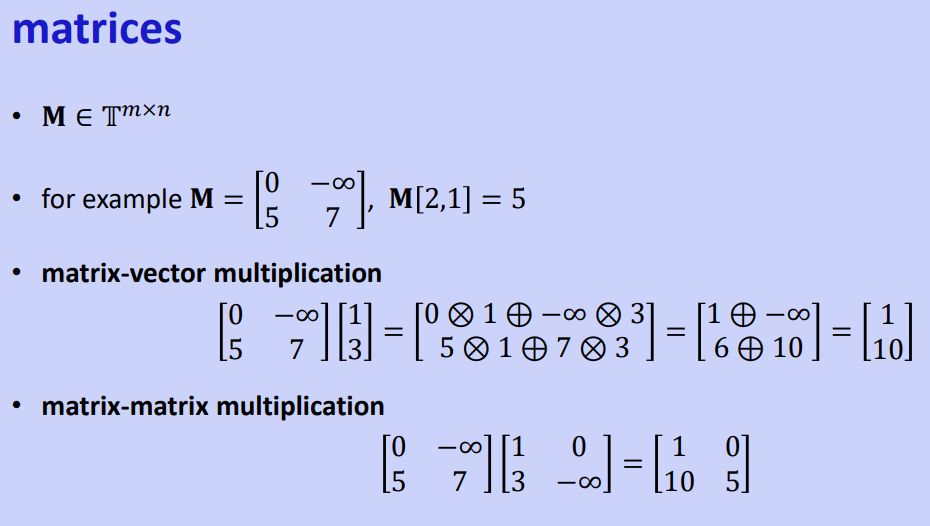
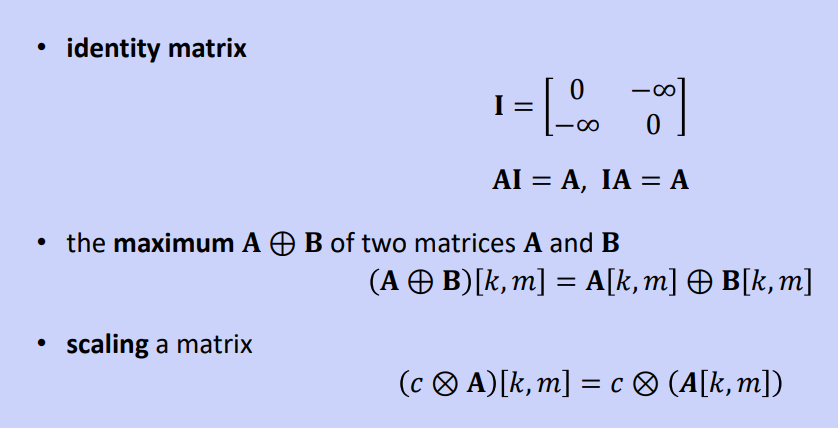
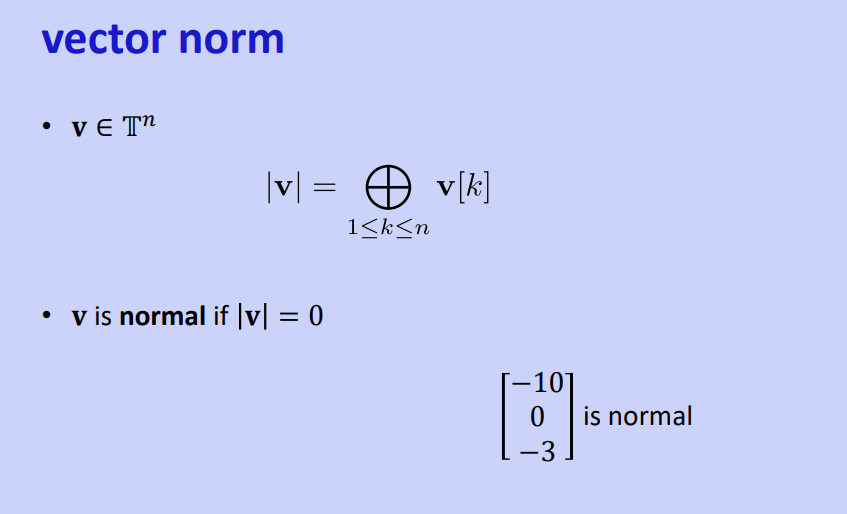
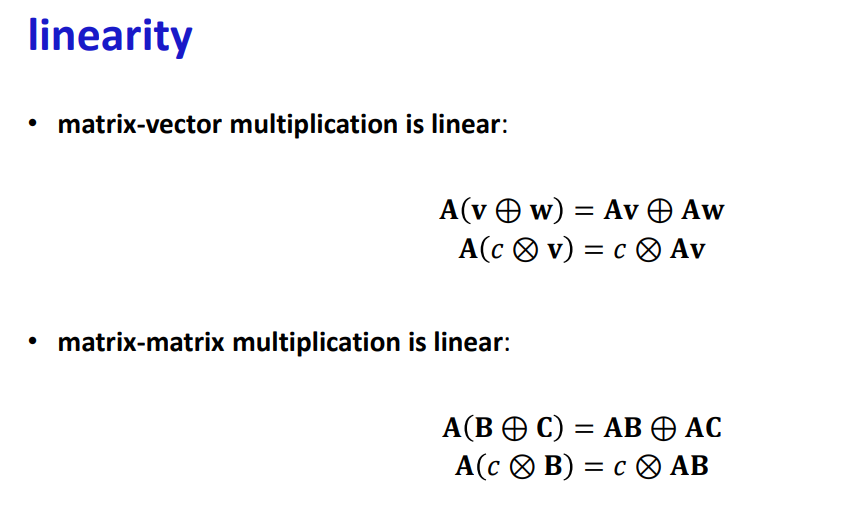
C.6 Max-plus Linear Algebra
Topic: Linear Algebra
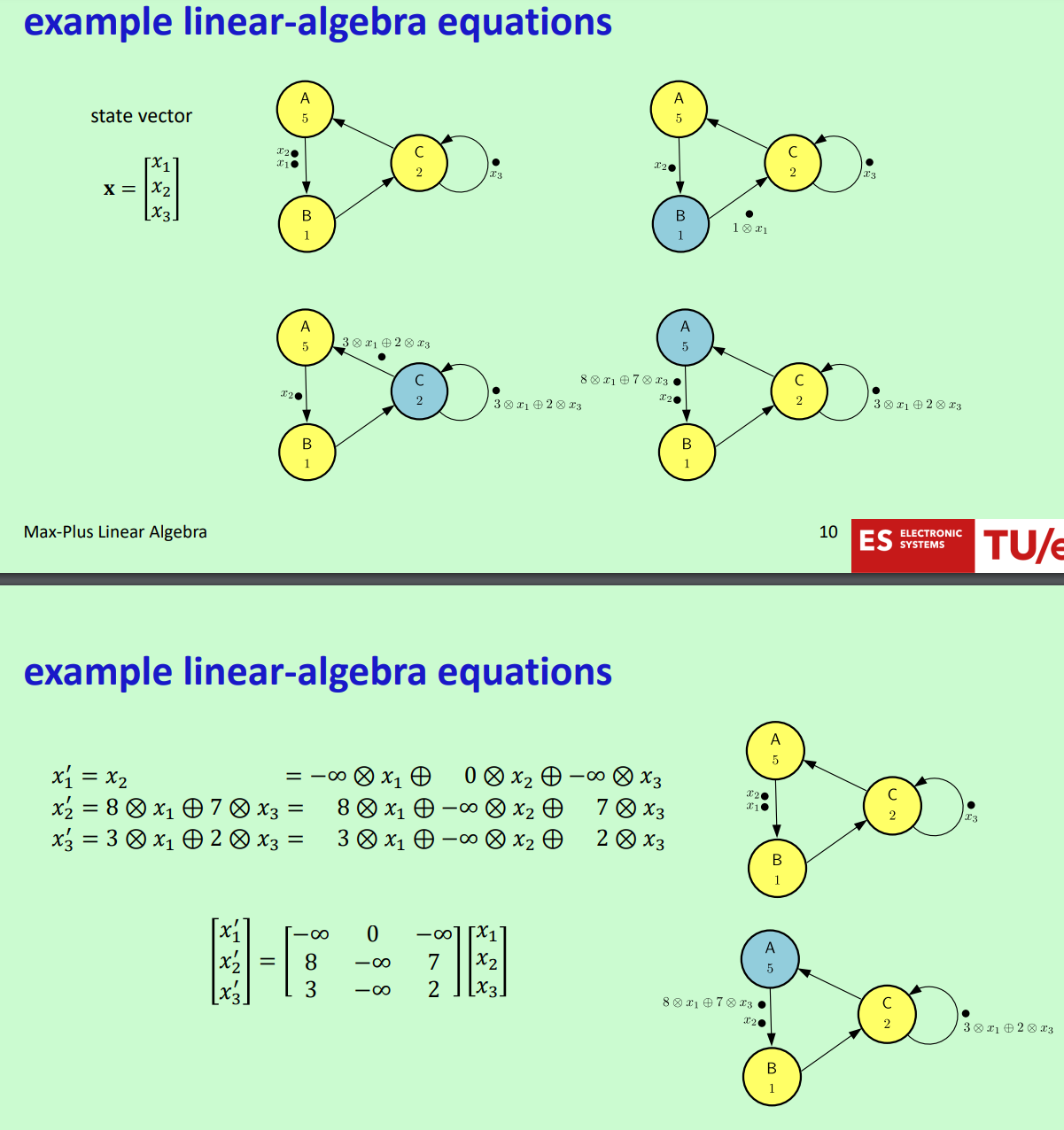
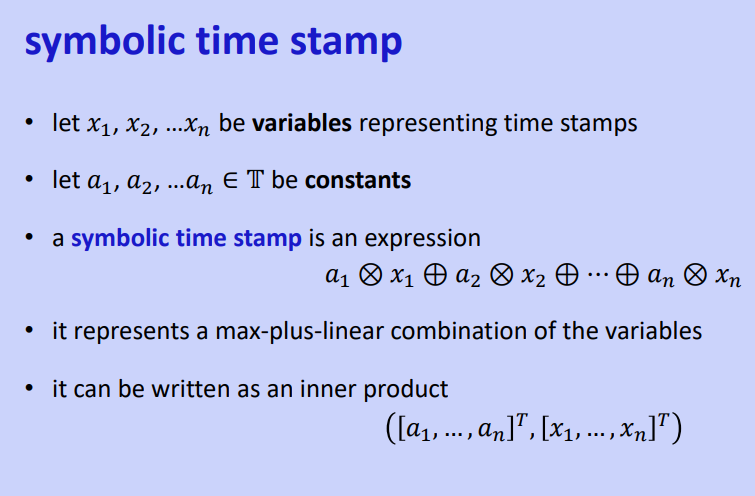
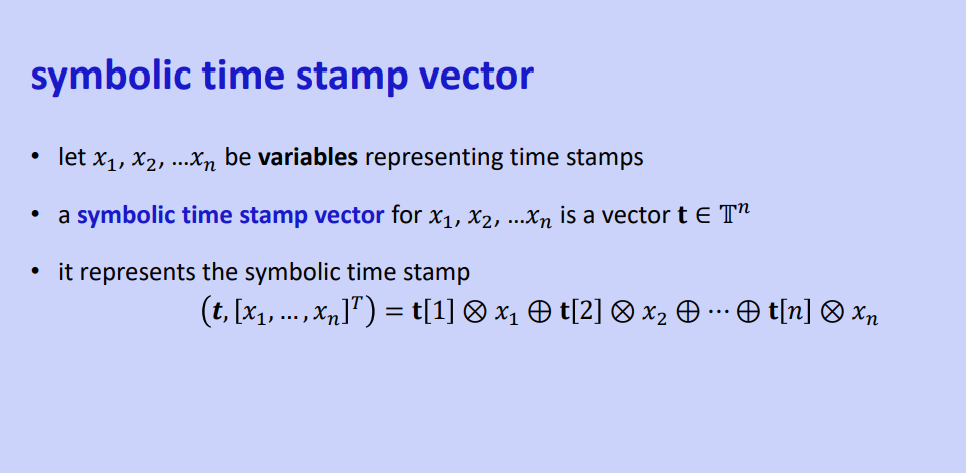
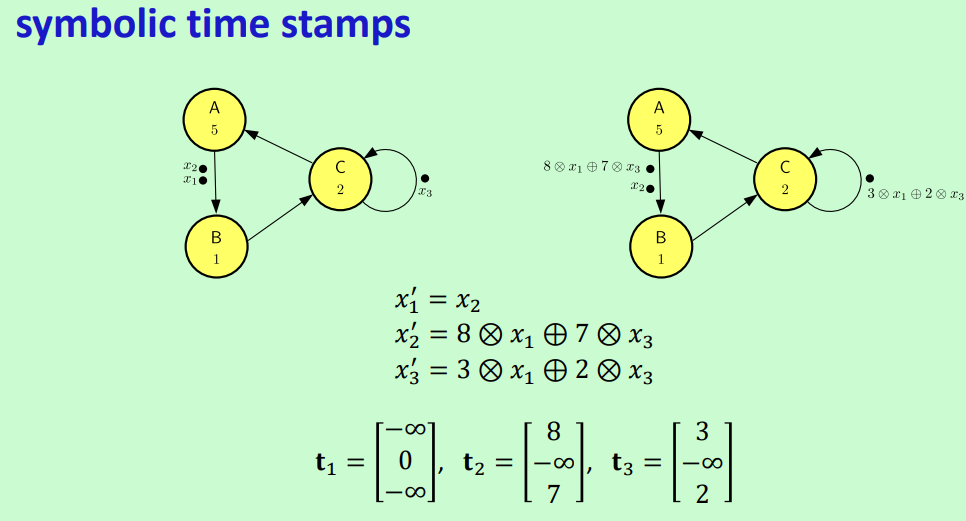
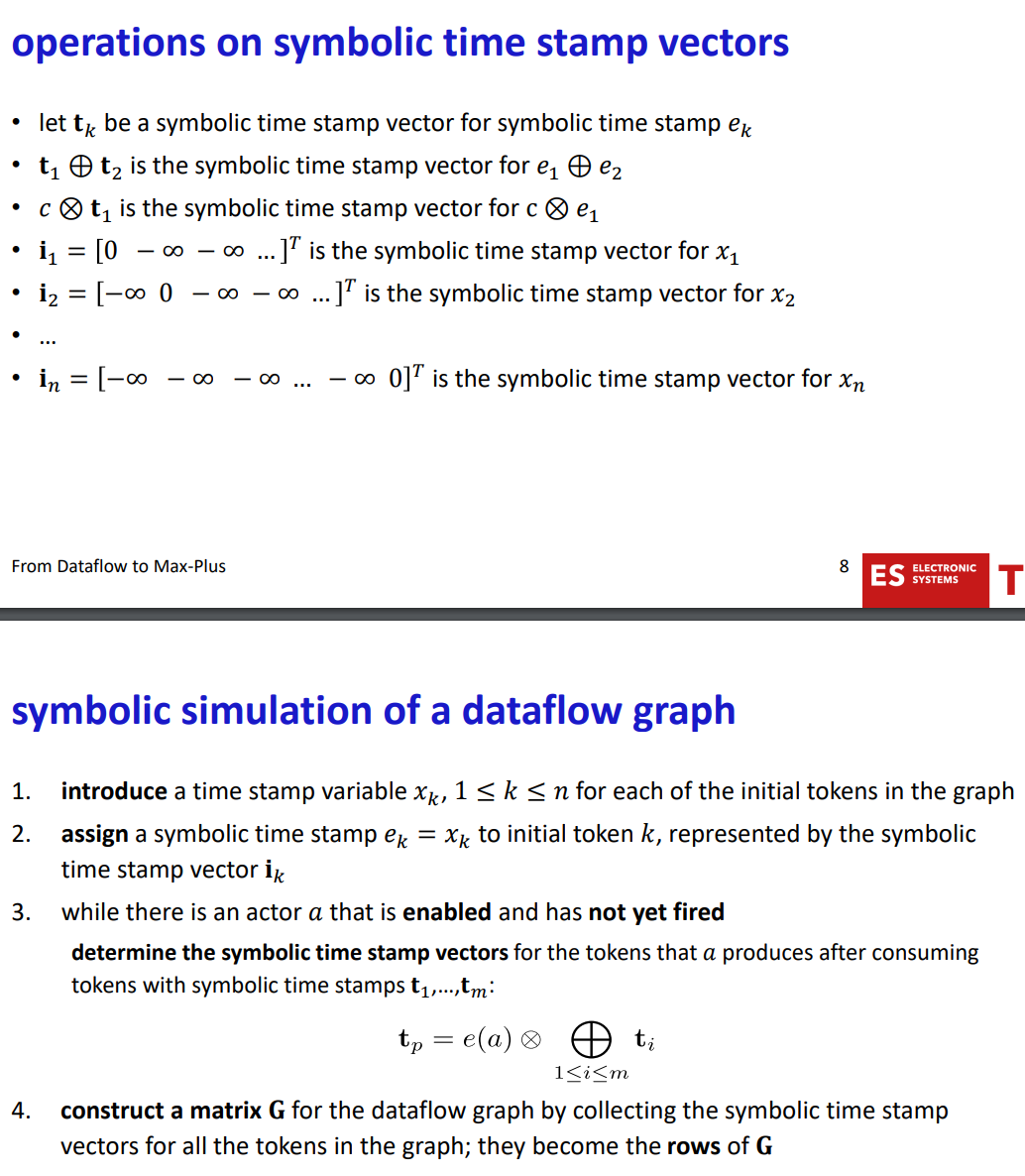
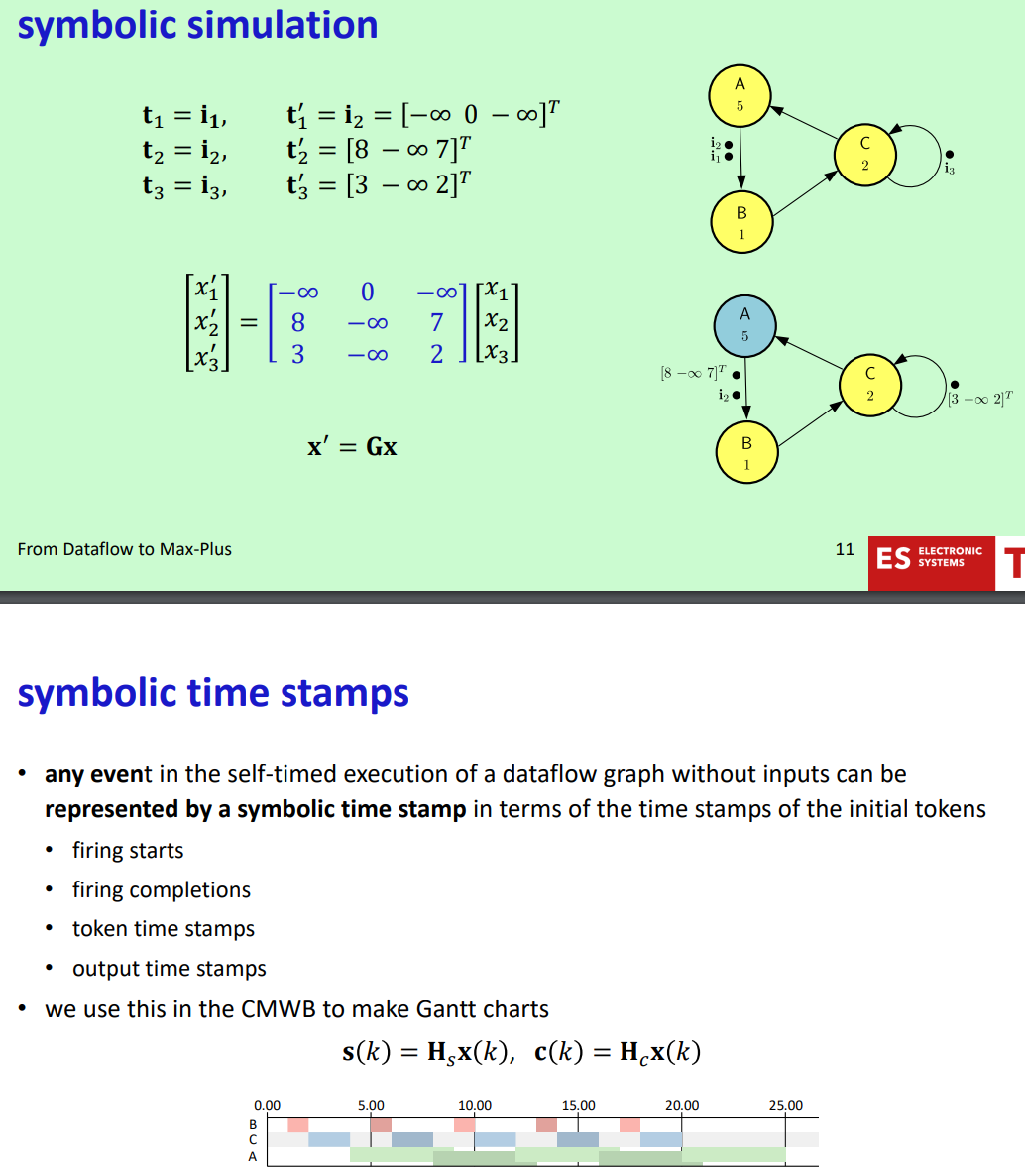
C.7 From Dataflow to Max-plus
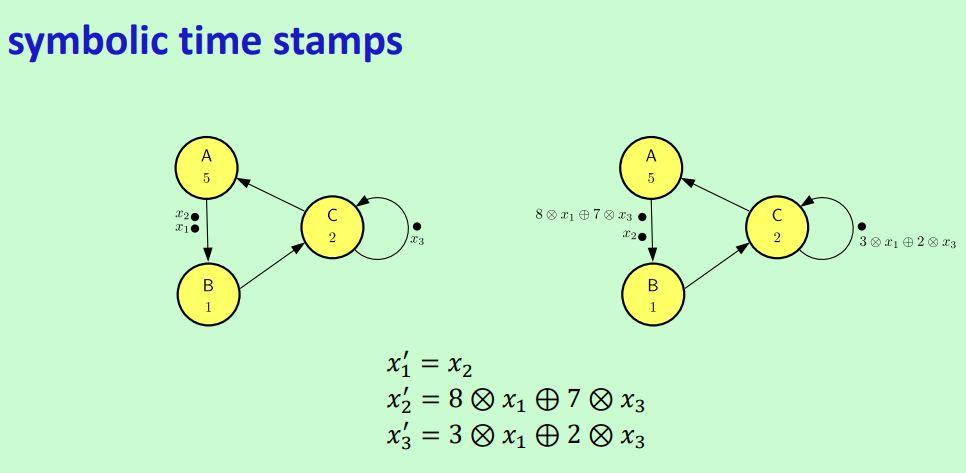
C.8 Monotonicity
Monotonic function - Wikipedia
max-plus algebra is monotone
if
if
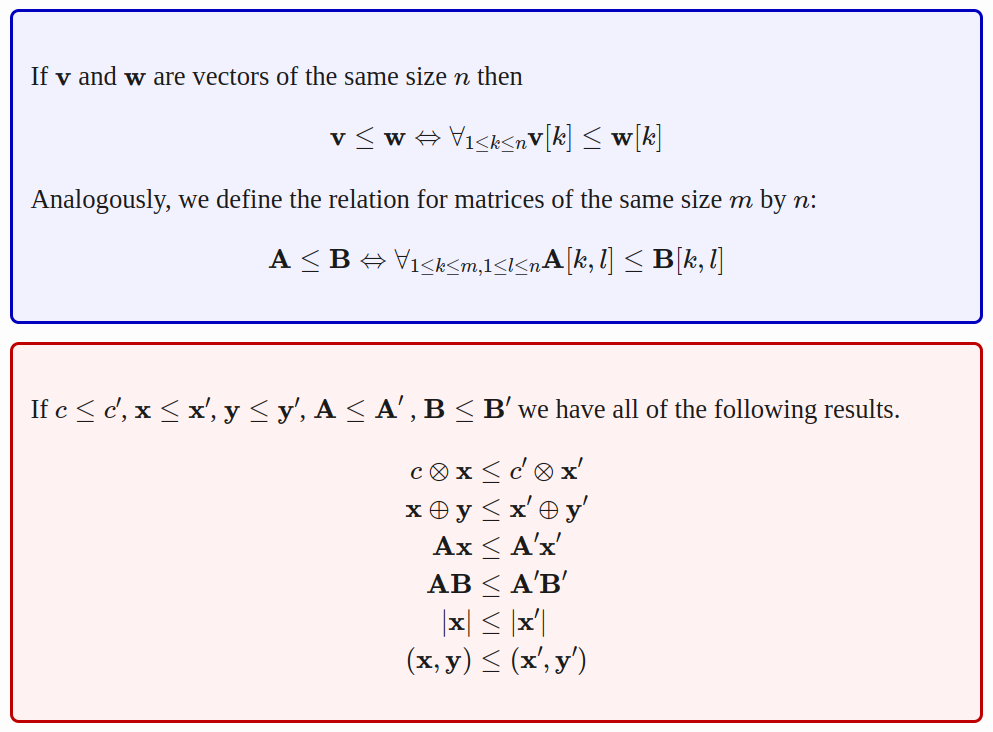
ordering event sequences:
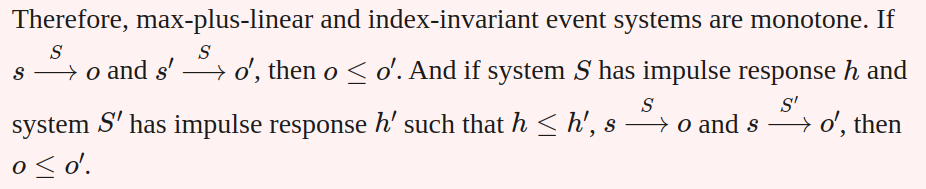
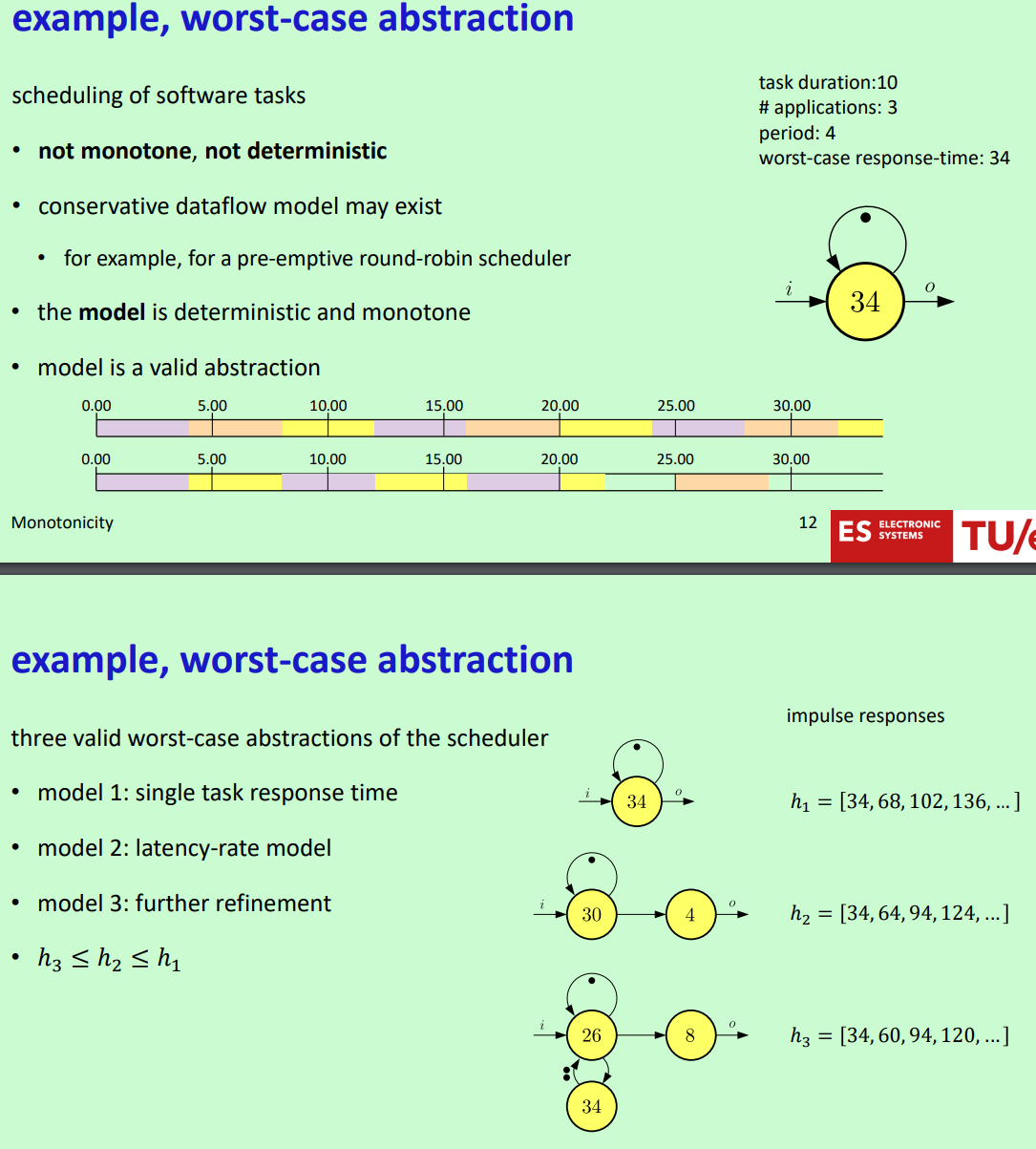
convolution is monotone: if
Week 8: C.9 & C.10 & C.11 & C.12
C.9 The Eigenvalue Equation
Topic: Linear Algebra
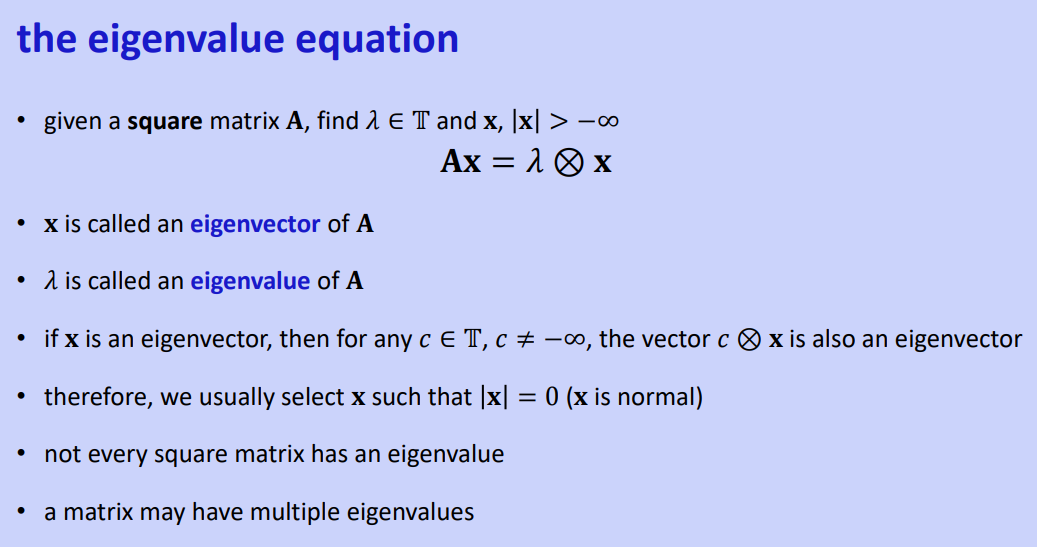
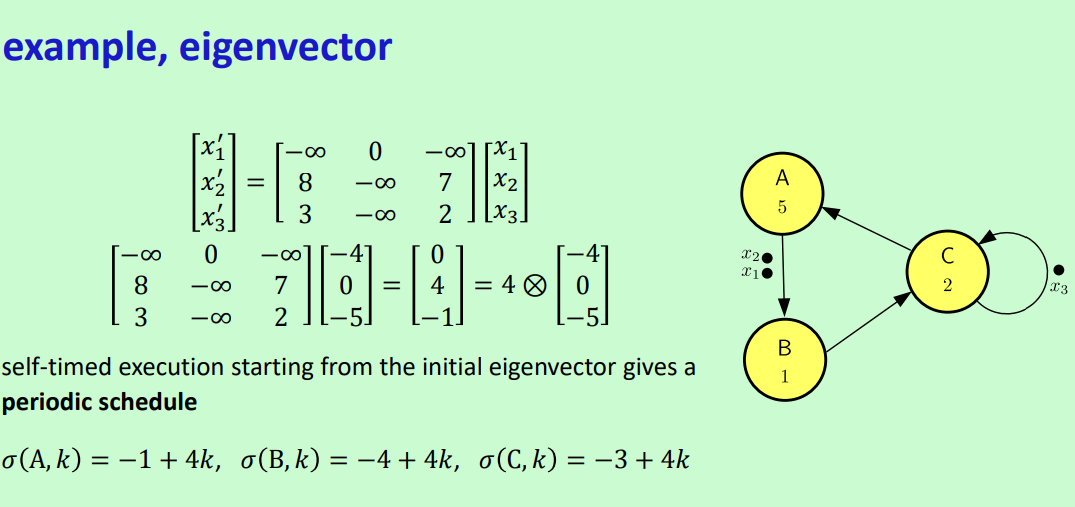
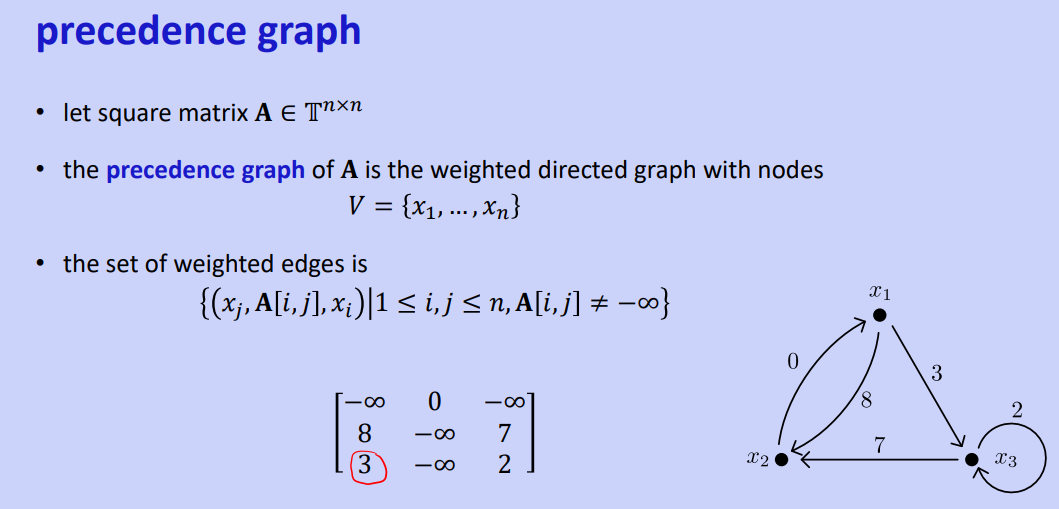
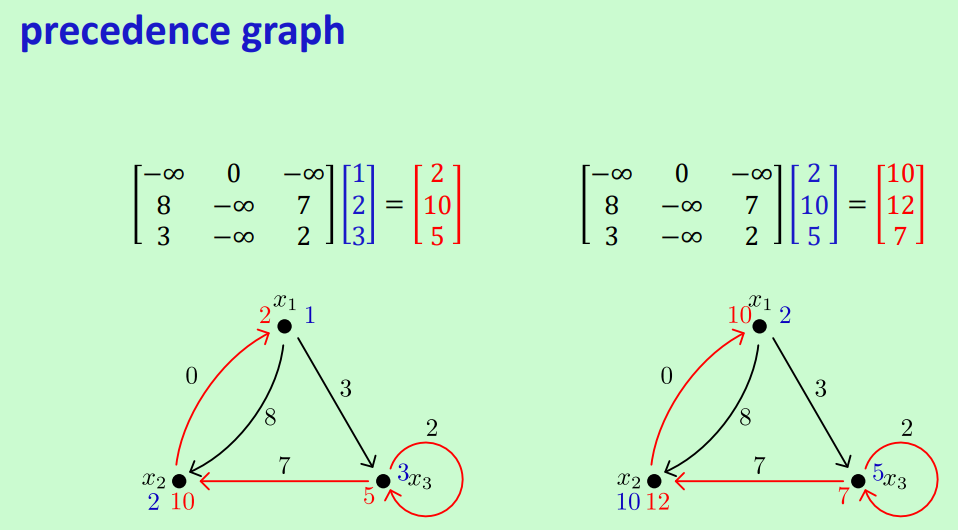
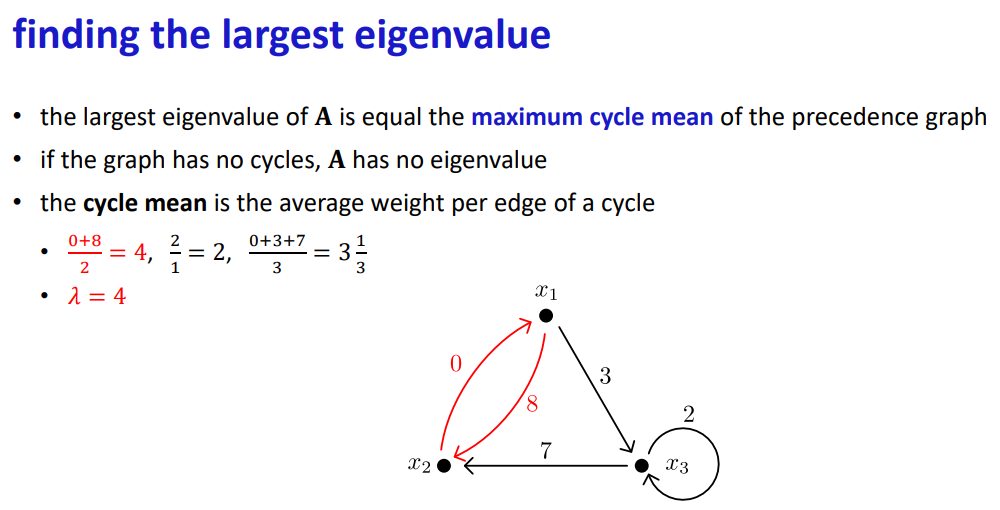
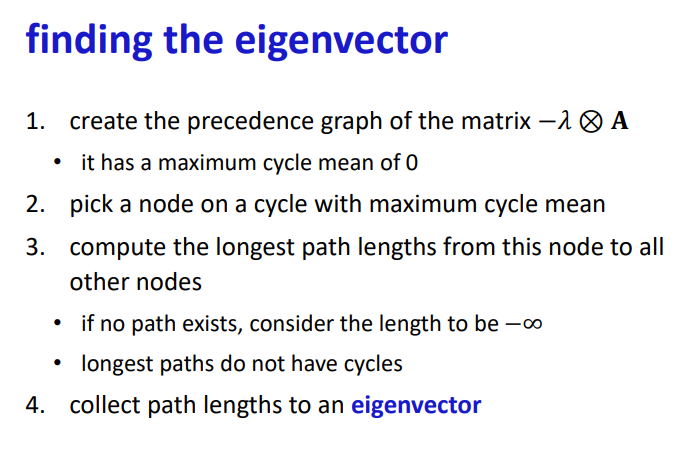
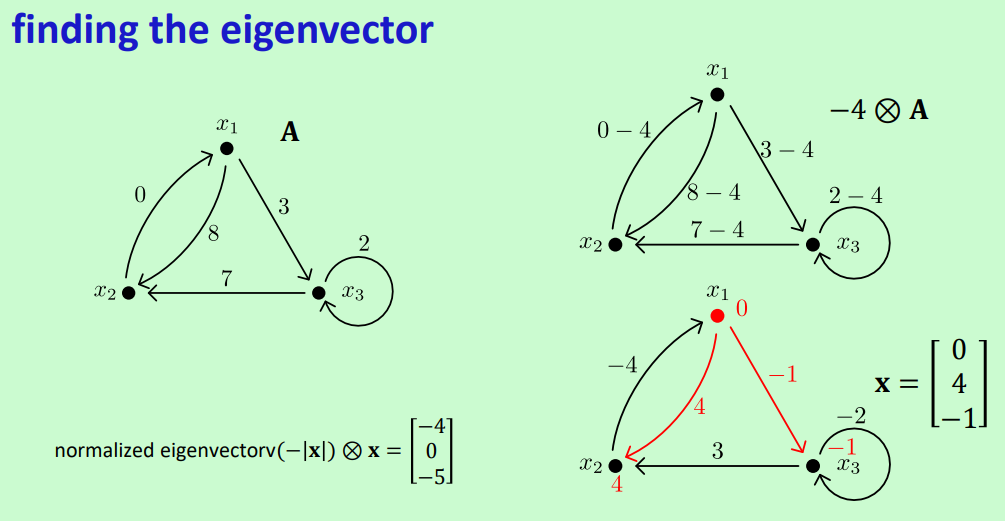
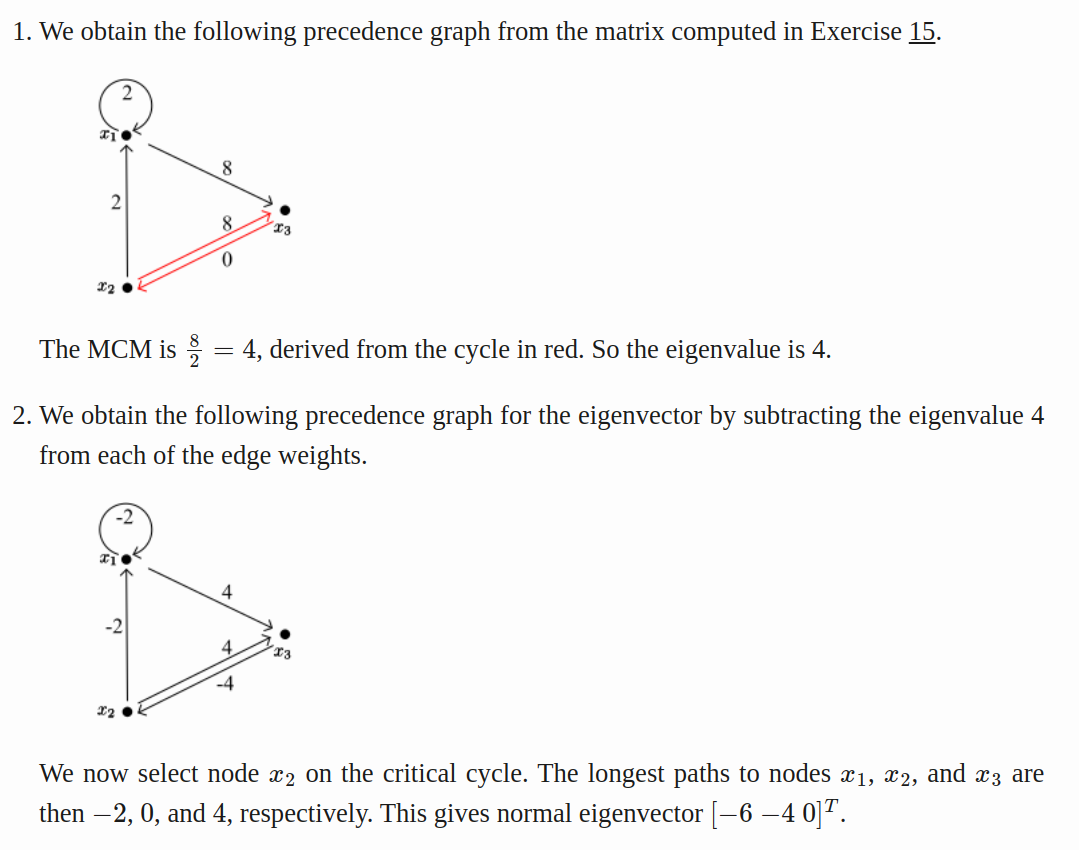
precedence graph take the longest channel length: example for
normalized eigenvector:
max(0, 4, -1) = 4 [0-4, 4-4, -1-4] = [-4, 0, -5]
- eigenvector for the largest eigenvalue can be constructed using the precedence graph
- choose one of the puncts for the eigenvector and then choose its longest paths to the other puncts
example

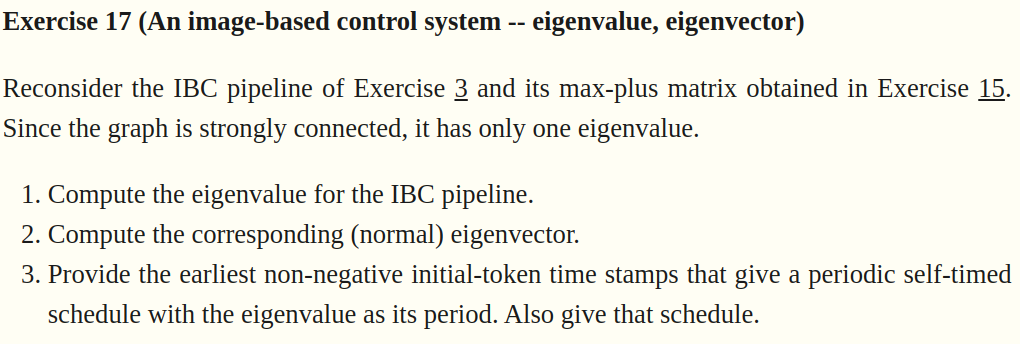
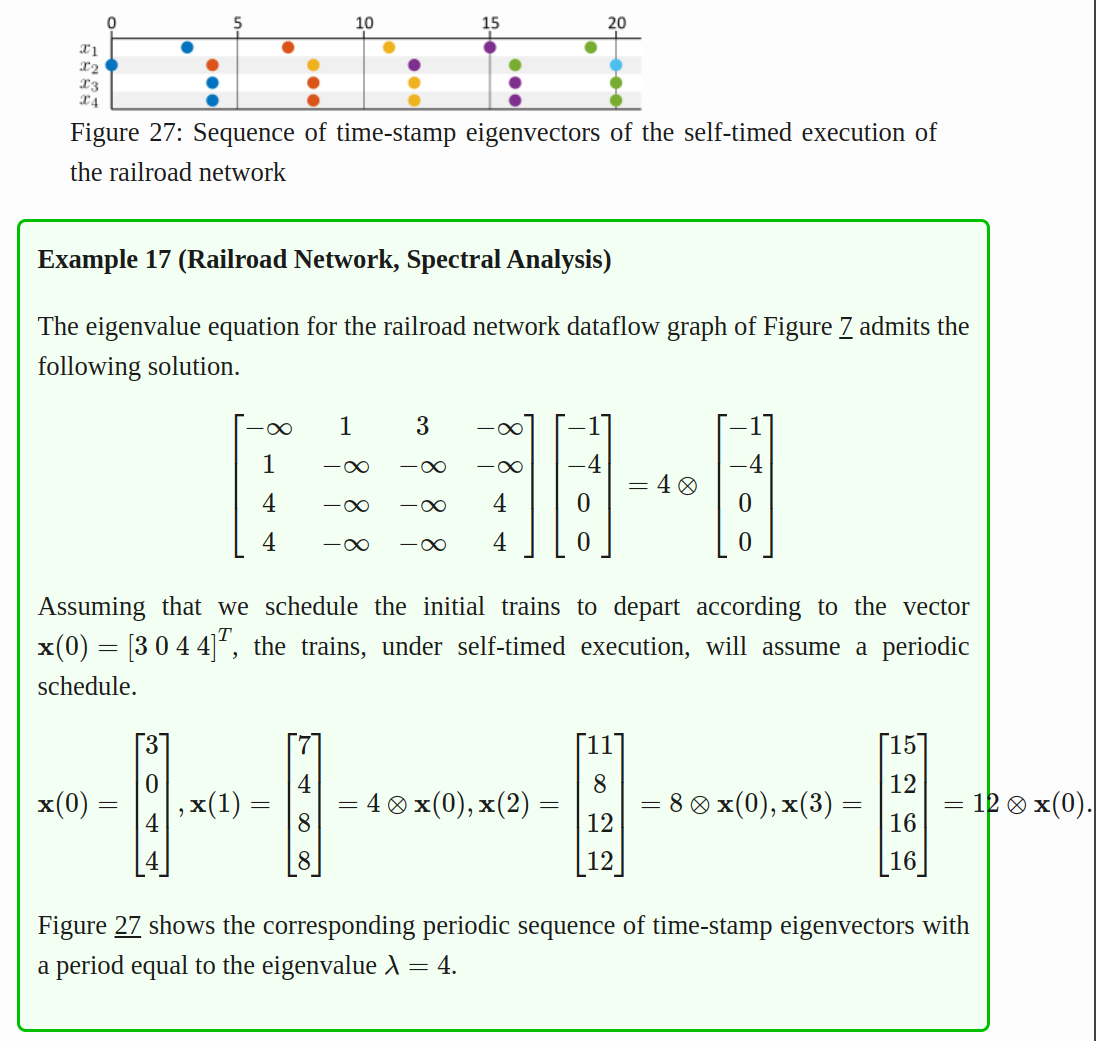
eigenvalue and normalized eigenvector obtained:
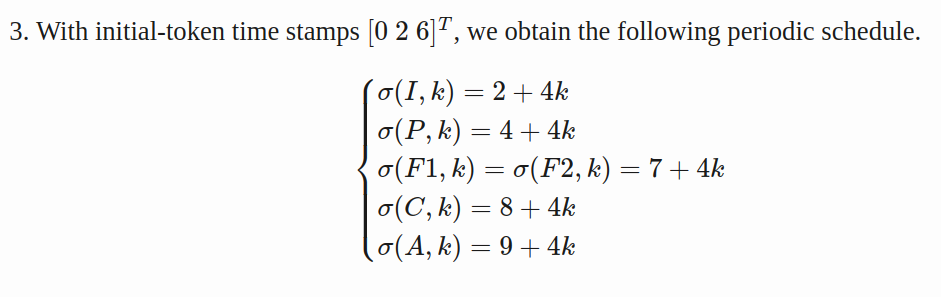
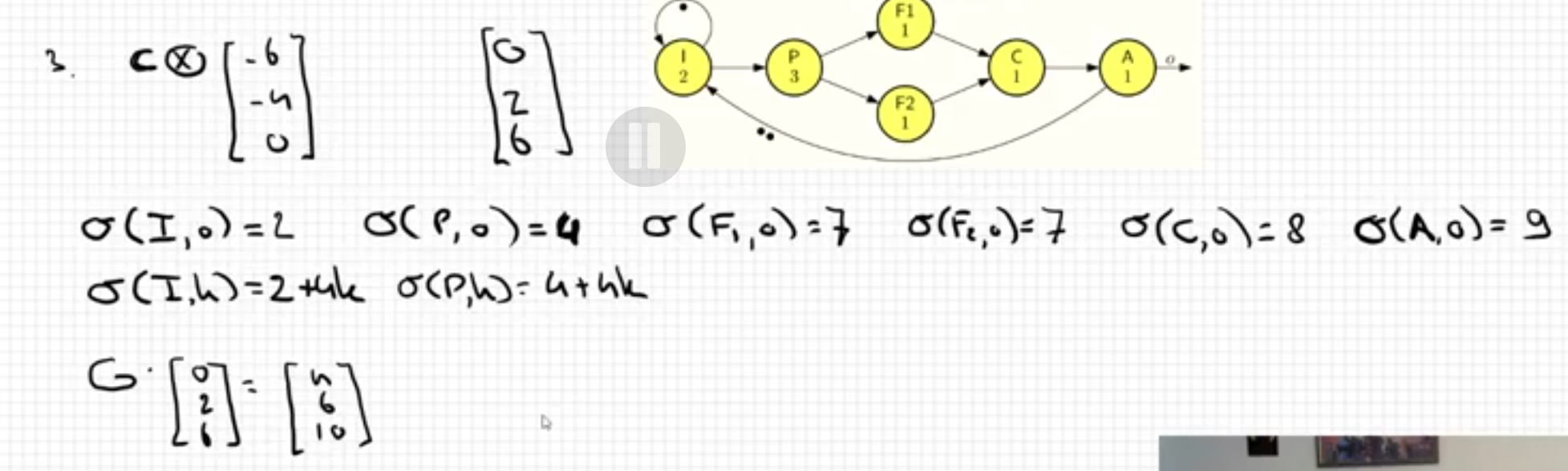
c is 6 to make it non negative:
starting
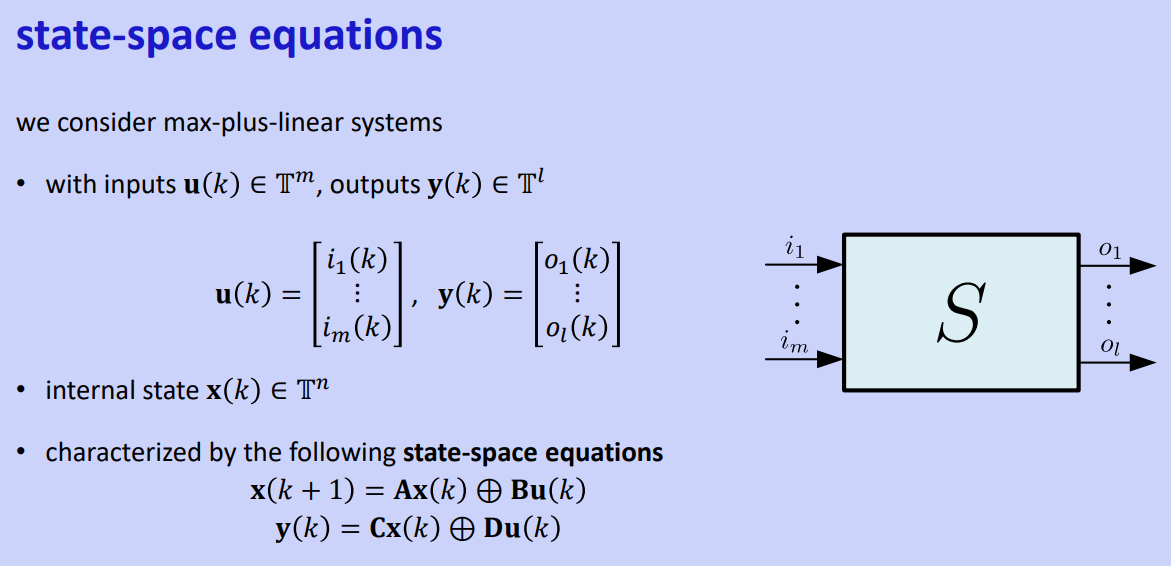
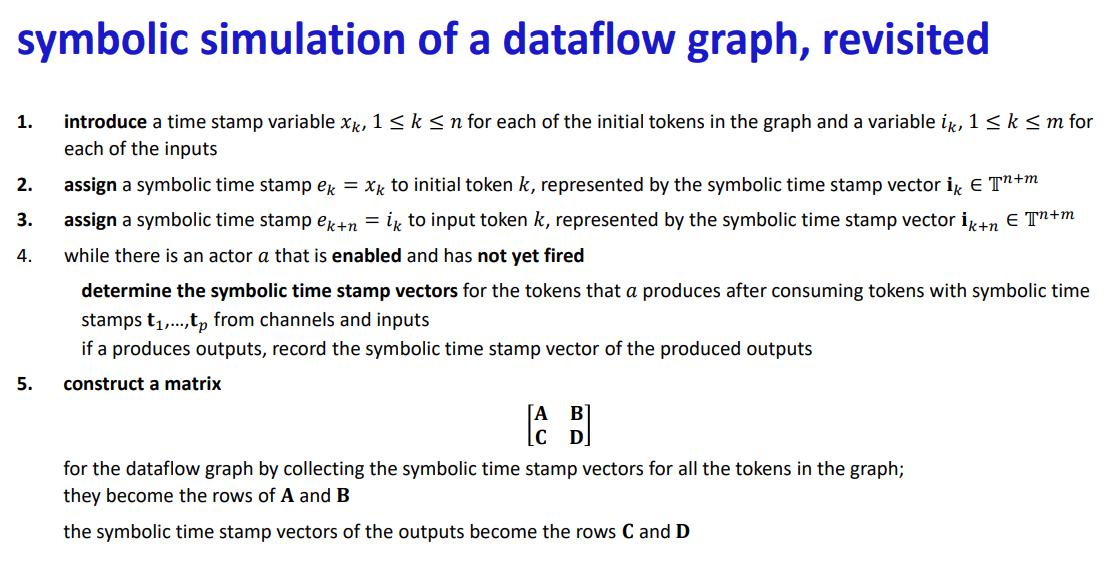
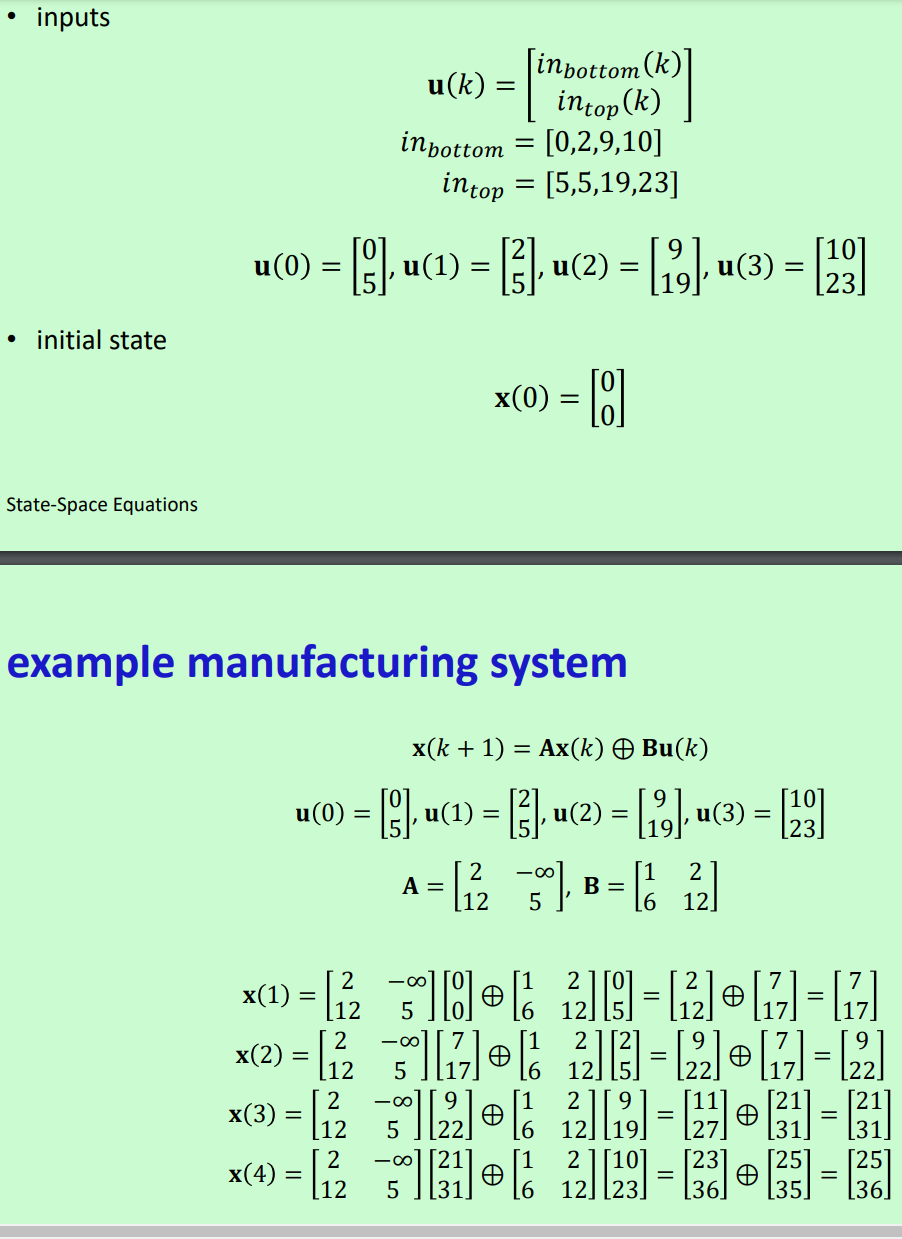
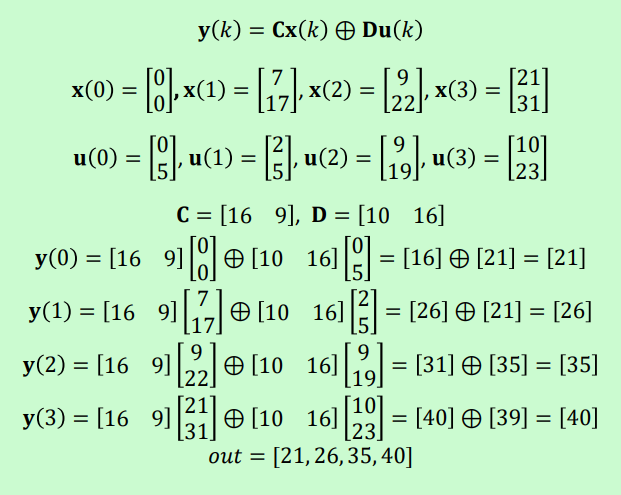
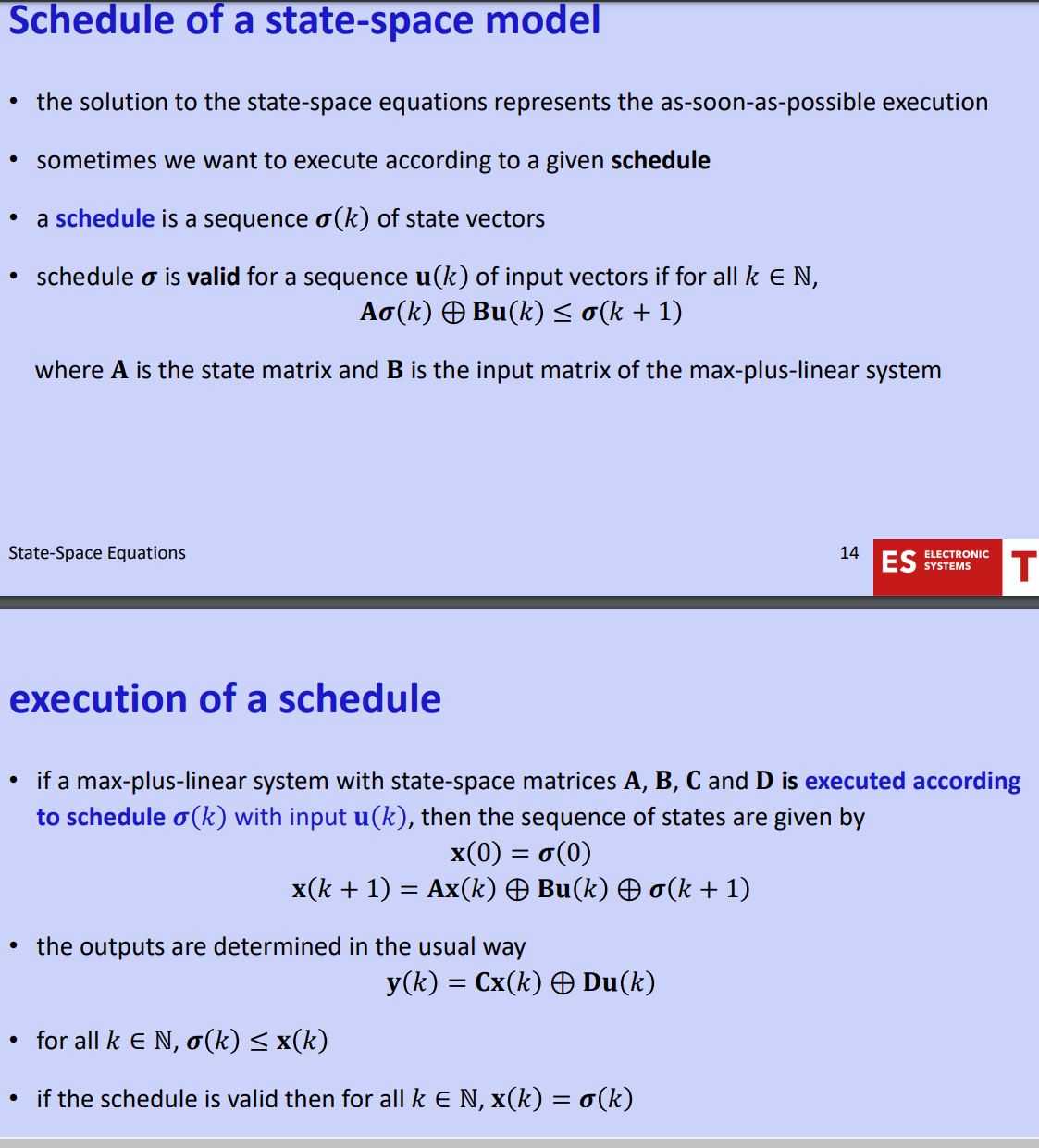
C.10 State Space Equations
Topic: State-Space Models
C.11 Throughput
maximal throughput
where
the throughput
example: 1 time unit delay per box; 5 time units to reach the end of the belt: so output:
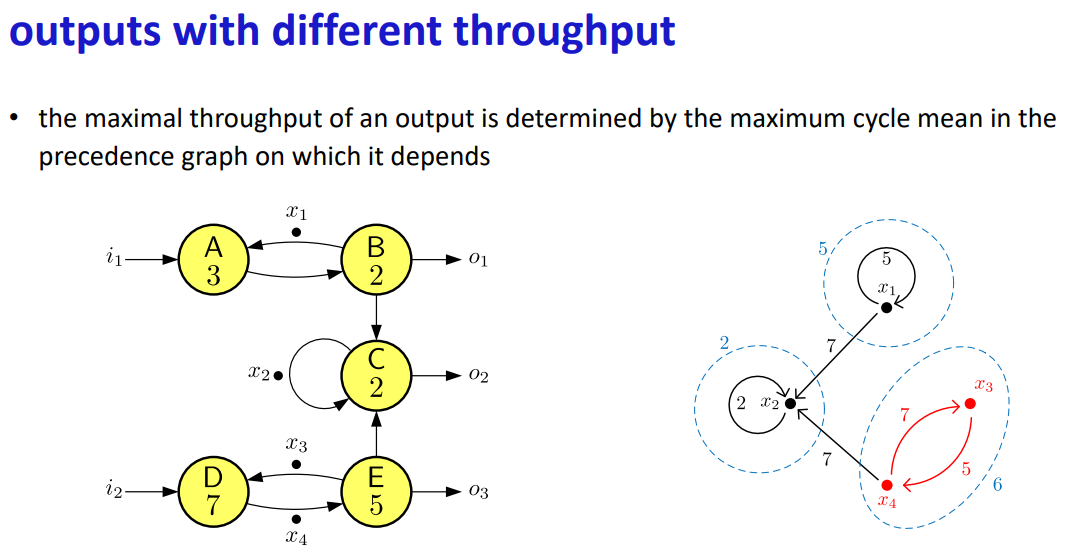
if for every element of the state vector there is an output that depends on it, then the maximal throughput of
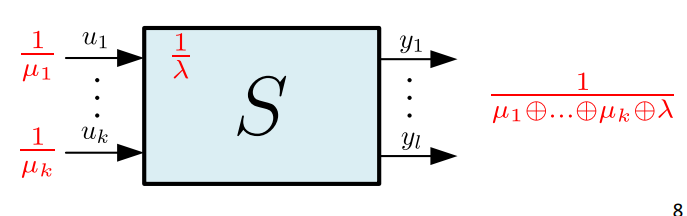
self-timed throughput: let matrices
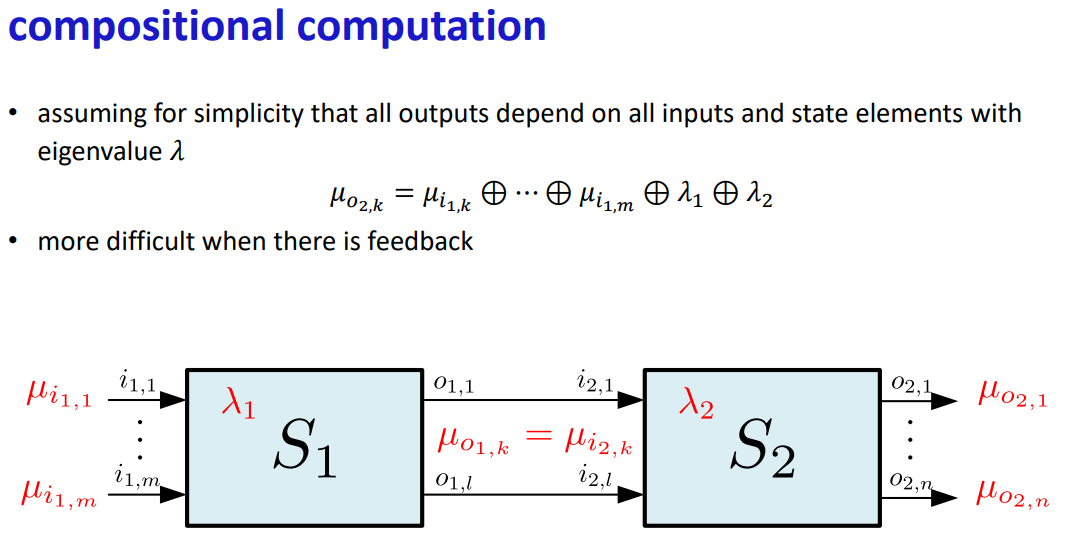
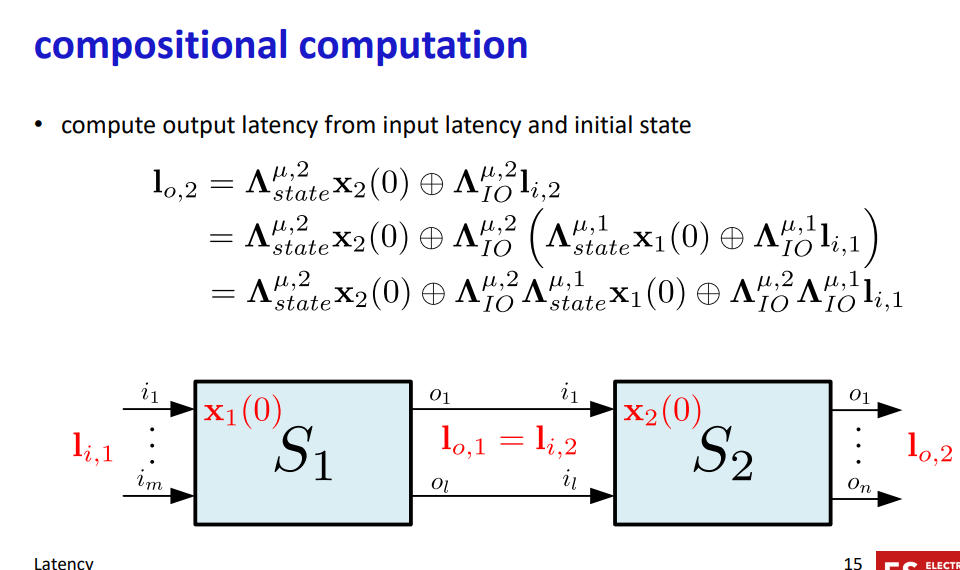
C.12 Latency
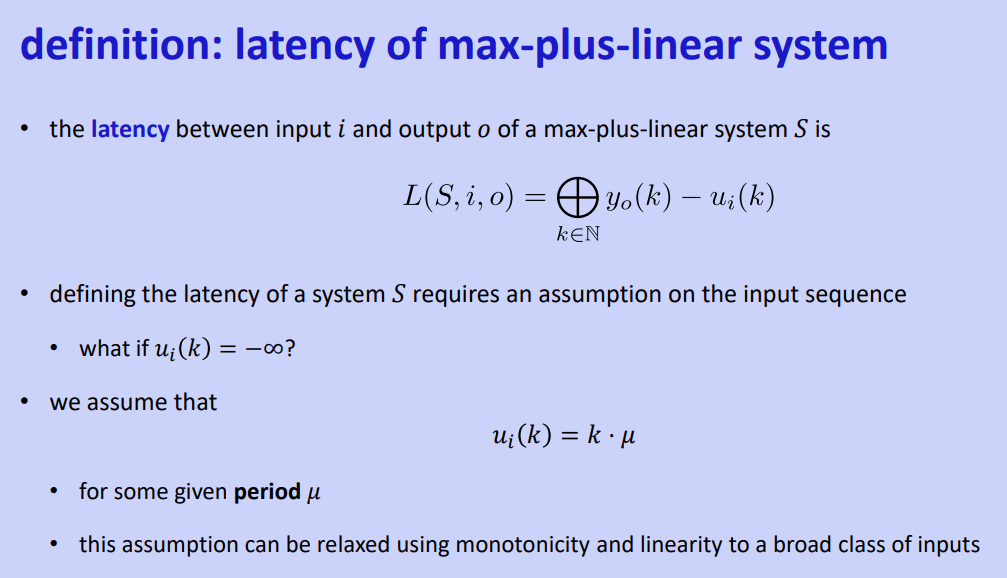
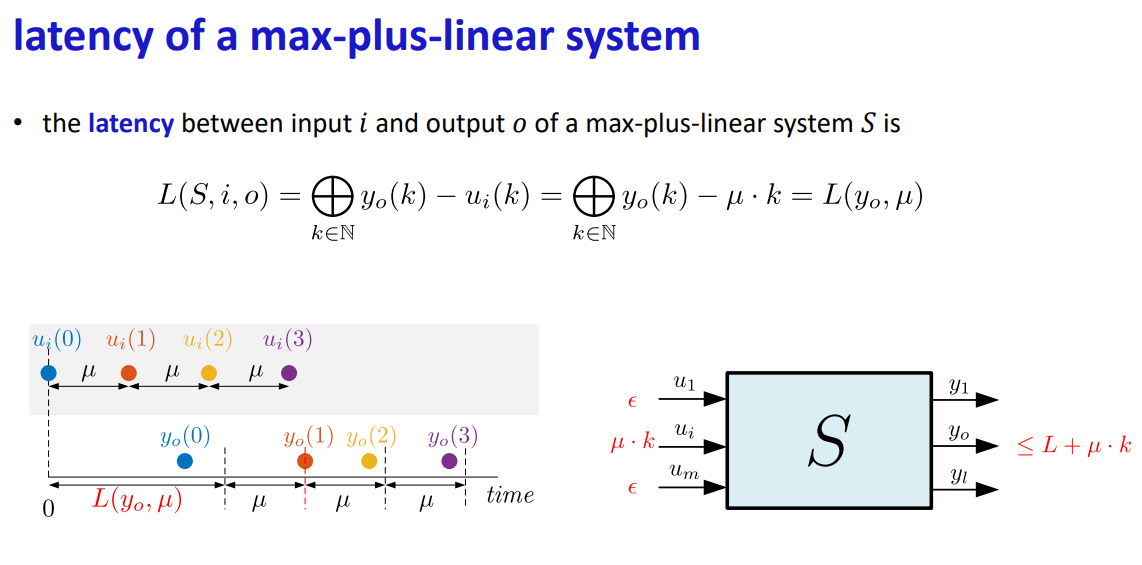
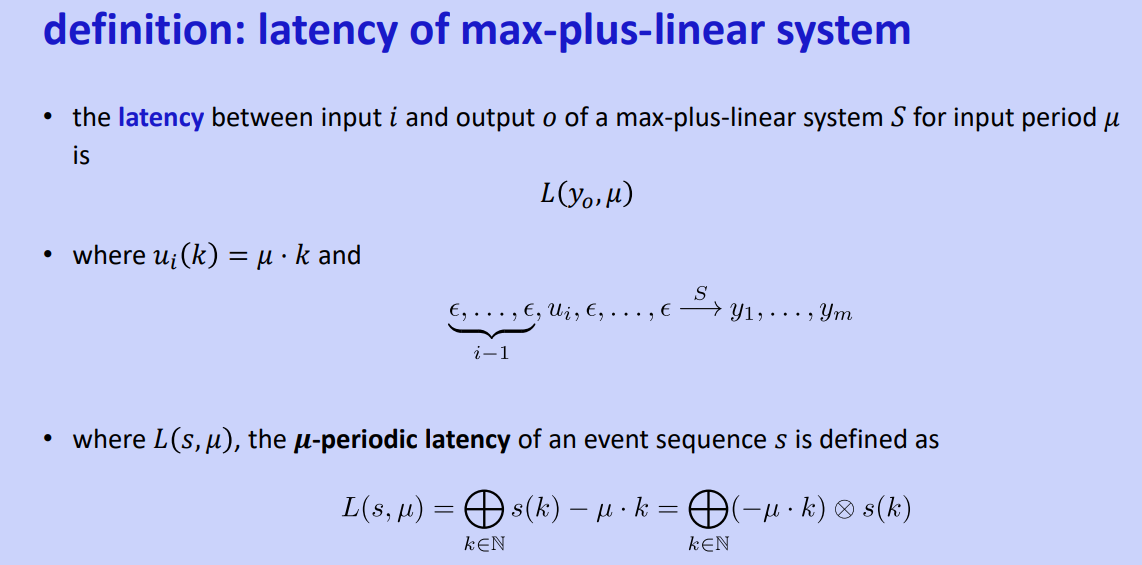
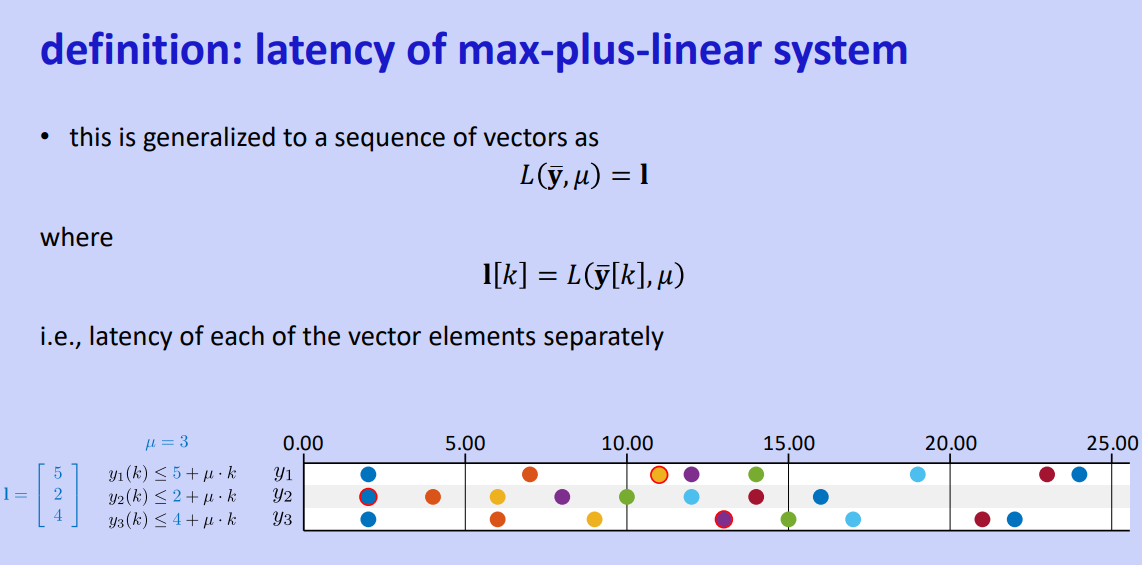
observing from graph the latency: row 1 eg:
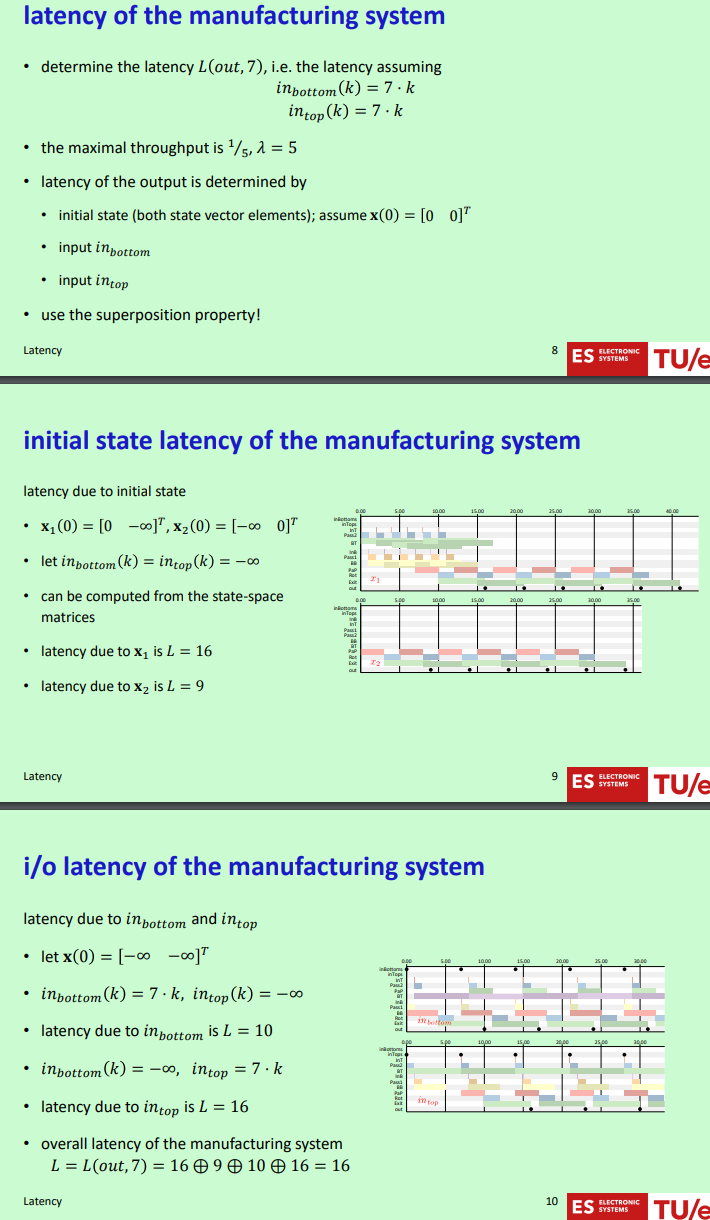
best to do latency mathematically:
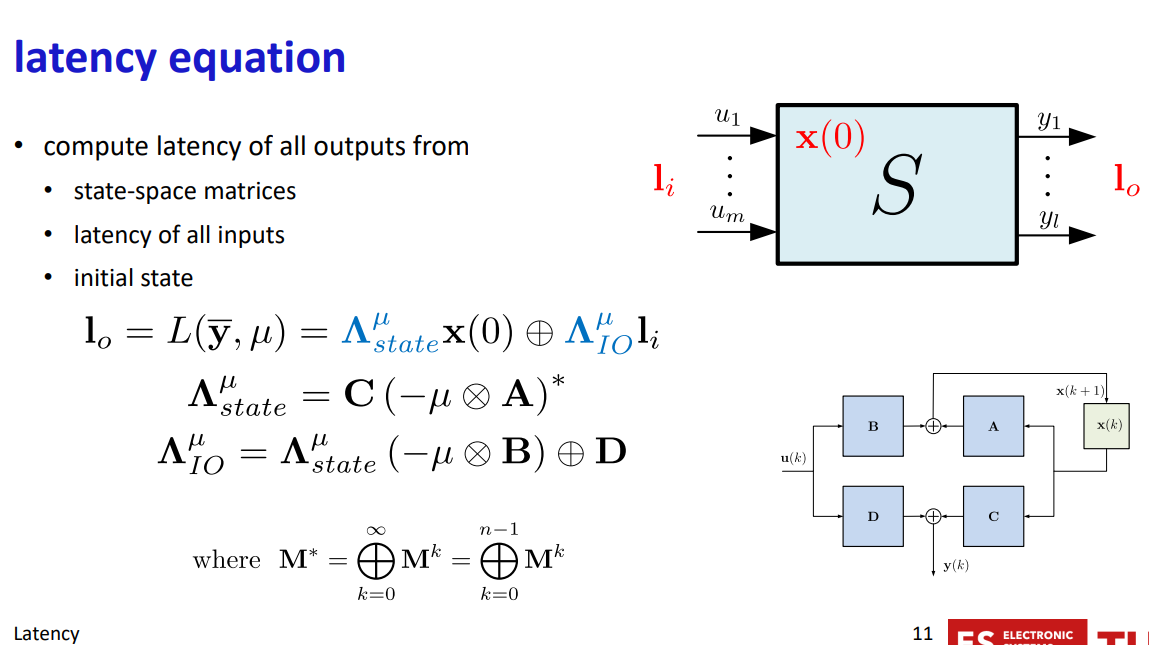
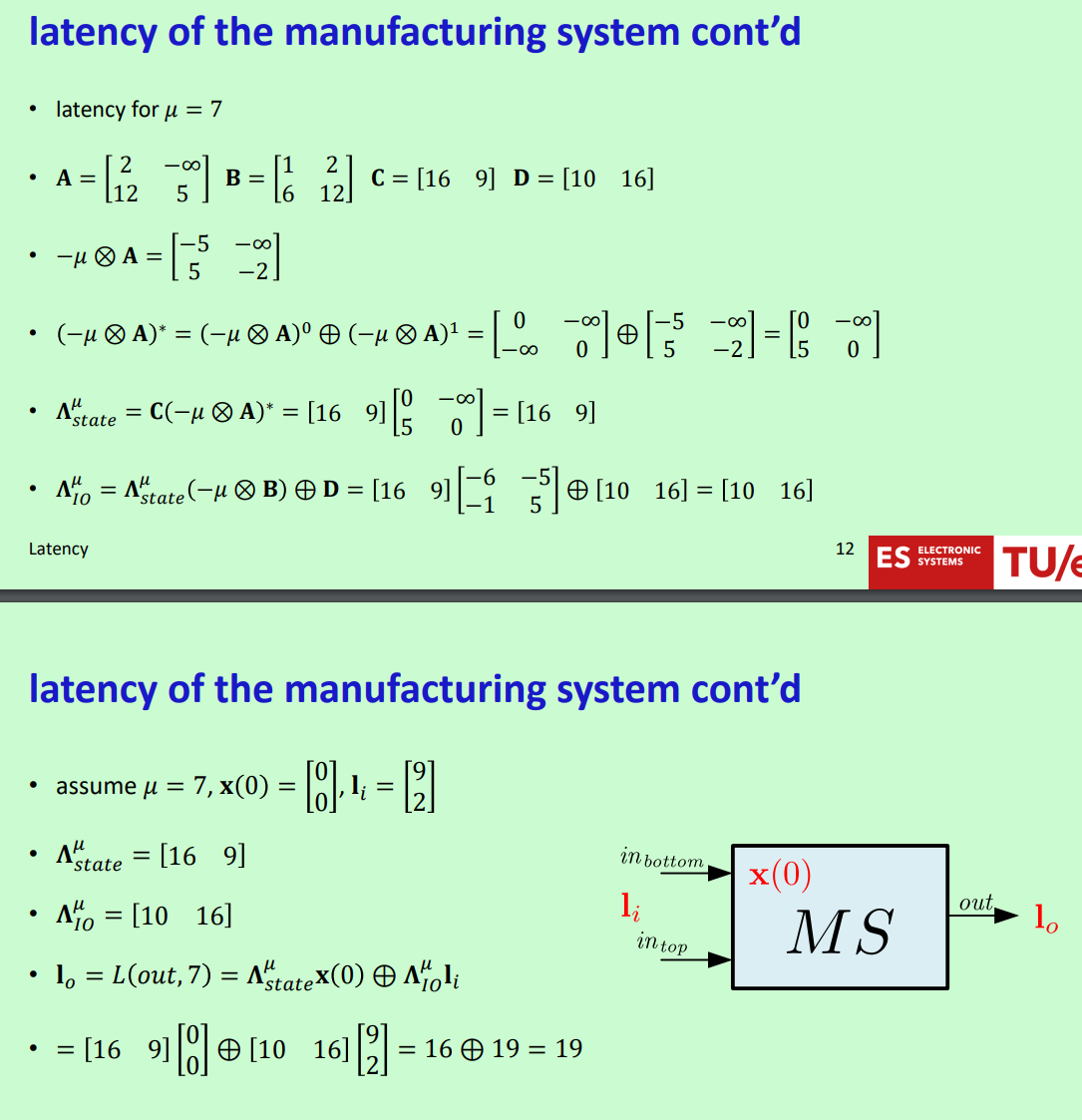
max-plus-linear algebra operations are monotone:
The ∗-closure is monotone. I.e., let