Resit notes for Computation II - 5EIB0
- Topics: Instruction Set Architecture
Procedure Call
RISC
Memory: lw (load), sw (store)
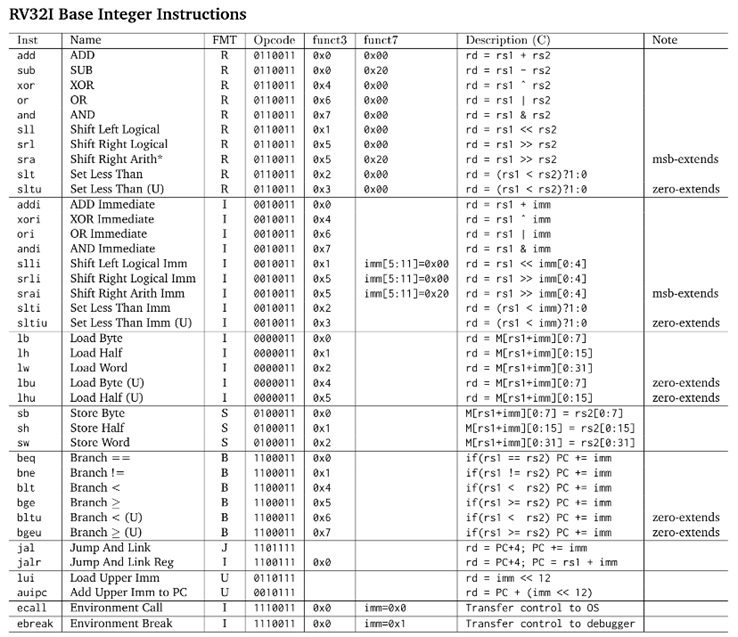
Byte memory: lbu (load byte unsigned), sb
Arithmetic: add, addi, sub, mul
- Binary arithmetic:
- AND: select range of bits
- OR: set to 1
- XOR: with 111….. to invert
Conditional branch: beq (=), bne (≠), (unsigned) (blt (<), bge (≥))
Call: jal (jump and link, use immediate address → caller), jalr (jump and link register, use indirect address → callee)
-
Notes:
- No sbu, ble, bgt, NOT
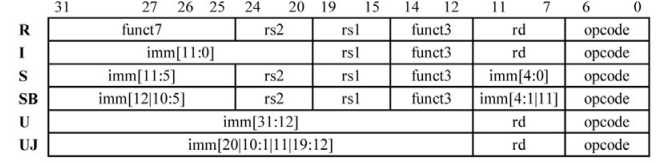
- (S)B ≠ S format ← 1st bit of immediate is always 0 (byte address)← instructions can only be multiples of 16 bits
- jalr immediate don’t assume 1st bit is 0 (because it use I-type) → reduce range
- jaddi with top bit = 1 will -1 from 20 upper bits (due to sign extension)
-
Steps to call function:
- Prologue: Put arguments in a place (registers) where function can access them
- Transfer control to function (jal)
- Acquire (local) storage resources needed for function
- Perform desired task of the function
- Put return value in a place where calling code can access it and restore any registers you used; release local storage
- Epilogue: Return control to point of origin, since a function can be called from several points in a program (ret)
int fact (int n)
{
if (n < 1) return (1);
else return (n * fact(n − 1));
}
fact:
//prologue
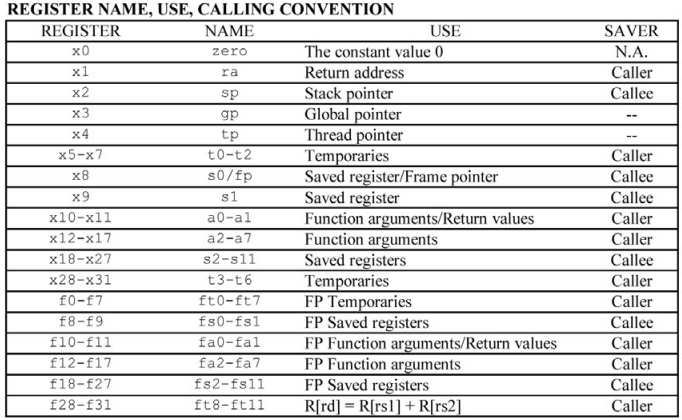
addi sp, sp, -8 // adjust stack for 2 items
sw x1, 4(sp) // save the return address
sw x10, 0(sp) // save the argument n
addi x5, x10, -1 // x5 = n - 1
bge x5, x0, L1 // if (n - 1) >= 0, go to L1
addi x10, x0, 1 // return 1
addi sp, sp, 8 // pop 2 items off stack
jalr x0, 0(x1) // return to caller
L1: addi x10, x10, -1 // n >= 1: argument gets (n − 1)
jal x1, fact // call fact with (n − 1)
//epilogue
addi x6, x10, 0
// return from jal: move result of fact (n - 1) to x6:
lw x10, 0(sp) // restore argument n
lw x1, 4(sp) // restore the return address
addi sp, sp, 8 // adjust stack pointer to pop 2 items
mul x10, x10, x6 // return n * fact (n − 1)
jalr x0, 0(x1) // return to the caller- Immediate addressing, where the operand is a constant within the instruction itself
- Register addressing, where the operand is a register
- Base or displacement addressing, where the operand is at the memory location whose address is the sum of a register and a constant in the instruction
- PC-relative addressing, where the branch address is the sum of the PC and a constant in the instruction
- Pseudodirect addressing, where the jump address is the 26 bits of the instruction concatenated with the upper bits of the PC
Compiler (resit) - 5EIB0
Floating Point (resit) - 5EIB0
MIPS
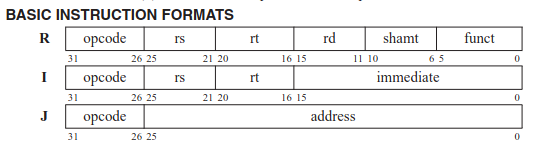
op: opcode
rs: first input
rt: second input
rd: output
shamt: shift amount
funct: function code
ARM V7
Instructions:
ARM addressing modes:
ARM V8
X86 Intel/AMD
Encoding
Addressing modes: